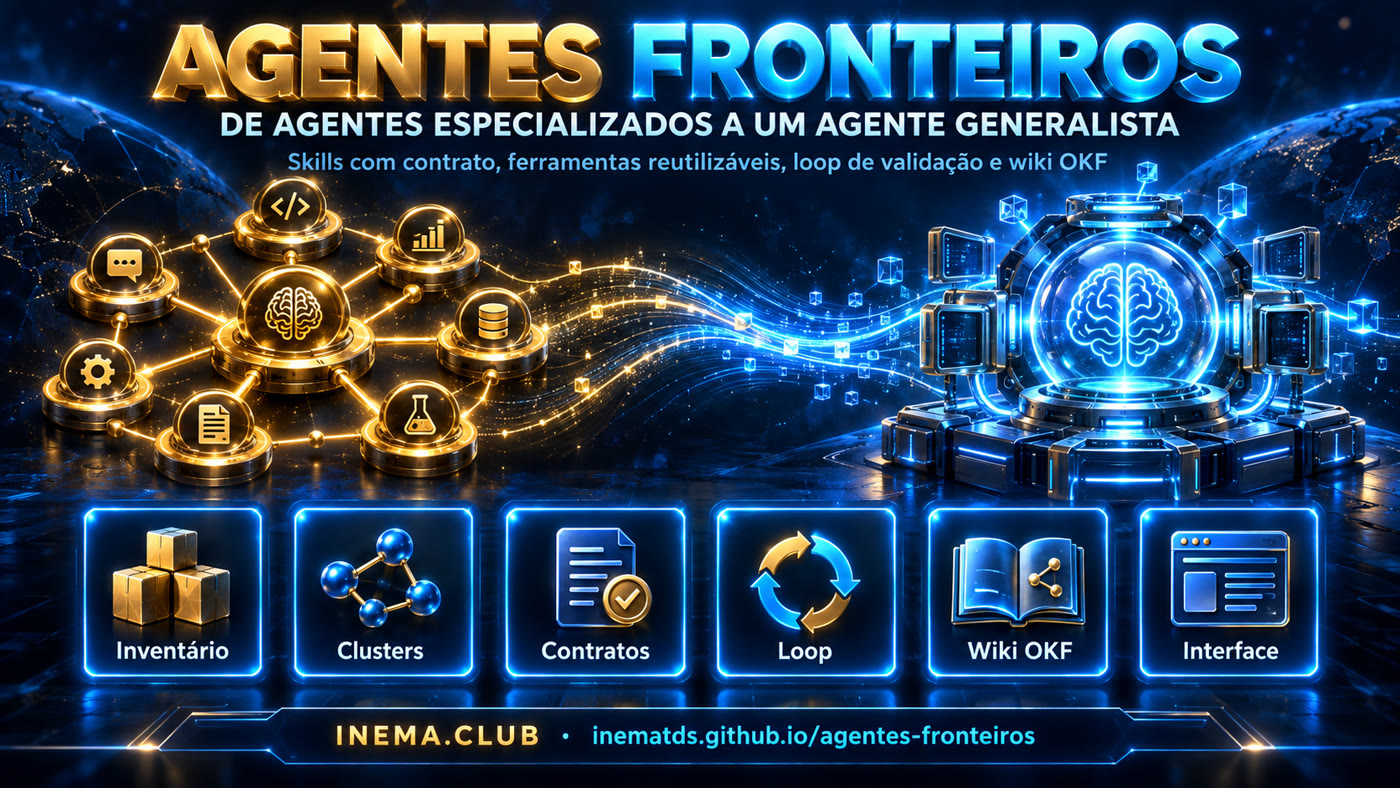
Automatic inventory, overlap clusters, contracts for each skill, a validation loop, and an OKF wiki maintained by the agent itself — with a kanban migration interface.

The thesis: we don't need to create more agents. We need to teach general-purpose agents to work our way. The repo brings together the migration plan, eve's folder structure (Vercel), and an OKF-format knowledge base maintained in the style of an LLM wiki.
Inventory → base agent → skills → tools → progressive disclosure → learning → loop → contract → router → living system. Each step produces something concrete in the repo.
The agent is a directory: agent/instructions.md, skills/, tools/, connections/, subagents/, schedules/ e evals/ alongside it. A convention, not the TypeScript runtime.
Markdown with YAML frontmatter (type, sources, generated, verified, status). The agent ingests raw sources, consolidates and indexes them, and records everything in the log. Migration state lives in the frontmatter.
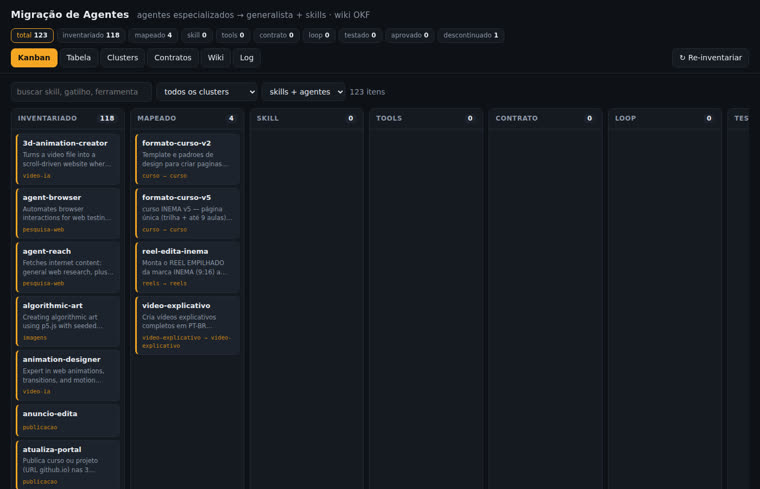
The inventory scans the skills and agents installed in Claude Code, generates an OKF page for each item, groups them into overlap clusters, and the interface tracks each one through the plan’s stages.
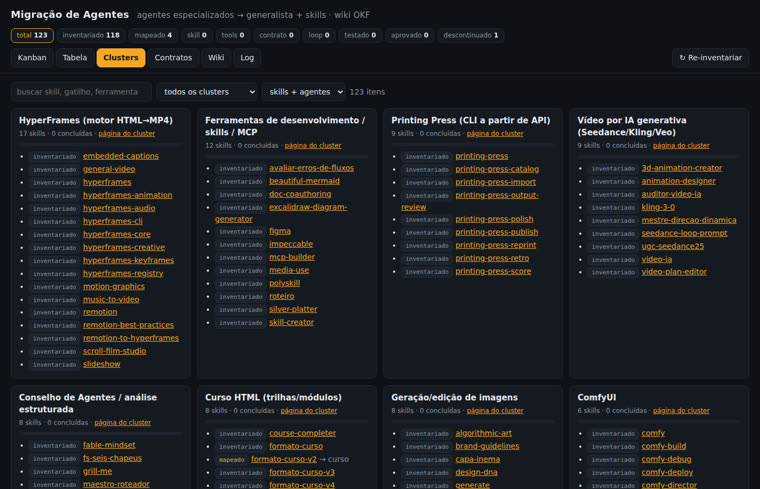
116 skills, 7 agents, 16 clusters. Each page lists triggers, cited tools, candidate scripts for tools/ and the stage 1 map.
Trigger, input, output, allowed tools, and verifiable acceptance criteria. The skill becomes an operational function of the company.
Plan → execute → inspect → critique → fix → test. The first version is a draft; limit: 3 rounds.
Fix the system, not the output: the skill, rule, example, or script. One line in FALHAS.md and in the wiki/log.md.
No framework, no build, no database. The interface server uses stdlib; the wiki is text in git.
With PyYAML installed.
# check python3 -c "import yaml; print(yaml.__version__)"
The inventory reads what’s installed on the machine.
ls ~/.claude/skills | wc -l ls ~/.claude/agents
Or use the project’s local folder.
git clone https://github.com/inematds/agentes-fronteiros cd agentes-fronteiros
Three commands. Everything else is a human decision in the interface and the agent’s work in the skills.
Scans the installed skills and agents and writes an OKF page for each item in wiki/skills/ e wiki/agentes/, plus the overlapping clusters. It is idempotent and preserves the migration stage already decided.
python3 tools/inventario.py # skills: 116 agents: 7 clusters: 16
Fails if a concept doesn't have type, if there's a broken link, related missing or invalid stage. Run before committing.
python3 tools/wiki_lint.py # wiki: 149 concepts · 0 errors
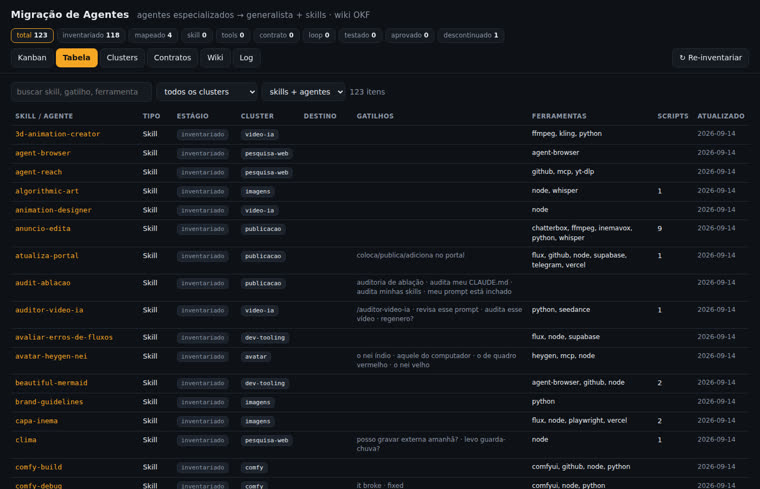
Kanban by stage, filterable table, clusters with progress bars, contracts, and wiki reader. Click a card to open the drawer and change the stage, cluster, destination, and notes — saved directly to the page’s frontmatter and in the wiki/log.md.
python3 interface/server.py # http://127.0.0.1:8765
Start with reels, video-explicativo e curso. The contract is already drafted; the migrated skill is created from the template and copies the contract alongside the SKILL.md.
# contract and template cat migracao/contratos/reels.yaml mkdir -p agent/skills/reels && cp migracao/template-SKILL.md agent/skills/reels/SKILL.md cp migracao/contratos/reels.yaml agent/skills/reels/contrato.yaml
Each skill only moves up to testado after passing two tasks from evals/tarefas/, and to aprovado after real-world use without corrections. If a correction was made, one line in FALHAS.md and the update to the skill.
ls evals/tarefas/ # reels-01.md · video-explicativo-01.md · curso-01.md
New source goes into wiki/raw/ with the date in the name and is never edited. The agent consolidates it into concepts and fills in sources e generated, regenerates the indexes, and records everything in the log. Full conventions in wiki/SCHEMA.md.
cp nova-fonte.md wiki/raw/2026-09-20-nova-fonte.md # agent: consolidate → conceitos/ · index.md · log.md python3 tools/wiki_lint.py
Screenshots of the local server right after the first inventory, with the three pilots already marked as mapped.


The order follows the plan's practical strategy: pilots first, then the clusters with the most overlap.