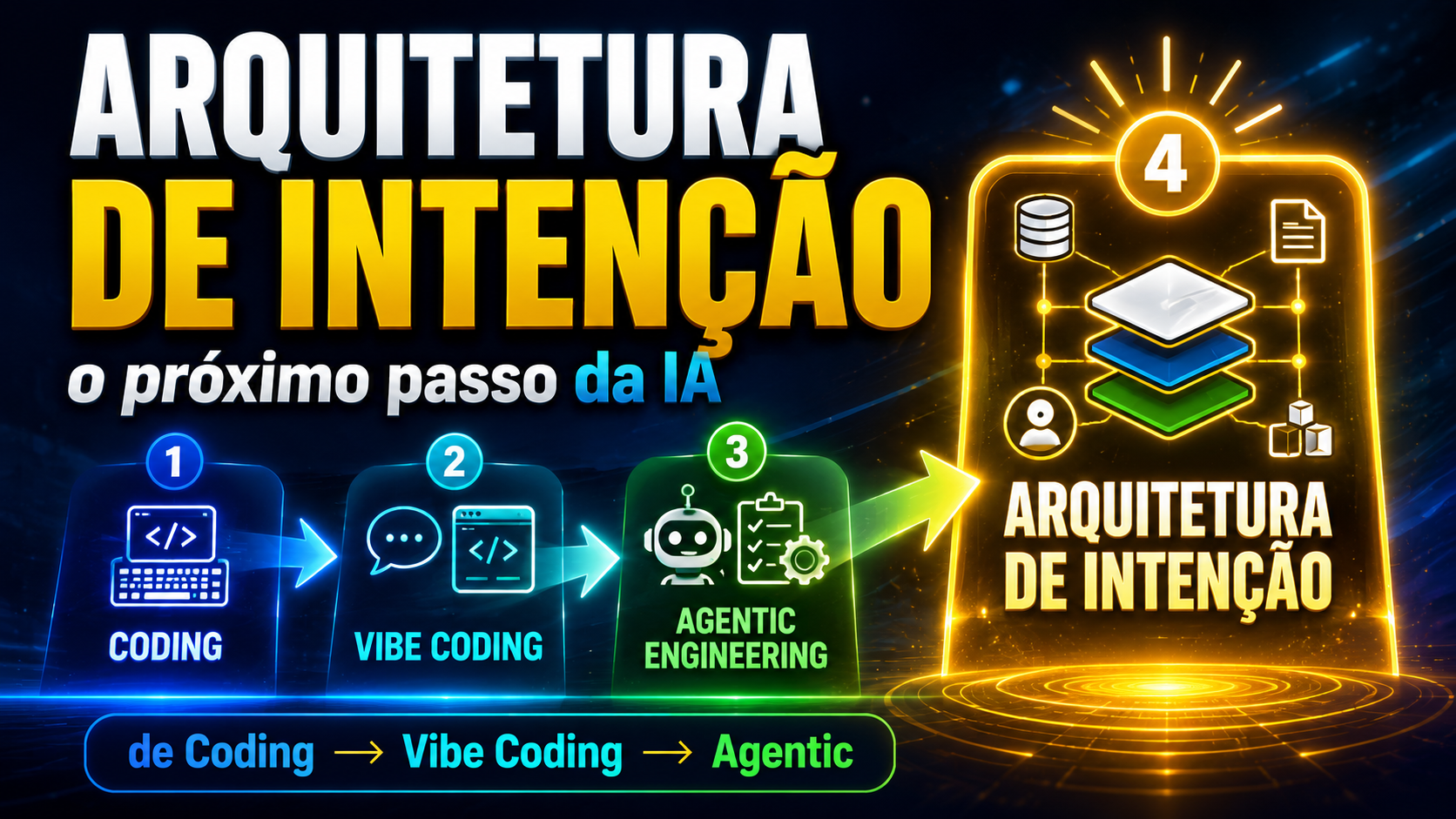
Intent Architecture
A prompt isn’t enough.
After the coding, from the vibe coding and of the agents, comes the next layer: structuring context, rules, memory, objectives, and validation so the AI can turn intent into a reliable, repeatable result that aligns with your goals.
In 4 days, you’ll move beyond improvised AI use and learn to design the system behind the intent — using the same logic that applies to any tool. Day 4 covers the September 2026 shift: what changed with Claude Fable 5.1 e o GPT-6 Astra, models that operate on intent rather than step-by-step prompts.
The AI ladder—each rung elevates the role of the person guiding it. The top is the focus of the intensive workshop.
Your progress in the immersion
Mark each section as read each day. Everything is saved in your browser.
What you’ll build
It's not "using AI better." It's leaving with a system yours, working.
See the pyramid
Understand the 4 layers and where you are today — so you can stop improvising.
Master the 5 pillars
Context, objectives, rules, memory, and validation — structured in a canvas.
Build a system
Bring everything together in a repeatable workflow with the run → validate → adjust → improve cycle.
Jump straight into applying it
A real-world case of your own runs through all 4 days and becomes a concrete outcome at the end.
The evolution, in four rungs
The question changes from “how do I write a better prompt?” stop “what system guides the AI?”.
Coding
The human writes every line and controls all the logic.
Vibe Coding
You describe an intention in natural language, and AI generates the first solution.
Agentic Engineering
The AI works in cycles—write, test, correct, deliver. You stop operating each step and start directing.
Intent Architecture
The focus shifts from the agent to the system that guides the agent. This is where the immersion lives.
Learning path map
🔺 Day 1 — The Pyramid
Improvise or design
6 sections · see + diagnose🧱 Day 2 — The 5 Pillars
Structure the intent
7 sections · the method, hands-on⚙️ Day 3 — The System
From intent to result
6 sections · build + operate🧭 Day 4 — The Turning Point
Models that operate based on intention (Fable 5.1 · GPT-6 Astra)
6 sections · subtract + migrate · new Sep/2026Prerequisites
- ✓No programming knowledge required. If you've used an AI chat, you're ready.
- ✓Ready to apply, not just watch. Hands-on.
- ✓A real-world case of your own (a problem, task, or idea) to bring to the 4 days.
How the immersion works
Day 1 — See. You see the pyramid, diagnose where you are, and choose your real intention.
Day 2 — Structure. You fill in the 5 pillars on the Canvas for your use case.
Day 3 — Build. You turn the Canvas into a system that runs and improves itself.
Day 4 — Shift. You migrate the system to the Sep/2026 generation (Fable 5.1, GPT-6 Astra): fewer steps, more intention, boundaries, and a definition of done.
Each day has practical exercises, ready-made examples, and a reusable template.
The next step after the prompt
Will you use AI superficially — or structure systems capable of multiplying results? Start now.