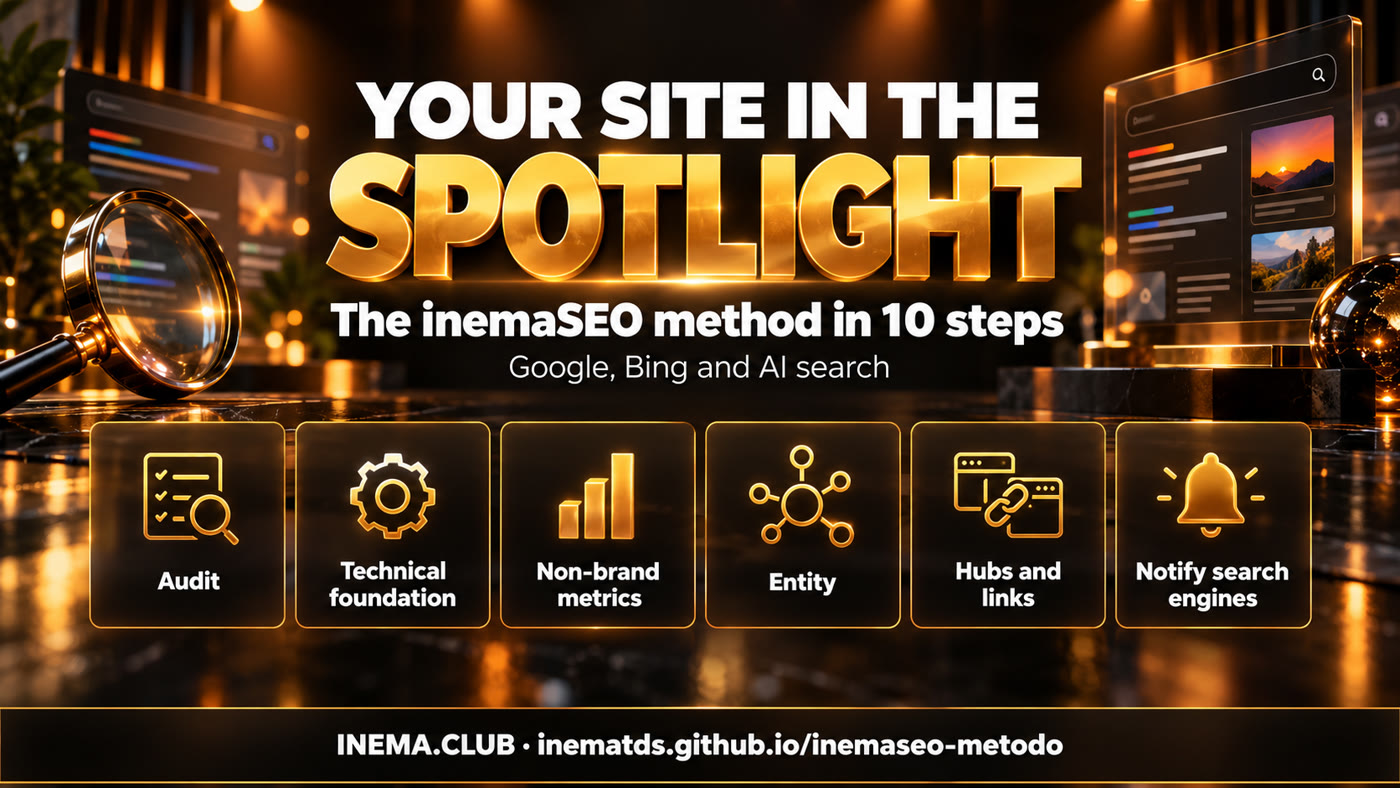
The method we use across the INEMA ecosystem to get found on Google, Bing and in answers from ChatGPT, Perplexity and Copilot. No paid tools and no invented content: AI agents do the repetitive work, and you make the decisions.

Ten steps that go from an X-ray of your site to notifying the search engines, with ready-made scripts and templates you adapt to your own site.
A single canonical, sitemaps with language, robots that let the AIs in, llms.txt and thin pages kept out of the index. Without this, no content pays off.
Every page is backed by a course, project, event or experiment that exists. The LLM extracts and rewrites; a validator discards whatever is not in the source.
The number that matters is searches that do not include your name: people who did not know you and found you. The weekly export separates them out.
In the order we apply them. The details of each one are in docs/METODO.md (in Portuguese).
Look at the HTML the server delivers: canonical, hreflang, JSON-LD and how many internal links exist. A page with no links is a page that barely exists.
One canonical only (www or not), a sitemap with real lastModified, robots letting the AI crawlers in, llms.txt and a content-index.json manifest per site.
A weekly Search Console export that separates brand searches, URL inspection and a conversion goal in analytics.
A Person and an Organization with a fixed @id, cited by every page and every subdomain.
Evergreen guide on the main site, news on the news site, events on the events site. One owner page for each search intent.
Pillars, question pages with a direct 40–60 word answer, and fact sheets with data extracted from the real page. Keywords validated by score, no paid tool.
A ladder of links for every new page and hub pages that read the other sites' manifests. A search page keeps an index of links in the HTML.
Each satellite (course, landing page, README) links to the right page on the main site, in batch and with a dry run.
One URL per news item and language, NewsArticle, an archive that is never pruned, and a minimal body written only with facts from the source.
IndexNow and Bing on every publish (ChatGPT and Copilot use Bing's index), sitemap in Search Console and a weekly read.

Everything is free. The search accounts need the site to be verified.
A verified domain property and gcloud with application credentials, for the measurement scripts.
gcloud auth application-default login \
--scopes=https://www.googleapis.com/auth/webmasters.readonly,\
https://www.googleapis.com/auth/cloud-platformSite verified on Bing (you can import it from Search Console) and an IndexNow key published at the root of the site.
# public key: https://yoursite.com/<key>.txt openssl rand -hex 16
git, curl, Python 3 and Node 18+. An AI agent (Claude Code or Codex CLI) for the extraction and writing steps.
git clone https://github.com/inematds/inemaseo-metodo
The commands are the scripts in this repository. Replace seusite.com with your own domain.
Redirects, robots, sitemaps, llms.txt and, per page, title, canonical, hreflang, JSON-LD and internal links in the HTML.
bash tools/auditoria.sh https://www.seusite.com /catalogo/ /sobre/ # report in the terminal
Use the templates: templates/robots.txt, templates/llms.txt, templates/content-index.json and templates/jsonld-entidade.json. Canonical, sitemap and JSON-LD on the same host.
# after publishing, confirm bash tools/auditoria.sh https://www.seusite.com
Run it every week. It produces a CSV of non-brand queries and one summary row per week and site.
export GSC_SITES="sc-domain:seusite.com" GSC_MARCA="seusite|seu nome" GSC_QUOTA_PROJ="seu-projeto-gcp" python3 tools/gsc_semanal.py --dias 7 # dados/gsc/resumo.csv
Autocomplete, Google Trends, impressions you already have and the strength of the top 10. GO at 6 points or more, and only if there is a real asset to cite. Table in docs/METODO.md.
# queries with impressions and no dedicated page = validated topic sort -t, -k4 -nr dados/gsc/*_sem-marca.csv | head -30
The LLM extracts from the real page (templates/prompt-ficha-extrativa.md, templates/prompt-texto-noticia.md); the validator discards any sentence with no support in the source and any number that does not appear in it.
node tools/validar_extracao.mjs fonte.txt "Curso com 5 módulos e 12 horas" # { apoiada: true, numerosNaFonte: false, ... } → discard
A JSON file with repo and target page. Dry run first; then --apply --commit.
python3 tools/link_de_volta.py mapa.json --guia https://www.seusite.com/aprender/ --guia-rotulo "Guia completo" python3 tools/link_de_volta.py mapa.json --apply --commit
Only URLs that return 200. The script checks first, then sends to IndexNow and, if you have a key, to Bing.
INDEXNOW_KEY=<key> BING_API_KEY=<key> bash tools/avisar_buscadores.sh urls.txt # IndexNow: HTTP 200 · Bing SubmitUrlBatch: HTTP 200
Ask Google for the status of each new page; the ones that do not show up get internal links and an indexing request in the console. Before publishing, run the quality checklist (in Portuguese).
python3 tools/gsc_inspecionar.py sc-domain:seusite.com https://www.seusite.com/nova-pagina/ # Submitted and indexed | crawled 2026-10-01 | Google canonical ...
The method ran on the portal (inema.club), the news site and the events site between September and October 2026.
One page per course in the catalog; dozens enriched with modules extracted from each course's page and validated against the source.
Courses published on GitHub Pages now link to their fact sheet and to the guide on the main site.
A "learn artificial intelligence" guide in PT, EN and ES, pillars on agents and community, and question pages with a direct answer.
/eventos/ and /noticias/ pages on the main site, reading each subdomain's manifest.
Permanent archive, NewsArticle, PT/EN/ES versions and a body written only with facts from the source; no text, noindex.
Author and organization with a fixed @id, cited by the portal, the knowledge base and the news site.
SEO lets your site be found. WebMCP lets AI agents use your site. The projects below complete the path.
Test whether your site is ready for AI agents: discovery, manifests, tools and best practices.
Five courses, from zero to expert: sites that talk to agents, integration and agent development.
An AEO/GEO playbook: how to get cited by AIs, with the INEMA case.
The WebMCP area of INEMA Events: get your site ready to talk to agents.
An SEO analysis skill for Claude Code: technical SEO, content (E-E-A-T), schema, sitemaps and AI search (GEO). Complements the audit in step 1.
The pillar guide of INEMA.CLUB, in three languages, with open learning paths and courses.
SEO pays off in weeks and months, not days. The routine is what produces the result.