PTENES
Dossier · status as of 15/09/2026

12 new AIs announced for October 2026

What’s rumor, what already exists, how much it costs today, and what changes in practice—each model compared with the verified current version in its lineage, with sources.

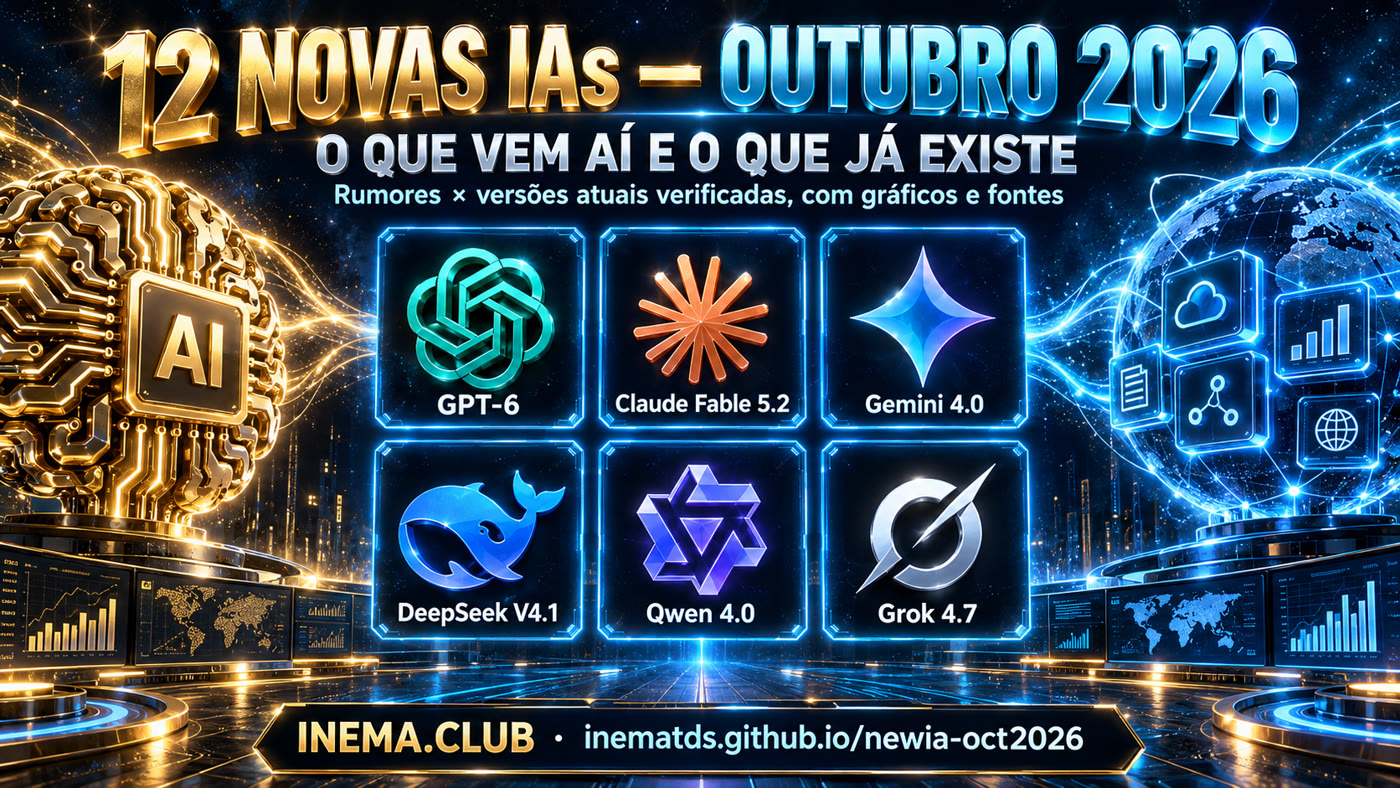
Banner: 12 new AIs — October 2026, rumors × currently verified versions
How to read this page

Rumor and fact are kept separate — deliberately

The list of 12 AIs circulated as “exciting news” without sources. Each name was researched online on 09/15/2026: what the lineage has already released (with URL), what the rumor claims, and whether any public source supports it.

✅ Verified

Number, date, or price that has Source URL (official blog, docs, model card, reliable press). It’s what you can use today.

🟠 Rumor with a source

The model’s name appears in some public source (leak, post on X, specialized press), but without official confirmation. Treat it as a hypothesis.

⚪ Rumor without a source

No public source mentions the name. Often, the rumor describes something that the current version already does — or confuses codenames.

Overview

What the research found

Of the 12 names, none have been officially announced through 15/09/2026. On the other hand, almost every lineage has released a new version in the last 60 days — which explains why the rumors sound plausible.

12rumored models in the list
10rumors with some public source
2rumors with no source at all
0officially announced by the manufacturer
RumorManufacturerRumor statusCurrent version verifiedReleased onContextInput / output (US$/1M)Open weights
🟢 GPT BelOpenAIRumor with a sourceGPT-6 Astra03/09/20261,05MUS$ 10 / US$ 50no
🟢 GPT-6 SolOpenAIRumor with a sourceGPT-6 Astra03/09/20261,05MUS$ 10 / US$ 50no
🟠 Claude Fable 5.2AnthropicRumor with a sourceClaude Fable 5.101/09/20261MUS$ 10 / US$ 50yes
🟠 Claude Opus 5.1AnthropicRumor without a sourceClaude Opus 524/07/20261MUS$ 5 / US$ 25no
⚫ Grok 4.7xAIRumor with a sourceGrok 4.612/08/2026500KUS$ 2 / US$ 6no
🐋 DeepSeek V4.1 ProDeepSeekRumor with a sourceDeepSeek-V4.1-Flash10/09/20261,05MUS$ 0,15 / US$ 0,60no
🔷 GLM-5.5 (Z.AI)Zhipu/Z.aiRumor with a sourceGLM-5.314/08/20261MUS$ 1.40 / US$ 4.40yes
🌙 Kimi K3.1Moonshot AIRumor with a sourceKimi K316/07/20261,05MUS$ 3 / US$ 15yes
🟣 Qwen 4.0AlibabaRumor with a sourceQwen3.8-Max03/08/20261MUS$ 2 / US$ 6no
💎 Gemini 4.0GoogleRumor with a sourceGemini 3.1 Pro (gemini-3.1-pro-preview)19/02/20261,05MUS$ 2 / US$ 12no
♾️ Muse Spark 1.4MetaRumor without a sourceMuse Spark 1.302/09/2026——no
📱 Xiaomi MiMo-V3-Pro / FlashXiaomiRumor with a sourceMiMo-V2.5-Pro30/04/20261MUS$ 0,30 / US$ 0,61yes

“Verified current version” = the latest model in the lineage with a primary source. Prices are public API prices in US$ per million tokens; “—” = unverified. 4 of the 12 lineages have open weights in the current version.

Charts

Where each lineage stands today

Only verified data is included. Rumors appear only as leaked markers—they have no figure to plot as a bar. Hover over the markers to see the value.

API price — current version verified (US$ per 1M tokens) · logarithmic scale · full bar = input, lighter bar = output
0.1110100DeepSeek-V4.1-FlashDeepSeekinput US$ 0,15US$ 0,15output US$ 0,60US$ 0,60MiMo-V2.5-ProXiaomiinput US$ 0,30US$ 0,30output US$ 0,61US$ 0.61GLM-5.3Zhipu/Z.aiinput US$ 1,40US$ 1.40output US$ 4,40US$ 4.40Grok 4.6xAIinput US$ 2US$ 2output US$ 6US$ 6Qwen3.8-MaxAlibabainput US$ 2US$ 2output US$ 6US$ 6Gemini 3.1 ProGoogleinput US$ 2US$ 2output US$ 12US$ 12Kimi K3Moonshot AIinput US$ 3US$ 3output US$ 15US$ 15Claude Opus 5Anthropicinput US$ 5US$ 5output US$ 25US$ 25GPT-6 AstraOpenAIinput US$ 10US$ 10output US$ 50US$ 50Claude Fable 5.1Anthropicinput US$ 10US$ 10output US$ 50US$ 50
inputoutput
Context window — currently verified version (millions of tokens) · Muse Spark 1.3: Meta does not publish the number
0M0,26M0,53M0,79M1,05MGPT-6 AstraGPT-6 Astra: 1,05M 1,05MDeepSeek-V4.1-FlashDeepSeek-V4.1-Flash: 1,05M 1,05MKimi K3Kimi K3: 1.05M 1,05MGemini 3.1 ProGemini 3.1 Pro: 1,05M 1,05MClaude Fable 5.1Claude Fable 5.1: 1M 1MClaude Opus 5Claude Opus 5: 1M 1MGLM-5.3GLM-5.3: 1M 1MQwen3.8-MaxQwen3.8-Max: 1M 1MMiMo-V2.5-ProMiMo-V2.5-Pro: 1M 1MGrok 4.6Grok 4.6: 0,5M 0,5M
GPQA Diamond (%) — only where there is a source for the current version · scientific reasoning benchmark; absence = unverified, not zero
024487296GPT-6 AstraGPT-6 Astra: 96 %96 %Grok 4.6Grok 4.6: 94,9 %94,9 %Gemini 3.1 ProGemini 3.1 Pro: 94,3 %94,3 %Kimi K3Kimi K3: 93.5%93,5 %Qwen3.8-MaxQwen3.8-Max: 92,6 %92,6 %
Release cadence by model family · solid dot = released version (sourced date) · hollow dot in Oct/2026 = rumor · larger amber dot = current version
07/202510/202501/202604/202607/202610/2026Oct/2026 (rumor)GPT BelGPT-5.5 — 23/04/2026GPT-5.6 Sol — 09/07/2026GPT-6 Astra — 03/09/2026GPT Bel — rumor, no confirmed dateGPT-6 SolGPT-5.5 — 23/04/2026GPT-5.6 Sol — 09/07/2026GPT-6 Astra — 03/09/2026GPT-6 Sol — rumor, no confirmed dateClaude Fable 5.2Claude Fable 5 / Mythos 5 — 06/09/2026Claude Sonnet 5 — 30/06/2026Claude Opus 5 — 07/24/2026Claude Fable 5.1 / Mythos 5.1 — 09/01/2026Claude Fable 5.2 — rumor, no confirmed dateClaude Opus 5.1Claude Opus 4.5 — 11/24/2025Claude Opus 5 — 07/24/2026Claude Opus 5.1 — rumor, no confirmed dateGrok 4.7Grok 4.6 — 12/08/2026Grok 4.7 — rumor, no confirmed dateDeepSeek V4.1 ProDeepSeek-V3.1 — 19/08/2025DeepSeek-V3.2-Exp — 29/09/2025DeepSeek-V3.2 — 01/12/2025DeepSeek-V4 (Preview) — 24/04/2026DeepSeek-V4-Flash-Vision-Exp — 21/08/2026DeepSeek-V4.1-Flash — 10/09/2026DeepSeek V4.1 Pro — rumor, no confirmed dateGLM-5.5 (Z.AI)GLM-4.5 — 01/07/2025GLM-4.6 — 30/09/2025GLM-4.7 — 01/12/2025GLM-5 — 01/02/2026GLM-5.1 — 08/04/2026GLM-5.2 — 16/06/2026GLM-5.3 — 14/08/2026GLM-5.5 (Z.AI) — rumor, no confirmed dateKimi K3.1Kimi K2 — 01/07/2025Kimi K2.5 — 01/01/2026Kimi K2.6 — 21/04/2026Kimi K2.7 Code — 12/06/2026Kimi K3 — 16/07/2026Kimi K2.8 Preview — 11/09/2026Kimi K3.1 — rumor, no confirmed dateQwen 4.0Qwen3-235B-A22B — 01/04/2025Qwen3.5-397B-A17B — 15/02/2026Qwen3.8-Max — 03/08/2026Qwen3.8-Flash-Next — 26/08/2026Qwen 4.0 — rumor, no confirmed dateGemini 4.0Gemini 3 Pro — 18/11/2025Gemini 3 Flash — 17/12/2025Gemini 3.1 Pro — 19/02/2026Gemini 3.5 Flash + Gemini Omni — 19/05/2026Gemini 3.6 Flash — 21/07/2026Gemini 3.8 Flash — 02/09/2026Gemini 4.0 — rumor, no confirmed dateMuse Spark 1.4Muse Spark (original) — 08/04/2026Muse Spark 1.1 — 09/07/2026Muse Spark 1.2 — 05/08/2026Muse Spark 1.3 — 02/09/2026Muse Spark 1.4 — rumor, no confirmed dateXiaomi MiMo-V3-Pro / FlashMiMo-7B — 30/04/2025MiMo-7B-RL-0530 — 30/05/2025MiMo-V2-Flash — 17/12/2025MiMo-V2-Pro — 18/03/2026MiMo-V2.5 / MiMo-V2.5-Pro — 30/04/2026Xiaomi MiMo-V3-Pro / Flash — rumor, no confirmed date
The rumors, one by one

What the list claims and what can be verified

Each claim from the original announcement, with the source (when available) that mentions the model name. Details are in each model's dossier.

🟢 GPT Bel Rumor with a source

  • Codename 'Bel' = pre-training run with more than 10 trillion parameters, successor to 'Doug' (source: X @synthwavedd, 25/Aug/2026, unconfirmed by OpenAI)
  • 'Bel' would reportedly be reserved internally while alignment teams build safety evaluation sandboxes
  • OpenAI publicly confirmed (Sep. 8, 2026) that an unnamed future model is “significantly more capable” than GPT-6 Astra, with no date, price, or name.
  • The specific claim of “6x faster than Astra” in internal tests is documented for the codename “GPT-6 Sol,” not “Bel”—the connection between the two names has not been confirmed by a primary source

Rumor source: orcarouter.ai/blog/gpt-6-astra-successor-leak…

🟢 GPT-6 Sol Rumor with a source

  • a model called 'GPT-6 Sol' would exist as the default workhorse of the GPT-6 generation
  • broad availability
  • focus on long-horizon agents and coding

Rumor source: eyestech.in/gpt-6-sol-benchmarks-astra-latency-t…

🟠 Claude Fable 5.2 Rumor with a source

  • stronger coding
  • stronger knowledge work
  • better at long tasks / long-horizon tasks
  • stronger research
  • release window: late September or early October 2026 (not confirmed by Anthropic)

Rumor source: cellcog.ai/blog/fable-5-2-release-date/

🟠 Claude Opus 5.1 Rumor without a source

  • cost-performance champion update
  • close to Fable at half the price
  • enterprise focus

No public source found for the model name.

⚫ Grok 4.7 Rumor with a source

  • xAI's flagship
  • SpaceX engineering data (no direct public source found)
  • real-time multimodality (no direct public source found)
  • enhanced reasoning (no public technical details)
  • cost-effectiveness (no public pricing)
  • ~2.1 trillion parameters (not officially confirmed)

Rumor source: bighatgroup.com/blog/xai-weekly-2026-09-13/

🐋 DeepSeek V4.1 Pro Rumor with a source

  • open-source leader
  • 1M context
  • very powerful agents
  • price cutter

Rumor source: thenextweb.com/news/deepseek-v4-1-flash-launch-v…

🔷 GLM-5.5 (Z.AI) Rumor with a source

  • more than 1 trillion total parameters
  • release scheduled for August 2026
  • official name would be GLM-5.5

Rumor source: wan27.org/blog/glm-5-5

🌙 Kimi K3.1 Rumor with a source

  • performance closest to GPT-5.6 and Claude Fable
  • faster inference / lower latency
  • better token efficiency in long reasoning tasks
  • more reliable coding/agent workflows, fewer wasted steps
  • continued advantage over Claude Opus 5 on some coding/agent tasks
  • continued release with open weights

Rumor source: orcarouter.ai/blog/kimi-k3-1-leak

🟣 Qwen 4.0 Rumor with a source

  • MoE with a much smaller active fraction (e.g., 6B active), preview via Qwen3.8-Flash-Next
  • major leap in multimodality and coding
  • broader ecosystem
  • release in September/2026 (unconfirmed leak)

Rumor source: technode.com/2026/08/26/alibabas-qwen-to-open-so…

💎 Gemini 4.0 Rumor with a source

  • Gemini 4 pretraining confirmed by Google on 21/07/2026
  • unofficial leak of 1.5M+ token context
  • unofficial leak of an internal Gemini 4 Pro checkpoint, with release in October/2026
  • no gemini-4-* model ID confirmed in the API by 02/09/2026

Rumor source: felloai.com/all-we-know-about-google-gemini-4/

♾️ Muse Spark 1.4 Rumor without a source

  • new release from Meta Superintelligence Labs
  • more token-efficient agent workflows
  • fewer resources for long tasks

No public source found for the model name.

📱 Xiaomi MiMo-V3-Pro / Flash Rumor with a source

  • MiMo-V3-Flash would be the anonymous 'Omen Alpha' model offered by OpenCode to Go plan subscribers since September 4, 2026, according to analyst teortaxesTex's hypothesis
  • MiMo-V3-Flash would be built on DeepSeek V4 GA open MIT weights (build 0813, Aug/2026), based on stylistic similarity in chain-of-thought
  • The MiMo-V3 generation would use a “High Sparse” architecture (full-attention layers as an oracle + KV cache sharing), as predicted by Luo Fuli at ICML in July 2026, with a claimed ~10x reduction in KV cache memory
  • Figures for a supposed MiMo-V3-Pro reportedly leaked in August 2026, but without verified details in this research

Rumor source: orcarouter.ai/blog/xiaomi-mimo-v3-flash-leak

Dossiers · 12 models

One dossier per model

Lineage, verified current version, version timeline, what is known about the rumor, what changes in practice, usefulness for people who create, teach, or code in Brazil, and all sources. Each dossier is also available as Markdown in the repository.

OpenAI

🟢 GPT Bel

Current version verified: GPT-6 Astra · 03/09/2026 · 1.05M context · US$ 10 / US$ 50 per 1M

Rumor with a source
Open full dossier (lineage, current version, timeline, rumor, usefulness, sources)
Status as of 2026-09-15. Rumor: OpenAI’s new line of names focused on alignment/safety, faster and more powerful than a supposed “Astra” model, with internal tests at 6x speed. Status: sourced rumor (but fragmented — public sources attribute parts of this rumor to DIFFERENT codenames; see section 4)

What the lineage is (manufacturer, positioning, 3 sentences)

OpenAI is the maker. As of Sep/2026, the public production lineage is the GPT-5.x family (GPT-5.2, GPT-5.5, GPT-5.6 with the Sol/Terra/Luna variants, GPT-5.3-Codex) and the new flagship GPT-6 Astra, released on Sep 3, 2026 (source: orcarouter.ai/blog/gpt-6-astra-successor-leak,… citing OpenAI developer docs and Artificial Analysis). "Astra" is not a rumor — it is a real model that has already been released and is billed through the API (gpt-6-astra). The name “GPT Bel” circulates in the press/on X as an internal pretraining codename, not as an announced product.

Current version verified (Sep/2026)

Version timeline (oldest → newest, 3 to 6 items)

VersionDateContextInput/output price (US$/1M)HighlightSource
GPT-5.22025-12-11unverifiedunverified3 modes (Instant/Thinking/Pro) + GPT-5.2-Codex variantopenai.com/index/introducing-gpt-5-2/
GPT-5.52026-04-231M tokens5 / 30“a new class of intelligence for real work,” gains in agentic coding and computer useopenai.com/index/introducing-gpt-5-5/ , openrouter.ai/openai/gpt-5.5
GPT-5.6 Sol2026-07-091.1M tokens (128K output)4 / 20 (promotional price valid through at least Nov 21, 2026)Flagship of the 5.6 family, SOTA in coding/knowledge work/cyber/science with fewer tokens and lower costrequesty.ai/models/openai/gpt-5.6-sol , orcarouter.ai/blog/gpt-6-astra-successor-leak…
GPT-5.3-Codexunverified (exact date)unverifiedunverifiedOpenAI's most capable agentic coding model to dateen.wikipedia.org/wiki/GPT-5.3-Codex
GPT-6 Astra2026-09-03 (GA 2026-09-05)~1.05M tokens (128K output)10 / 50Current flagship; strong in science/cyber; rollout described as "messy" by OpenAI/Altman themselvesorcarouter.ai/blog/gpt-6-astra-successor-leak…

The rumor: what’s known

  • "Bel" — codename for a pretraining run with more than 10 trillion parameters, succeeding another internal codename, “Doug.” Original source: an X post by anonymous account @synthwavedd on Aug 25, 2026, with no named source within OpenAI (summary via orcarouter.ai/blog/gpt-6-astra-successor-leak…). Also reproduced by eyestech.in/gpt-6-sol-benchmarks-astra-latency-t… which describes “Bel” as internally reserved while alignment teams build evaluation sandboxes—this is the connection to the “alignment/safety” part of the requested rumor.
  • Relationship to Astra: the sources themselves disagree — some readers treat "Bel" as the base that became the already-released GPT-6/Astra; others as the model NEXT after Astra (source: orcarouter.ai/blog/gpt-6-astra-successor-leak…).
  • The “6x faster” claim, specifically: public sources attribute this number to a DIFFERENT codename — "GPT-6 Sol" (not “Bel”) — in internal tests, reportedly running ~6x faster than Astra, with one user citing an SVG task completed in 3 min vs. 19 min for Astra; speculated to launch at DevDay on 09/29/2026 (source: x.com/hqmank/status/2096886608582643847 e kucoin.com/news/flash/gpt-6-sol-begins-internal-…). No public source specifically ties the “6x” figure to the name “Bel.”
  • A second codename is also circulating, "Doug", cited by SemiAnalysis (Aug 7, 2026) as a “much larger model, actively in development,” predecessor to “Bel” (source: orcarouter.ai/blog/gpt-6-astra-successor-leak…).
  • On 8/Sep/2026, OpenAI itself publicly stated that an unnamed future model exists, “significantly more capable than GPT-6 Astra,” and that it had produced a proof related to Navier-Stokes — but without a name, price, date, or API identifier (source: orcarouter.ai/blog/gpt-6-astra-successor-leak…).

Labeling of each claim in the combined rumor ("GPT Bel," alignment/safety, faster/more powerful than Astra, 6x in internal tests):

  • "New naming line focused on alignment/safety": verificável? parcialmente — a report (eyestech.in) links “Bel” to an alignment/safety evaluation period before release, but the primary source is an interpretation of anonymous X posts, not an OpenAI document.
  • "Faster and more powerful than Astra": verificável? parcialmente — OpenAI confirmed (via Altman/Axios and a post on Sep 8) that a future model "significantly more capable" than Astra exists; the speed specifically was not confirmed by OpenAI.
  • "Internal tests with 6x speed": verificável? não, para o nome "Bel" — this specific number is documented in press/X sources linked to the codename "GPT-6 Sol", not “Bel.” The rumor you heard may involve a naming mix-up.
  • "Called GPT Bel": verificável? não — no official OpenAI source uses this name; it originates entirely from anonymous X posts, with no company confirmation.

What changes in practice vs. the current version (3 bullets, with “if the rumor is confirmed”)

  • If the rumor is confirmed (whether as "Bel" or "GPT-6 Sol"), OpenAI would offer an option that is considerably faster than the current Astra (~6x on one tested task), possibly trading some raw quality for latency—useful for agentic workflows that today struggle with Astra's 128K output tokens on long tasks.
  • If the connection to "alignment/safety" is confirmed, the launch may be slower and go through additional safety gates—the Astra itself had its rollout delayed after a "Critical" cyber risk finding, so a more capable successor is likely to face the same kind of delay.
  • Until OpenAI announces an official name, price, or date, any product or budget decision today should be based on GPT-6 Astra (US$ 10/US$ 50 per 1M tokens) or GPT-5.6 Sol (US$ 4/US$ 20, cheaper), not projections about “Bel.”

Usefulness for a Brazilian creator/educator/dev (3 bullets: where to use it, cost, caveat)

  • Where to use it: today, for real-world production (writing, code, research), GPT-5.6 Sol is the verified best value (US$ 4/US$ 20 per 1M, 1.1M context); GPT-6 Astra is worth it for tasks that require heavy scientific/mathematical reasoning, given the leap in GPQA Diamond and FrontierMath—but at more than double the cost.
  • Cost: with the dollar weighing on the budgets of those paying in Brazilian reais, the difference between US$ 20/1M (Sol) and US$ 50/1M (Astra) in output is significant for high-volume use (e.g., batch script generation, agents running all day) — it’s worth measuring whether Astra’s benchmark gains translate into perceived quality for your use case before switching.
  • Caution: do not plan a workflow or budget around "GPT Bel" — it is an unconfirmed rumor from OpenAI, with details that are not always consistent across sources (including confusion between "Bel" and "GPT-6 Sol" in the press ecosystem itself); treat it as a watch list item, not a roadmap.

Sources (URL list)

Source file: modelos/gpt-bel.md

OpenAI

🟢 GPT-6 Sol

Current version verified: GPT-6 Astra · 03/09/2026 · 1.05M context · US$ 10 / US$ 50 per 1M

Rumor with a source
Open full dossier (lineage, current version, timeline, rumor, usefulness, sources)
Status as of 2026-09-15. Rumor: broad availability, standard “workhorse” model, long-horizon agents and coding. Status: sourced rumor (but low reliability — the name “GPT-6 Sol” appears only on an unofficial leaks blog; OpenAI has not confirmed this name)

What the lineage is (manufacturer, positioning, 3 sentences)

The GPT lineage is from OpenAI. In September/2026, it has two generations active simultaneously: the GPT-5.x family (5.4, 5.5, 5.6—the latter divided into three variants, Sol/Terra/Luna) and the new GPT-6 generation, whose first member, GPT-6 Astra, was released on Sep 3, 2026, as “the world's smartest and most aligned model” (OpenAI's official positioning) (source: en.wikipedia.org/wiki/GPT-6). The name “GPT-6 Sol” cited in the rumor in this dossier does NOT correspond to a model confirmed by OpenAI: “Sol” is actually the name of the flagship model in the GPT-5.6 family, released on 9/jul/2026, described by OpenAI itself as its “workhorse” and “best coding model to date” (source: en.wikipedia.org/wiki/GPT-5.6). A leak blog (eyestech.in) speculates that OpenAI will repeat the Astra/Sol/Terra/Luna taxonomy in the “GPT-6 era” as well, with a “GPT-6 Sol” as a high-throughput engineering tier — but this has no official source or independent confirmation (source: eyestech.in/gpt-6-sol-benchmarks-astra-latency-t…).

Current version verified (Sep/2026)

Secondary reference: GPT-5.6 Sol (the actual "Sol," previous generation)

Version timeline (oldest → newest, 3 to 6 items)

VersionDateContextInput/output price (US$/1M)HighlightSource
GPT-5.1unverified (discontinued in Mar/2026)unverifiedunverifiedRemoved from ChatGPT on 11/03/2026, automatically migrated to GPT-5.3/5.4releasebot.io/updates/openai/openai-models
GPT-5.4unverifiedunverified2.50 (input, comparison)Combines reasoning, coding, and agentic workflows in a single frontier modeldevelopers.openai.com/api/docs/models/gpt-5.6-so…
GPT-5.523/04/2026unverified5.00 (input, comparison)Described by OpenAI as “the most intelligent and intuitive model yet”en.wikipedia.org/wiki/GPT-5.4
GPT-5.6 (Sol/Terra/Luna)09/07/20261,050,000 (Sol)4.00 / 20.00 (Sol)Introduces a split into 3 variants by cost/performance; Sol is the coding “workhorse”en.wikipedia.org/wiki/GPT-5.6 ; developers.openai.com/api/docs/models/gpt-5.6-so…
GPT-6 Astra03/09/2026~1,050,000 in / 128,000 out10,00 / 50,00First model in the GPT-6 generation; focused on long-horizon autonomy and computer use; cybersecurity risk rating "Critical"orcarouter.ai/blog/gpt-6-astra-successor-leak…

The rumor: what’s known

  • Sources citing something close to the "GPT-6 Sol" rumor (URL + 1-line summary):
    • eyestech.in/gpt-6-sol-benchmarks-astra-latency-t… — unofficial leaks blog speculates that OpenAI will repeat the 4-level taxonomy (Astra/Sol/Terra/Luna) in the "GPT-6 era" as well, with "GPT-6 Sol" as a high-throughput coding engineering tier; no primary source cited, and the article has a speculative/clickbait tone.
    • orcarouter.ai/blog/gpt-6-astra-successor-leak… — confirms rumors of a successor to GPT-6 Astra (codenames “Doug” and “Bel,” according to SemiAnalysis and anonymous X accounts), but NONE of these sources use the name “Sol” for that successor — in these sources, “Sol” remains the name of the GPT-5.6 generation variant, which has already been released.
    • No public source (official or from a reliable news outlet) confirms a model literally called "GPT-6 Sol" with the meaning described in the user's rumor (broad availability, default workhorse, long-horizon agents, and coding).
  • Each rumor claim, labeled:
    • "A model called GPT-6 Sol exists/will be released" → verifiable? no — no official OpenAI source uses this name; it appears only on a low-credibility leaks blog that mixes GPT-5.6-generation naming with speculation about the GPT-6 generation.
    • "Wide availability" → verifiable? no — no date, price, or availability announcement for a “GPT-6 Sol”; what exists today is GPT-6 Astra, available in API/ChatGPT since 03/09/2026.
    • "Default 'workhorse' model" → verifiable? partially, but for ANOTHER model — the description "workhorse" applies, according to a source, to GPT-5.6 Sol (the previous generation, already released in July/2026), not to a "GPT-6 Sol" (source: en.wikipedia.org/wiki/GPT-5.6).
    • "Long-Horizon Agents and Coding" → verifiable? partially, but for Astra — long-horizon agent/computer-use capability is a confirmed attribute of GPT-6 Astra (the real model in the current GPT-6 generation), not a separate "GPT-6 Sol" (source: orcarouter.ai/blog/gpt-6-astra-successor-leak…).

What changes in practice vs. the current version (3 bullets, with “if the rumor is confirmed”)

  • If the rumor is confirmed (that is, if OpenAI actually releases a "GPT-6 Sol" variant as a workhorse below Astra), the market would gain a lower-cost option than Astra (currently US$ 10/US$ 50 per 1M) while retaining much of its coding/agent capability—repeating what has already happened between GPT-5.6 Sol (US$ 4/US$ 20) and a hypothetical, more expensive "GPT-6 Astra."
  • If the rumor is confirmed, ~1M tokens of context and an emphasis on coding/engineering tasks (SWE-bench, refactoring, CI) would become the "daily use" standard for the GPT-6 generation, leaving Astra for maximum-reasoning tasks (robotics, formal proofs, WebGL).
  • Until this is official, the recommended practice today is to use GPT-6 Astra (released and documented) for tasks that require the top of the line, and GPT-5.6 Sol (also released and documented, and cheaper) as the true “workhorse” available now — don’t build anything in production around a “GPT-6 Sol” that doesn’t officially exist yet.

Usefulness for a Brazilian creator/educator/dev (3 bullets: where to use it, cost, caveat)

  • Where to use it: for assisted coding, long-horizon agents, and automation workflows (e.g., content pipelines, scripts, code review), the currently available and documented model that best fits the rumor’s description is GPT-5.6 Sol (via API gpt-5.6-sol or alias gpt-5.6) — not a nonexistent “GPT-6 Sol.”
  • Cost: GPT-5.6 Sol costs US$ 4,00/1M input tokens and US$ 20,00/1M output tokens (with input caching at US$ 0,40/1M), much less than GPT-6 Astra (US$ 10,00/US$ 50,00 per 1M) — for routine creator/dev use, the 5.6-generation Sol tends to be the best value until OpenAI confirms something official for "GPT-6 Sol" (sources: developers.openai.com/api/docs/models/gpt-5.6-so… ; orcarouter.ai/blog/gpt-6-astra-successor-leak…).
  • Caution: do not plan integration or budget around the name "GPT-6 Sol" — it is an unconfirmed rumor, mixed up with the real name of a different model (GPT-5.6 Sol) and speculation from a low-credibility blog; OpenAI itself publicly mentioned a successor "significantly more capable than GPT-6 Astra" on 08/09/2026, but gave no name, price, or date — any architecture decision should wait for a real API identifier before committing to production (source: orcarouter.ai/blog/gpt-6-astra-successor-leak…).

Sources (URL list)

Source file: modelos/gpt-6-sol.md

Anthropic

🟠 Claude Fable 5.2

Current version verified: Claude Fable 5.1 · 01/09/2026 · 1M context · US$ 10 / US$ 50 per 1M

Rumor with a source
Open full dossier (lineage, current version, timeline, rumor, usefulness, sources)
Status as of 2026-09-15. Rumor: “Claude Fable 5.2 — Anthropic’s next flagship iteration; coding, knowledge work, long tasks, stronger research.” Status: sourced rumor (single source, not confirmed by Anthropic)

What the lineage is (manufacturer, positioning, 3 sentences)

Claude is Anthropic’s line of language models. Since June 2026, Anthropic has reorganized its catalog into four tiers — Haiku (fast/cheap), Sonnet (cost-performance balance), Opus (agentic coding and complex enterprise work), and, above all, “Mythos-class” Fable (demanding reasoning and long-horizon agentic tasks) (source: docs.claude.com/en/docs/about-claude/models/over…). According to Anthropic, Fable and Mythos are “the same model” with different safeguard levels: Fable is generally available, while Mythos is available only through trusted access programs (source: anthropic.com/claude-fable-and-mythos-5-1). The name “Fable 5.2” cited in the request does not correspond to any official release found through 2026-09-15 — it is a single-source rumor on X (Twitter).

Current version verified (Sep/2026)

Version timeline (oldest → newest, 3 to 6 items)

VersionDateContextInput/output price (US$/1M)HighlightSource
Claude Fable 5 / Mythos 52026-06-09unverifiedunverifiedFirst public release in the "Mythos" class (Fable)anthropic.com/news/claude-fable-5-mythos-5
Claude Sonnet 52026-06-30unverified2 / 10Performance close to Opus 4.8 at a lower priceanthropic.com/news/claude-sonnet-5
Claude Opus 52026-07-24unverified5 / 25Focused on agentic coding and complex enterprise workdocs.claude.com/en/docs/about-claude/models/over…
Claude Haiku 4.5unverifiedunverified1 / 5Fastest model with near-frontier intelligencedocs.claude.com/en/docs/about-claude/models/over…
Claude Fable 5.1 / Mythos 5.12026-09-01unverified10 / 50New benchmark in coding, knowledge, and long-running tasks; cache reads 75% cheaper; Enterprise Frontier Safeguards (EFS)anthropic.com/claude-fable-and-mythos-5-1
"Claude Fable 5.2"not released — rumor points to "late September or early October 2026"unverifiedunverifiedRumor of the next flagship iteration — not confirmed by Anthropiccellcog.ai/blog/fable-5-2-release-date/ (citing posts by @kimmonismus on X)

The rumor: what’s known

  • Primary rumor source: posts from a single account on X, @kimmonismus — on 2026-09-05: “Fable 5.2, or whatever it ends up being called” was “expected very soon”; on 2026-09-08: described a “new pretraining run” with a planned release for “end of September or early October” (source: cellcog.ai/blog/fable-5-2-release-date/, which cites and links to the two original posts)
  • Other mentions on X (accounts “Aman” and “Surendar”), with no additional verifiable information, repeating the same generic expectation of “beats Fable 5.1” and “improves coding and agentic workflows”—no technical specifics or original source (source: X searches via WebSearch, 2026-09-15; this is user speculation, not an evidence-backed leak)
  • Explicitly, a rumor aggregator (CellCog) states: "There is no leaked evaluation sheet, no configuration string, no early-access identifier and no provider-catalog sighting attributed to Fable 5.2 as of September 10, 2026" (source: cellcog.ai/blog/fable-5-2-release-date/)
  • Prediction markets cite probabilities (they are not sources of facts about the model, only of market expectations): Polymarket prices the "next Fable model" at 53% by 31/10/2026 and 87.5% by 31/12/2026 (source: cellcog.ai/blog/fable-5-2-release-date/, citing polymarket.com/event/next-fable-model-5pt2-relea…)
  • No official Anthropic source (docs.anthropic.com, anthropic.com/news, anthropic.com/pricing) mentions "Fable 5.2" as of this date

Labeling of each rumor claim:

  • "Anthropic’s next flagship iteration" — partially verifiable (the historical 5 → 5.1 → 5.2 numbering pattern is consistent with the cycle already seen for Fable 5 → 5.1), but the model’s existence itself has no official confirmation
  • "Stronger coding" — verifiable? No, it’s an extrapolation from a trend (every generation so far has improved at coding), with no leaked benchmark
  • "Stronger knowledge work" — verifiable? No, same reason
  • "Long tasks / better long-horizon performance" — verifiable? No, no cited technical source, only qualitative expectations in social media posts
  • "Stronger research" — verifiable? No, no primary source

What changes in practice vs. the current version (3 bullets, with “if the rumor is confirmed”)

  • If the rumor is confirmed, a "Fable 5.2" would likely follow the Fable 5 → 5.1 pattern (same kind of announcement, possible cache cost reduction and a slight benchmark gain)—but this is an inference based on history, not data from the rumor (historical pattern source: anthropic.com/claude-fable-and-mythos-5-1)
  • If the rumor is confirmed with the cited timeline ("late September/early October 2026"), the launch would come just a few weeks after Fable 5.1 (01/09/2026), a much shorter interval than the one observed between Fable 5 (09/06/2026) and Fable 5.1 (01/09/2026)—about 3 months (date source: anthropic.com/news/claude-fable-5-mythos-5 e anthropic.com/claude-fable-and-mythos-5-1)
  • Without confirmation of the rumor's price, context, or benchmarks, it is not possible to say what changes technically—right now, it is only an expectation of "general improvement"

Usefulness for a Brazilian creator/educator/dev (3 bullets: where to use it, cost, caveat)

  • Where to use it today: for the confirmed model (Fable 5.1), heavy reasoning tasks, complex code review/debugging, and long-horizon agentic work via Claude API/Claude Code, also available through AWS, Google Cloud, and Microsoft Foundry (source: anthropic.com/claude-fable-and-mythos-5-1)
  • Cost: Fable 5.1 is the most expensive model in the current catalog (US$ 10 input / US$ 50 output per million tokens), far above Sonnet 5 (US$ 2/US$ 10) and Opus 5 (US$ 5/US$ 25)—for high-volume use, consider Sonnet 5 or Opus 5 with adjusted "effort" before scaling up to Fable (source: docs.claude.com/en/docs/about-claude/models/over…)
  • Caution: do not plan a workflow or budget around "Fable 5.2" — it is a rumor from a single source (an X account) with no confirmation from Anthropic; use only the officially documented 5.1 version until there is an announcement at anthropic.com/news (source: cellcog.ai/blog/fable-5-2-release-date/)

Sources (URL list)

Source file: modelos/claude-fable-5-2.md

Anthropic

🟠 Claude Opus 5.1

Current version verified: Claude Opus 5 · 24/07/2026 · 1M context · US$ 5 / US$ 25 per 1M

Rumor without a source
Open full dossier (lineage, current version, timeline, rumor, usefulness, sources)
Status as of 2026-09-15. Rumor: “Claude Opus 5.1 — cost-performance champion update, close to Fable at half the price, enterprise focus.” Status: unsourced rumor

What the lineage is (manufacturer, positioning, 3 sentences)

The Opus lineage is Anthropic's “top-of-the-line” (flagship) family of models within the Claude portfolio, which also includes Sonnet (cost/performance balance) and Haiku (fast/low-cost); above them is now the Fable line as the most capable model of all (anthropic.com/claude/opus, techcrunch.com/2026/07/24/anthropic-launches-opu…). Opus is positioned for long-running agentic coding, computer use, and professional/scientific reasoning. Anthropic markets it as the model that “comes close” to Fable’s frontier intelligence at half the price (anthropic.com/news/claude-opus-5). The current version in the lineage is Claude Opus 5, released on 24/07/2026, replacing Opus 4.8 (techcrunch.com/2026/07/24/anthropic-launches-opu…).

Current version verified (Sep/2026)

  • Model: Claude Opus 5, API ID claude-opus-5 (source: anthropic.com/news/claude-opus-5)
  • Release date: July 24, 2026 (source: techcrunch.com/2026/07/24/anthropic-launches-opu… e anthropic.com/news/claude-opus-5)
  • Context window: 1,000,000 (1M) tokens, both the default and maximum value (there is no smaller-context variant); maximum output of 128,000 tokens (source: platform.claude.com/docs/en/about-claude/models/… — also reported in essamamdani.com/blog/claude-opus-5-launch-develo…)
  • API price: input US$ 5,00 / 1M tokens, output US$ 25,00 / 1M tokens — price unchanged from Opus 4.8 (source: anthropic.com/news/claude-opus-5, confirmed by techcrunch.com/2026/07/24/anthropic-launches-opu…); up to 90% savings with prompt caching and 50% with batch processing (source: anthropic.com/news/claude-opus-5)
  • Benchmarks:
    • IMO 2026 (Olympiad math problems): 42/42, equivalent to a gold medal level at the International Mathematical Olympiad—the exact primary source name has not been verified beyond the aggregated summary (reported source: system card / aggregated coverage, see alphaxiv.org/abs/2607.claude-opus-5 — unverified against Anthropic’s official PDF; treat with caution)
    • ARC-AGI-3: 30.16%—about four times the previous record, according to aggregated coverage (source: same coverage above — unverified against the primary document)
    • SWE-bench Verified: não verificado — secondary sources disagree (one gives 96.0%, another says Anthropic did not publish a SWE-bench Verified entry at Opus 5’s launch); a single figure could not be confirmed in a primary source (anthropic.com/news or system card) at the time of this research
    • GPQA Diamond: não verificado — no specific number for Opus 5 found in a primary source (only figures for Opus 4.7/4.8, which do not apply to this version)
    • AIME 2025 / LMArena: não verificado — no specific number for Opus 5 found in a primary source
  • Multimodality / key features: "thinking" (extended reasoning) enabled by default; new "xhigh" effort level between "high" and the uncapped "max" level; designed for long-running agentic coding and computer use (source: platform.claude.com/docs/en/about-claude/models/…)

Version timeline (oldest → newest, 3 to 6 items)

VersionDateContextInput/output price (US$/1M)HighlightSource
Claude 3 Opusunverified (withdrawn on 05/01/2026)unverifiedunverifiedOpus model from the Claude 3 generation; retired in 2026aggregated timeline coverage, with no confirmation from a primary Anthropic source — não verificado
Claude Opus 4unverifiedunverifiedunverifiedBeginning of the Claude 4 generation, focused on coding, advanced reasoning, and agentsaggregated timeline coverage — não verificado
Claude Opus 4.5Nov/2025unverifiedunverifiedAdded new integrations (Chrome, Excel)techcrunch.com/2025/11/24/anthropic-releases-opu…
Claude Opus 4.8unverified (before Jul/2026)1M5 / 25Latest version before Opus 5, same priceinferred from "Opus 5 maintains the price of Opus 4.8" at marktechpost.com/2026/07/24/meet-the-new-claude-…
Claude Opus 524/07/20261M5 / 25Close to Fable 5 at half the price; "thinking" enabled by default; new "xhigh" effort levelanthropic.com/news/claude-opus-5, techcrunch.com/2026/07/24/anthropic-launches-opu…
"Claude Opus 5.1" (rumor)no confirmed dateno reliable sourceno reliable sourceUnverified claims from content websites (see section 4)no reliable public source

The rumor: what’s known

  • Sources citing the rumored model (URL + 1-line summary):
    • mindstudio.ai/blog/claude-opus-5-1-benchmarks… — third-party blog (not a recognized news outlet or primary source) claims that "Opus 5.1" was already released on 01/09/2026, with benchmark gains over Opus 5.
    • mindstudio.ai/blog/claude-opus-5-1-pricing — same site, says the price matches Opus 5 (US$ 10/US$ 50 per 1M) but the effective cost is lower due to cache/token efficiency.
    • cometapi.com/claude-opus-5-1/ — third-party aggregator site, titled “Claude Opus 5.1 Is Coming Soon” (says it has not yet launched, contradicting the same topic in another article).
    • cellcog.ai/blog/claude-opus-5-1-release-date/ — aggregator site, discusses “leaks vs. what was released” without citing a traceable primary source.
    • kie.ai/blog/what-is-claude-opus-5-1 — third-party site about 3D generation, tangential mention of the name “Opus 5.1.”
    • None of these sources are primary (docs.anthropic.com, anthropic.com/news, anthropic.com/pricing) or recognized news outlets (The Verge, TechCrunch, Reuters, The Information, Ars Technica). They are content/SEO sites, with inconsistent information among them (one says "already released on 01/09/2026," another says "coming soon"), which is a strong indication of speculative or automatically generated content, not a real leak.
    • A targeted search of reputable media (TechCrunch, Reuters, The Information) and Anthropic's official site returned no mentions of "Claude Opus 5.1" or a version after Opus 5 (source: searches conducted on 09/15/2026, see section 7).
    • Conclusion: no reliable public source found.
  • Each rumor claim, labeled:
    • "Cost-effectiveness champion update" — verifiable? Not yet — there is no confirmation of a release from a primary source or recognized news outlet; the description of the *current* Opus 5 as the "cost-effectiveness champion" (close to Fable at half the price) IS verifiable and already real, but that describes Opus 5, not a 5.1 version (source: anthropic.com/news/claude-opus-5).
    • "Close to Fable at half the price" — verifiable? Yes, but this feature is already attributed to the current Opus 5, not a 5.1 version (source: anthropic.com/news/claude-opus-5, techcrunch.com/2026/07/24/anthropic-launches-opu…). There is no evidence that this changes or will be repeated in a “5.1.”
    • "Enterprise focus" — verifiable? No — no primary source or recognized news outlet links a supposed Opus 5.1 to an enterprise repositioning; this claim appears only on unreliable content sites.

What changes in practice vs. the current version (3 bullets, with “if the rumor is confirmed”)

  • If the rumor is confirmed, an "Opus 5.1" would bring incremental benchmark gains over the current Opus 5 (coding, computer use, reasoning) while staying in the same price range—but this is only the historical pattern of Anthropic's ".1" updates (e.g., Opus 4 → 4.1 → 4.5 → ... → 4.8), not a specific factual confirmation.
  • If the rumor is confirmed with an enterprise focus, you would expect more governance/compliance features, enterprise integrations, and perhaps lower per-token costs through caching—but no reliable source supports this specific direction today.
  • Until this is confirmed, nothing changes in practice: the available and recommended Opus model remains Claude Opus 5 (claude-opus-5), released on 07/24/2026, with a 1M-token context window and a price of US$ 5/US$ 25 per 1M tokens (source: anthropic.com/news/claude-opus-5).

Usefulness for a Brazilian creator/educator/dev (3 bullets: where to use it, cost, caveat)

  • Where to use it: Opus 5 is suited to long-running agentic coding tasks, complex workflow automation, and professional/scientific reasoning—not simple, low-cost tasks, where Sonnet or Haiku (Anthropic’s less expensive lineages) tend to be more efficient (source: anthropic.com/claude/opus).
  • Cost: at US$ 5/US$ 25 per million tokens (input/output), Opus 5 is cheaper than Fable 5 (which costs US$ 10/US$ 50 according to the pricing table consulted), with Anthropic reporting reductions of up to 90% via prompt caching and 50% via batch processing — measure actual usage before committing a budget (source: anthropic.com/news/claude-opus-5).
  • Caution: do not treat any feature, price, or release associated with "Claude Opus 5.1" as confirmed until it appears in a primary source (anthropic.com/news, docs.anthropic.com) or recognized press — the articles currently citing this name come from content/SEO sites with conflicting information.

Sources (URL list)

Source file: modelos/claude-opus-5-1.md

xAI

⚫ Grok 4.7

Current version verified: Grok 4.6 · 12/08/2026 · 500K context · US$ 2 / US$ 6 per 1M

Rumor with a source
Open full dossier (lineage, current version, timeline, rumor, usefulness, sources)
Status as of 2026-09-15. Rumor: Grok 4.7 — xAI flagship, SpaceX engineering data, real-time multimodality, reasoning, cost-performance. Status: sourced rumor (public statements by Elon Musk on X, covered by the tech press; no official xAI document)

What the lineage is (manufacturer, positioning, 3 sentences)

The Grok lineage is developed by xAI, Elon Musk's company, which now operates under the institutional brand “SpaceXAI” on its own official domains (docs.x.ai and x.ai display “SpaceXAI” in the page titles) (source: docs.x.ai/docs/models). Grok is positioned as a general-purpose assistant with deep integration with the X social network, focused on long-running agentic tasks (research, coding, analysis), and differentiated through the platform X’s “real-time” data and, according to the rumor discussed in this dossier, SpaceX engineering data. The latest model publicly confirmed is Grok 4.6, released on 12/08/2026 (source: x.ai/news/grok-4-6), and its successor “Grok 4.7” has been publicly overdue since July/2026, with no release as of this dossier’s date.

Current version verified (Sep/2026)

Version timeline (oldest → newest, 3 to 6 items)

VersionDateContextInput/output price (US$/1M)HighlightSource
Grok 4unverified (exact date not found in searches)256,000 tokens3,00 / 15,00Original model grok-4-0709, now retired (withdrawn on 15/05/2026, redirected to Grok 4.3)pricepertoken.com/pricing-page/model/xai-grok-4
Grok 4.1 / Grok 4.1 Fastunverified (release date); retired on 15/05/20262,000,000 tokens (Grok 4.1 Fast)0.20 / 0.50 (Grok 4.1 Fast)Volume tier; requests to the old slug began being silently redirected to Grok 4.3ai-toolbox.co/grok-models/grok-pricing-plans-api…
Grok 4.3unverified (exact date)1,000,000 tokens1,25 / 2,50Started receiving traffic from the slugs grok-4.1/grok-4.1-fast retiredbenchlm.ai/xai/api-pricing
Grok 4.5unverified (exact date)500,000 tokens2,00 / 6,00Pricing baseline and context retained from Grok 4.6; SWE (DeepSWE v1.1) at 54%layer3labs.io/guides/grok-4-6-benchmarks
Grok 4.612/08/2026500,000 tokens2,00 / 6,00Current flagship; GPQA Diamond 94,9%, AA Intelligence Index 61, major leap on DeepSWE v1.1 (54%→65,9%)x.ai/news/grok-4-6
"Grok 4.7" (rumor)not yet released; Musk’s most recent verbal target was 12/09/2026, which was missedunverifiedunverified~2.1 trillion rumored parameters (versus ~1.5 trillion for Grok 4.6); repeated delays since July/2026bighatgroup.com/blog/xai-weekly-2026-09-13/

The rumor: what’s known

  • cellcog.ai/blog/grok-4-7-release-date/ — summarizes that, as of 14/09/2026, xAI has no announcement, model page, API identifier, pricing, or release notes for Grok 4.7; the newest confirmed model remains Grok 4.6 (12/08/2026).
  • bighatgroup.com/blog/xai-weekly-2026-09-13/ — reports that Grok 4.7 “slipped” again: Musk’s target of 12/09/2026 was missed, and he publicly said the model “needs a few more days” of RL (reinforcement learning) tuning to fix response-length and task-management issues.
  • kucoin.com/news/flash/xai-delays-grok-4-7-releas… — press coverage reporting the delay of Grok 4.7 amid updates to competing models.
  • cryptobriefing.com/xai-delays-grok-4-7-release/ — similar coverage of a delay.
  • History of Musk’s verbal promises (via X, reported by the press, not official documents): on 24/07/2026 he said “in 4 weeks”; on 28/07/2026 he revised that to “a few weeks” after the launch of Grok 4.6; when Grok 4.6 came out on 12/08/2026, he projected “3 to 4 weeks” for its successor; delays kept recurring through the date of this dossier (source: synthesis of bighatgroup.com/blog/xai-weekly-2026-09-13/ e cellcog.ai/blog/grok-4-7-release-date/).
  • Rumored parameter specs: ~2,1 trillion parameters (up ~40% from the ~1,5 trillion attributed to Grok 4.6), with Musk saying the new model should outperform its predecessor “in most areas” but will be “a bit slower to serve” (source: synthesis of search results about bighatgroup.com/blog/xai-weekly-2026-09-13/ e cellcog.ai/blog/grok-4-7-release-date/ — parameter count not confirmed in any xAI technical document).
  • Regarding the specific wording of the rumor covered in this dossier ("SpaceX engineering data, real-time multimodality, reasoning, value for money"): none of the searches found a public source that literally mentions "SpaceX engineering data" as training input for Grok 4.7. The institutional rebranding of docs.x.ai/x.ai to "SpaceXAI" (source: docs.x.ai/docs/models) is a structural indication of closer ties between xAI and SpaceX, but it doesn’t confirm that SpaceX engineering data is being used to train Grok 4.7 — no direct public source for that has been found.

Labeling of the verifiability of each rumor claim:

  • "xAI flagship" — verifiable? Yes, in terms of positioning (it is the next main model in the lineup); specifications cannot be verified because the model has not been released.
  • "SpaceX engineering data" — verifiable? No, no direct public source linking SpaceX data to Grok 4.7 training was found.
  • "Real-time multimodality" — verifiable? No, no source detailing specific multimodal features of Grok 4.7 was found; the announcements found only mention delays due to RL tuning (response length and task management).
  • "Reasoning" — verifiable? Partially; it is consistent with the trend in the Grok 4.x lineup (all recent models are "reasoning models"), but no source details specific reasoning gains for Grok 4.7.
  • "Cost-effectiveness" — verifiable? No, no source with pricing or a cost-effectiveness benchmark for Grok 4.7 was found; there is no price because the model has not been released.
  • “~2.1 trillion parameters” — verifiable? No, the figure appears only in press coverage and secondary blogs citing Musk, with no official technical confirmation from xAI.

What changes in practice vs. the current version (3 bullets, with “if the rumor is confirmed”)

  • If the ~2.1 trillion parameter rumor is confirmed, Grok 4.7 would be significantly larger than Grok 4.6 (~1.5 trillion, not officially verified), which tends to increase inference costs and, according to Musk himself, make the model "a little slower to serve"—a relevant trade-off for anyone using Grok 4.6 in latency-constrained workflows today.
  • If the promise of "SpaceX engineering data" is confirmed, Grok 4.7 could stand out on physical/aerospace engineering tasks and complex technical reasoning—but that is third-party speculation, not a feature announced by xAI; there is no basis for planning a use case around it today.
  • Until Grok 4.7 comes out, Grok 4.6 (500K context, US$ 2/US$ 6 per 1M tokens, GPQA Diamond 94,9%) remains the actual, testable ceiling of the lineup — any adoption decision should be based on it, not the rumor.

Usefulness for a Brazilian creator/educator/dev (3 bullets: where to use it, cost, caveat)

  • Where to use it: today, Grok 4.6 is the lineage’s mature option for long-running coding agents and multistep research (via API or Cursor); there’s no practical reason yet to plan around “Grok 4.7,” which still has no date, price, or documentation.
  • Cost: US$ 2.00/1M input tokens and US$ 6.00/1M output tokens (source: benchlm.ai/models/grok-4-6) tends to be more expensive than xAI’s own volume tiers (e.g., the discontinued Grok 4.1 Fast, US$ 0.20/US$ 0.50) — it’s worth comparing usage scenarios before standardizing on a single model, especially for an educational project on a tight budget.
  • Caution: never plan release timelines, pricing, or capabilities based on Elon Musk’s statements about Grok 4.7 on X — its own track record shows “4 weeks” promises turning into multiple delays between July and September 2026 (source: bighatgroup.com/blog/xai-weekly-2026-09-13/); treat it as a rumor until xAI publishes a model page at docs.x.ai/x.ai/news.

Sources (URL list)

Source file: modelos/grok-4-7.md

DeepSeek

🐋 DeepSeek V4.1 Pro

Current version verified: DeepSeek-V4.1-Flash · 10/09/2026 · 1.05M context · US$ 0.15 / US$ 0.60 per 1M

Rumor with a source
Open full dossier (lineage, current version, timeline, rumor, usefulness, sources)
Status as of 2026-09-15. Rumor: “open-source leader, 1M context, very strong agents, price cutter.” Status: sourced rumor

What the lineage is (manufacturer, positioning, 3 sentences)

DeepSeek (DeepSeek-AI, China) is a lab that publishes open-weight language models, covering the V2 → V3 → V3.1 → V3.2 → V4 → V4.1 lineage, all available through its own API (api-docs.deepseek.com) and/or Hugging Face/GitHub (github.com/deepseek-ai) (Change Log | DeepSeek API Docs). The company’s positioning is as an open, low-cost alternative to proprietary models (OpenAI, Anthropic, Google), historically cutting API prices with each new release (DeepSeek API Pricing (September 2026)). In September 2026, the lineage is undergoing an architectural transition: the V4 family introduced a new “Causal Encoder-Decoder (CED)” design with native multimodal support, replacing the old dense MoE in V3.x (DeepSeek V4.1 Flash API Pricing & Specs).

Current version verified (Sep/2026)

Version timeline (oldest → newest, 3 to 6 items)

VersionDateContextParametersInput/output price (US$/1M)HighlightSource
DeepSeek-V3.12025-08-19 (or 21/08 depending on the source)128K tokens671B total / 37B activeunverifiedDoubled context from 64K to 128K; MIT licenseDeepSeek-V3.1 Release, aibase
DeepSeek-V3.2-Exp2025-09-29unverified (same range as V3.1)unverifiedunverifiedNew sparse attention for cheaper long context; GPQA Diamond ~79,9, SWE-bench ~67,8%Introducing DeepSeek-V3.2-Exp
DeepSeek-V3.22025-12-01unverifiedunverifiedunverifiedThinking integrated with tool use; gold at IMO/IOI 2025; GPQA Diamond 82.4, SWE-bench Verified 77.2DeepSeek-V3.2 Release, arxiv 2512.02556
DeepSeek-V4 (Preview)2026-04-24unverified~1T total / ~37B active (according to leaks, unofficial)unverifiedFirst public preview of the new V4 architectureDeepSeek V4 Preview Release
DeepSeek-V4-Flash-Vision-Exp2026-08-21unverifiedunverifiedunverifiedExperimental multimodal APIRelease
DeepSeek-V4.1-Flash2026-09-101,048,576 tokens552B total / 8B(in)-16B(out) active0.15 / 0.60 (off-peak, cache miss)Replaced V4-Pro in API traffic routing; first Flash with native visionDeepSeek-V4.1-Flash Release, Dataconomy

The rumor: what’s known

Each claim from the rumor described in the user's brief, labeled:

  • “open-source leader” — verifiable? No, for now. No benchmarks have been published for V4.1 Pro; the leadership claim can’t be checked against any leaderboard (LMArena, Artificial Analysis, SWE-bench) in this research.
  • “1M context” — verifiable? Partially. V4.1 Flash (released, not Pro) already has a confirmed 1,048,576 tokens (source above); it’s plausible that Pro inherits the same context window, but that’s an extrapolation, not confirmation — não verificado for Pro specifically.
  • “Very strong agents” — verifiable? No. No source found provides agent benchmarks (e.g., SWE-bench, Terminal-Bench) for a model called V4.1 Pro.
  • “price cutter” — verifiable? Partially, based on historical patterns. DeepSeek has a history of lowering prices with each generation (V4.1 Flash is already cheaper and replaced V4 Pro in routing), so the expectation is consistent with the company’s pattern, but no price list has been published for V4.1 Pro itself — não verificado.

What changes in practice vs. the current version (3 bullets, with “if the rumor is confirmed”)

  • Today, V4.1-Flash already offers 1M context and native vision at US$0.15/US$0.60 per 1M tokens (off-peak)—if the V4.1 Pro rumor is confirmed, the expected improvement would be in reasoning/agent capability (more active parameters or a larger architecture), not necessarily context, which Flash already covers.
  • V4-Pro (the former flagship, US$ 0,66/US$ 1,98 off-peak) is already being phased out and its traffic redirected to Flash — if V4.1 Pro arrives, it will likely reclaim the "flagship model for difficult tasks" position, at a price above Flash.
  • For anyone relying on agent/coding benchmarks today, the solid basis for comparison is still DeepSeek-V3.2 (SWE-bench Verified 77.2, GPQA 82.4)—if V4.1 Pro delivers on “very strong agents,” it would need to beat those numbers with its own source, which doesn’t exist yet.

Usefulness for a Brazilian creator/educator/dev (3 bullets: where to use it, cost, run locally?, caveat)

  • Where to use it today: for agents/RAG with very long context and low cost, DeepSeek-V4.1-Flash (already released, deepseek-flash in the API) is the mature option now — avoid planning a product around "V4.1 Pro" while it remains just a name mentioned without a date.
  • Cost: take advantage of the off-peak window (01:00–04:00 and 06:00–10:00 UTC; weekdays 01:00–04:00 UTC are peak hours with double pricing) to lower the cost of large processing batches — outside these hours and on weekends, the price is half (source: DeepSeek Launches V4.1-Flash - Dataconomy).
  • Run locally / caution: running locally requires checking the specific weights license for each model before redistributing or using it commercially — the V3 lineage had a weights license that differed from the code license (MIT for the code, a custom license for V3 weights); do not assume every new DeepSeek model is MIT without checking the exact license for that model's repository.

Sources (URL list)

Source file: modelos/deepseek-v4-1-pro.md

Zhipu/Z.ai

🔷 GLM-5.5 (Z.AI)

Current version verified: GLM-5.3 · 14/08/2026 · 1M context · US$ 1.40 / US$ 4.40 per 1M

Rumor with a source
Open full dossier (lineage, current version, timeline, rumor, usefulness, sources)
Status as of 2026-09-15. Rumor: “GLM-5.5 Zhipu Trillion-Parameter Model Aims to Dethrone the Frontier” — next-generation model with more than 1 trillion parameters, expected in August 2026 (wan27.org/blog/glm-5-5). Status: sourced rumor (market analysis/press, without official confirmation from Zhipu/Z.ai)

What the lineage is (manufacturer, positioning, 3 sentences)

GLM is Zhipu AI's language model lineage (now operating under the Z.ai brand), a Tsinghua University spin-off focused on open-weight models that compete with closed leaders (OpenAI, Anthropic, Google). Its positioning is aggressively “open + agentic coding”: models are released with weights published on Hugging Face (with varying licenses), API prices far below those of closed competitors, and a strong focus on coding tasks, tool use, and long-running agentic workflows. In 2026, Z.ai became the first publicly listed Chinese AI company (HKEX, January 2026), according to a report cited in a search (source: presenc.ai/research/zhipu-glm-model-lineage-2026 — not verified by a primary source).

Current version verified (Sep/2026)

Version timeline (oldest → newest, 3 to 6 items)

VersionDateContextParametersInput/output price (US$/1M)HighlightSource
GLM-4.5Jul/2025unverifiedunverifiedunverifiedFocused on tool use, agentic loops, and codinglayer3labs.io/guides/z-ai-explained
GLM-4.630/09/2025200K (204,800) tokens, max output 16,384/128K depending on the source355B total / 32B active (MoE)0.43 / 1.75 (OpenRouter)MIT License, ~15% more token-efficient than GLM-4.5, #1 Chinese domestic model in cited rankingsopenrouter.ai/z-ai/glm-4.6 ; developer.puter.com/tutorials/zai-glm-api-pricin…
GLM-4.7Dec/2025unverifiedunverifiedunverifiedSWE-bench 73.8% (+5.8 pp vs. GLM-4.6); Terminal-Bench 2.0: 41% (+16.5 pp); free GLM-4.7-Flash variant releasedaggregated search, no single primary source URL — unverified
GLM-5Feb/2026unverified744B (cited)unverifiedFirst actual "GLM-5"; Z.ai becomes a publicly listed company (HKEX), according to an aggregated sourcegithub.com/zai-org/GLM-5 ; presenc.ai/research/zhipu-glm-model-lineage-2026 (not verified in a primary source)
GLM-5.108/04/2026 (open-source; available to subscribers since late Mar/2026)unverifiedunverifiedunverified"Towards Long-Horizon Tasks"z.ai/blog/glm-5.1
GLM-5.216/06/20261,000,000 tokens (cited)753B total (cited)not verified in this research"Built for Long-Horizon Tasks", usable 1M-token context for project engineeringz.ai/blog/glm-5.2 ; morphllm.com/glm-5-2
GLM-5.3API 08/14/2026, weights 08/28/20261,000,000 tokens (max output 128K)753B total / 40B active (MoE)1,40 / 4,40"Frontier Coding with Emergent Cyber Capabilities"; proprietary license (not MIT)z.ai/blog/glm-5.3 ; docs.z.ai/guides/llm/glm-5.3 ; venturebeat.com/technology/glm-5-3-hits-the-api-…

The rumor: what’s known

  • wan27.org/blog/glm-5-5 — "GLM-5.5 Launching August 2026: Zhipu Trillion-Parameter Model Aims to Dethrone the Frontier" — projects a launch in August/2026 and more than 1 trillion parameters.
  • kie.ai/blog/what-is-glm-5-5 — describes GLM-5.5 as Zhipu’s “next 1T-parameter open-weight model,” speculatively.
  • evolink.ai/blog/glm-5-5-release-date — covers “release date, rumors, and API availability” for GLM-5.5, also speculatively.
  • baike.baidu.com/en/item/GLM-5.5/2568706 — Chinese wiki entry describing GLM-5.5 as Zhipu AI’s “trillion-parameter language model” — an aggregator/encyclopedic source, not a primary source.
  • According to an aggregated search, the projection of more than 1 trillion parameters and the August/2026 timeframe come from Reuters and CGTN reporting that cites JPMorgan research, with the parameter estimate also repeated by the Chinese outlet AIBase (source: aggregated search result—Reuters/CGTN/JPMorgan primary URLs not directly verified in this research).
  • No page was found on docs.z.ai, the official z.ai/blog blog, GitHub zai-org, or Hugging Face zai-org that mentions "GLM-5.5" as a model officially released or announced. The latest real release confirmed by a primary source is the GLM-5.3 (z.ai/blog/glm-5.3, docs.z.ai/guides/llm/glm-5.3).
  • One source cites founder Tang Jie (Zhipu) describing a future upgrade as "epic plus" on 20/07/2026, but does not explicitly identify it as GLM-5.5 (source: aggregated search result about GLM-5.5 rumors — primary URL for the statement was not verified in this research).

Each rumor claim, labeled:

  • "More than 1 trillion parameters" — verifiable? Not today. It is an analyst projection (JPMorgan, according to secondary sources), not confirmation from Zhipu/Z.ai.
  • "August 2026 release" — verifiable? No — the date has already passed (today is 15/09/2026), and what was actually released in August 2026 was the GLM-5.3 (API on 08/14, weights on 08/28), not a “GLM-5.5.” There’s no evidence that the rumor came true under that name.
  • "Official name will be 'GLM-5.5'" — verifiable? No — no primary source (z.ai, docs.z.ai, GitHub zai-org, Hugging Face zai-org) uses this name as of the date of this research.

What changes in practice vs. the current version (3 bullets, with “if the rumor is confirmed”)

  • If the rumor is confirmed (>1T total parameters), GLM-5.5 would be nearly twice the size of GLM-5.3 (753B total), likely maintaining a similar sparse activation (MoE) ratio—but no primary source confirms the projected active parameter count; unverified.
  • If the rumor of context up to 1M tokens is confirmed (the same order of magnitude as GLM-5.2/5.3), the practical change for you would be smaller than the "generation leap" suggests—1M context has been available since GLM-5.2 (source: z.ai/blog/glm-5.2); the actual gains would be in coding/agentic benchmarks, not context window.
  • Given that Zhipu adopted a “rolling release” strategy with incremental versions (5.1 → 5.2 → 5.3) instead of full-generation jumps, it’s plausible — but unverified — that the next release will be labeled “GLM-5.4” rather than “GLM-5.5”; a report is already circulating (unverified) that the “5.5” numbering is just market speculation, not an official roadmap.

Usefulness for a Brazilian creator/educator/dev (3 bullets: where to use it, cost, run locally?, caveat)

  • Where to use it / cost: today, the actual version available for use via API is GLM-5.3, at US$ 1,40/1M input tokens and US$ 4,40/1M output tokens (source: venturebeat.com/technology/glm-5-3-hits-the-api-…) — more expensive than GLM-4.6 (US$ 0.43/US$ 1.75, source: openrouter.ai/z-ai/glm-4.6), but still below leading closed Western models (absolute price comparison with Claude/GPT: not verified in this research).
  • Run locally: GLM-5.3 weights are on Hugging Face (zai-org/GLM-5.3), but under Z.ai’s own license (not MIT), with restrictions for “model-as-a-service” companies with over US$ 10 bi/year in revenue — this likely doesn’t apply to personal or educational use, but it’s worth reading the terms before redistributing or reselling access (source: digitalapplied.com/blog/glm-5-3-weights-bespoke-…). The GLM-5.3-Flash (320B) variant is MIT-licensed and more practical to run locally, although 320B still requires heavy hardware (multiple GPUs), according to an aggregated source (kingy.ai/blog/glm-5-3-specs-benchmarks-api-how-t…).
  • Caution: the “GLM-5.5” mentioned in blogs and aggregators (kie.ai, wan27.org, evolink.ai, felloai.com) is press/analyst speculation—don’t use that name or parameter count in educational materials as if it were a released fact; today (15/09/2026), the most advanced real model publicly confirmed is GLM-5.3.

Sources (URL list)

Source file: modelos/glm-5-5.md

Moonshot AI

🌙 Kimi K3.1

Current version verified: Kimi K3 · 16/07/2026 · 1.05M context · US$ 3 / US$ 15 per 1M

Rumor with a source
Open full dossier (lineage, current version, timeline, rumor, usefulness, sources)
Status as of 2026-09-15. Rumor: “Kimi K3.1” — a post on X by @Mr_Salio on 26/07/2026 alleging a K3.1 update with performance closer to GPT-5.6 and Claude Fable, faster/lower-latency inference, better token efficiency in long reasoning, more reliable coding/agent workflows, fewer wasted reasoning steps, a continued advantage over Claude Opus 5 in some coding/agent tasks, and continued release with open weights (source: orcarouter.ai/blog/kimi-k3-1-leak). Status: sourced rumor (a single unofficial source, without corroboration)

What the lineage is (manufacturer, positioning, 3 sentences)

Kimi is Moonshot AI's family of language models, from a Chinese company, focused on long context, agentic reasoning, and large-scale open weights (source: en.wikipedia.org/wiki/Kimi_(chatbot)). The lineage evolved from K1.5 (January/2025) to the K2 series (K2, K2 Thinking, K2.5, K2.6, K2.7 Code, K2.8 Preview) and culminated in K3, released on 07/16/2026 as the largest open-weights model ever released, with 2.8 trillion total parameters (source: en.wikipedia.org/wiki/Kimi_(AI)). Moonshot positions itself as a direct competitor to OpenAI and Anthropic on top benchmarks, debuting K3 at No. 3 on the Artificial Analysis leaderboard, behind Claude Fable 5 and GPT-5.6 Sol (source: en.wikipedia.org/wiki/Kimi_(AI)).

Current version verified (Sep/2026)

Version timeline (oldest → newest, 3 to 6 items)

VersionDateContextParametersInput/output price (US$/1M)HighlightSource
Kimi K2Jul/2025256K (exact value not verified in this search)1T total / 32B activeunverifiedFirst K2, open MoE 1Tintuitionlabs.ai/articles/kimi-k2-open-weight-ll…
Kimi K2 Thinkingunverified (2025/2026)262.1441T total / 32B activeUS$ 0,60 / US$ 2,50Long-horizon agentic reasoning, 71,3% SWE-bench Verifiedopenrouter.ai/moonshotai/kimi-k2-thinking
Kimi K2.5Jan/2026256K1T total / 32B activeUS$ 0,60 / US$ 3,00Intermediate generation in the K2 seriesopenrouter.ai/moonshotai/kimi-k2.5
Kimi K2.621/04/2026256K1T total / 32B active (exact details unverified)US$ 0.95 / US$ 4.00Moved out of "Preview" status; GAkimi-k2.org/blog/24-kimi-k2-6-release ; benchlm.ai/moonshot/api-pricing
Kimi K2.7 Code12/06/2026256K1T total / 32B active (exact details unverified)US$ 0.95 / US$ 4.00Focused on agentic coding, +21,8% on Kimi Code Bench v2 vs K2.6marktechpost.com/2026/06/12/moonshot-ai-releases…
Kimi K316/07/2026 (announcement) / 27/07/2026 (weights)1.048.5762.8T total / 104B activeUS$ 3.00 / US$ 15.00Largest open-weight model released to date; multimodal; Swarmen.wikipedia.org/wiki/Kimi_(AI)
Kimi K2.8 Preview11/09/20261.048.576 (~1,0M)unverifiedunverifiedMultimodal, performance "close" to K3, within Kimi Codekucoin.com/news/flash/moonshot-kimi-k2-8-preview… ; llm-stats.com/models/kimi-k2.8

The rumor: what’s known

  • orcarouter.ai/blog/kimi-k3-1-leak — summary: an OrcaRouter article (26–27/07/2026) tracing back to a single X post by @Mr_Salio announcing “Kimi K3.1 Leak”; the article itself labels this an unconfirmed rumor and says Moonshot AI had not officially announced or confirmed any “K3.1” as of its publication date.
  • No official Moonshot AI source (neither platform.moonshot.ai, huggingface.co/moonshotai, nor Moonshot's GitHub) mentions "K3.1" in the searches conducted.

Each rumor claim, labeled for verifiability:

  • "Performance closer to GPT-5.6 and Claude Fable" — verifiable? No, it is a qualitative promise with no associated benchmark in the original post (source: orcarouter.ai/blog/kimi-k3-1-leak)
  • "Faster inference / lower latency" — verifiable? No, no latency figures are cited (source: orcarouter.ai/blog/kimi-k3-1-leak)
  • "Better token efficiency in long reasoning" — verifiable? No, no metric (source: orcarouter.ai/blog/kimi-k3-1-leak)
  • "More reliable coding/agents, fewer wasted steps" — verifiable? No, no benchmark (source: orcarouter.ai/blog/kimi-k3-1-leak)
  • “Sustained advantage over Claude Opus 5” — verifiable? No, there’s no comparative data (source: orcarouter.ai/blog/kimi-k3-1-leak)
  • "Continued release with open weights" — verifiable? Not directly, but it is consistent with Moonshot’s historical pattern (K2 and K3 have already been open) — plausible based on precedent, not confirmed for K3.1
  • Context, parameters, pricing, and release date for the rumor: não verificado — the leak itself does not cite any of these numbers (source: orcarouter.ai/blog/kimi-k3-1-leak)

What changes in practice vs. the current version (3 bullets, with “if the rumor is confirmed”)

  • If the rumor is confirmed, K3.1 would be an incremental efficiency/latency update over K3 (2.8T total / 104B active, 1M context—source: en.wikipedia.org/wiki/Kimi_(AI)), not an architectural rewrite — the cited post doesn’t mention a change in parameter count or context window.
  • If the rumor is confirmed, the main claimed gain would be in long-horizon coding/agents with "fewer wasted steps," aligning with the trend already seen from K2 Thinking → K3 (interleaved reasoning with tool use)—but there is no comparable figure today.
  • In practice, K2.8 Preview (11/09/2026, confirmed) already occupies the space that a "K3.1" would fill — it is a real, multimodal update, with performance "close to K3" within Kimi Code — so the K3.1 rumor may be confusing or anticipating this real release (source: kucoin.com/news/flash/moonshot-kimi-k2-8-preview…).

Usefulness for a Brazilian creator/educator/dev (3 bullets: where to use it, cost, run locally?, caveat)

  • Where to use it: Kimi K3 is strong at agentic coding and handling very long documents/context (1M tokens)—useful for reviewing large codebases, lengthy contracts, or research with many sources; access it via the official API (api.moonshot.ai) or resellers such as OpenRouter.
  • Cost: US$ 3.00/1M input and US$ 15.00/1M output tokens on K3 (source: benchlm.ai/moonshot/api-pricing) — more expensive than the K2.x variants (K2.5 at US$ 0.60/US$ 3.00, K2.6/K2.7 at US$ 0.95/US$ 4.00 — same source); for high-volume use, it’s worth comparing the cost-benefit with K2.7 Code, which is cheaper and focused on coding.
  • Run locally / caution: open weights under the "Kimi K3 License" (modified MIT) allow self-hosting, but 2,8T total parameters require enterprise-class GPU infrastructure — infeasible on home hardware; companies with revenue above US$ 20 million/year that offer the model as a service to third parties need a separate commercial agreement with Moonshot (source: codersera.com/blog/kimi-k3-complete-guide-2026/…). Caution: there are unconfirmed allegations that K3 was distilled from Claude Fable, according to U.S. authorities — treat this as an ongoing controversy, not a fact (source: en.wikipedia.org/wiki/Kimi_(AI)).

Sources (URL list)

Source file: modelos/kimi-k3-1.md

Alibaba

🟣 Qwen 4.0

Current version verified: Qwen3.8-Max · 03/08/2026 · 1M context · US$ 2 / US$ 6 per 1M

Rumor with a source
Open full dossier (lineage, current version, timeline, rumor, usefulness, sources)
State as of 2026-09-15. Rumor: next-generation Alibaba Tongyi, major leap in multimodality and coding, broader ecosystem. Status: sourced rumor (architecture already previewed via a model preview, without an official release of the complete "Qwen4")

What the lineage is (manufacturer, positioning, 3 sentences)

The Qwen (Tongyi Qianwen) lineage is developed by the Qwen Team at Alibaba Cloud and spans small dense models to large MoE flagships, with an open branch (weights on Hugging Face, Apache 2.0 license for most releases) and a proprietary API branch (“Max” line), the latter closed. The company evolved rapidly in 2026: from the Qwen3 series (April/2025), it moved through Qwen3.5 (February/2026, natively multimodal) and reached Qwen3.6/3.7/3.8, while the “Max” line evolved in parallel as a proprietary top-tier model through Alibaba Cloud Model Studio (formerly DashScope). In August 2026, Alibaba launched “Qwen3.8-Flash-Next,” explicitly described as a preview of the next-generation “Qwen4” architecture, but without confirming a date or releasing the full Qwen4 by 09/15/2026 (source: technode.com/2026/08/26/alibabas-qwen-to-open-so…).

Current version verified (Sep/2026)

Version timeline (oldest → newest, 3 to 6 items)

VersionDateContextParametersInput/output price (US$/1M)HighlightSource
Qwen3-235B-A22BApril/202532,768 native / 131,072 with YaRN235B total / 22B active (MoE, 128 experts, 8 active)unverified (primarily open-weight release)First open flagship MoE of the Qwen3 series, Apache 2.0huggingface.co/Qwen/Qwen3-235B-A22B
Qwen3-235B-A22B-Instruct-25072025 (exact date unverified)262,144 native235B total / 22B activeunverifiedNon-thinking mode update, Apache 2.0huggingface.co/Qwen/Qwen3-235B-A22B-Instruct-250…
Qwen3-Max / Qwen3-Max-Thinkingexact date unverified (2025-2026)unverifiedunverified (proprietary)unverified (varies by reseller)Top of LMArena text (preview), SWE-bench Verified 69.6, AIME 25 = 100qwen.ai/blog?id=qwen3-max
Qwen3.5 (incl. Qwen3.5-397B-A17B and Qwen3.5-Plus)15/02/2026unverified397B total / 17B active (largest open variant)unverifiedNative multimodal architecture, hybrid linear attention + sparse MoEWebSearch: "Qwen3.5: Towards Native Multimodal Agents" (qwen.ai/blog?id=qwen3.5)
Qwen3.8-Max (API) + Qwen3.8-2.4T-A95B (open weights)preview 19/07/2026, GA 03/08/2026, open weights 12/08/20261,000,000 tokens2.4T total / ~95B activeUS$ 2.00 / US$ 6.00First "Max"-class flagship with open weightsyottalabs.ai/post/qwen-3-8-max-release-date-spec… ; developersdigest.tech/blog/qwen-3-8-max-release-…
Qwen3.8-Flash-Next26-27/08/2026unverified125B total / 6B active (MoE)unverifiedOfficial preview of the multimodal "Qwen4" architecturetechnode.com/2026/08/26/alibabas-qwen-to-open-so…

The rumor: what’s known

  • technode.com/2026/08/26/alibabas-qwen-to-open-so… — Alibaba open-sourced "Qwen3.8-Flash-Next," described by Qwen itself as a preview of the next-generation "Qwen4" architecture, so the developer community can prepare; this is not the Qwen4 launch itself.
  • kucoin.com/news/flash/alibaba-to-release-qwen-3-… — same news story (08/26/2026), reinforcing that this is an “architectural preview,” not a release.
  • decrypt.co/376530/alibaba-qwen-3-8-flash-next-pr… — similar coverage, with no release date for the full Qwen4.
  • yottalabs.ai/post/qwen-4-release-date-what-is-kn… — mentions a 07/20/2026 leak (attributed to a YouTube channel) claiming a September/2026 release, but without documentation or confirmation from Alibaba; it also cites a prediction market giving a 44% chance of release before 10/01/2026 and 74% before 11/01/2026 — this is market speculation, not an official source.
  • Each rumor claim:
    • "Qwen4 will have a MoE architecture with a much smaller fraction of active parameters (e.g., 6B active out of 125B total, as in Flash-Next)" — verifiable? Yes, partially — this has already been demonstrated in Qwen3.8-Flash-Next, which is explicitly described as a preview of the Qwen4 architecture (source: technode.com above). But this does not confirm that the full Qwen4 (flagship) will have exactly these proportions.
    • "September/2026 release" — verifiable? No — based on an undocumented leak with no official confirmation from Alibaba (source: yottalabs.ai above).
    • "Major leap in multimodality and coding, broader ecosystem" — verifiable? No — no official Alibaba statement specifically attributed to "Qwen4" with these terms was found; the trend toward "native multimodality" already appeared in Qwen3.5 (Feb/2026), so it is a reasonable extrapolation, but it is not an official claim about Qwen4 itself — no direct public source was found.

What changes in practice vs. the current version (3 bullets, with “if the rumor is confirmed”)

  • Inference efficiency: Qwen3.8-Flash-Next already shows Alibaba moving to MoE with a much smaller active fraction (6B active / 125B total) — if the Qwen4 rumor is confirmed along these lines, expect lower API costs and lower latency per generated token while retaining “large model” capabilities (source: technode.com/2026/08/26/alibabas-qwen-to-open-so…).
  • Native multimodality: the current version (Qwen3.8-Max) already supports text+vision input; if the rumor of a "major leap in multimodality" is confirmed, Qwen4 should extend this to more native modalities (audio/video) in a more integrated way — without a specific official source for Qwen4, this is an extrapolation from the trend started with Qwen3.5.
  • Open weights: the current version has already broken precedent by releasing the weights of a “Max” flagship (Qwen3.8-2.4T-A95B, 12/08/2026); if the “broader ecosystem” rumor is confirmed, it’s plausible that Qwen4 will continue this policy of opening at least one flagship variant—but this hasn’t been confirmed specifically for Qwen4; it’s an inference from the recent pattern.

Usefulness for a Brazilian creator/educator/dev (3 bullets: where to use it, cost, run locally?, caveat)

  • Where to use it: via the API on Alibaba Cloud Model Studio (Qwen3.8-Max) for long-context tasks (1M tokens) and coding/agents—useful if you already use Claude/GPT and want to compare value, since the price (US$ 2/US$ 6 per 1M) is competitive with Western frontier models (source: yottalabs.ai/post/qwen-3-8-max-release-date-spec…).
  • Cost/run locally: those who want to run it locally (with no API cost) can use the open weights — Qwen3-235B-A22B (Apache 2.0, older, lightweight for MoE) or the more recent Qwen3.8-2.4T-A95B (open weights since 12/08/2026), but the latter requires substantial hardware given its size (2.4T total); no specific license for this latest release was verified in this research — check the Hugging Face card before using it commercially (source: yottalabs.ai/post/qwen-3-8-benchmarks-what-is-ve…).
  • Caution: “Qwen4” has not yet been officially released as of 15/09/2026 — any educational or commercial content promising “use Qwen4 now” is actually referring to the architectural preview (Qwen3.8-Flash-Next) or market speculation; don’t confuse that with a confirmed release.

Sources (URL list)

Source file: modelos/qwen-4.md

Google

💎 Gemini 4.0

Current version verified: Gemini 3.1 Pro (gemini-3.1-pro-preview) · 19/02/2026 · 1.05M context · US$ 2 / US$ 12 per 1M

Rumor with a source
Open full dossier (lineage, current version, timeline, rumor, usefulness, sources)
State as of 2026-09-15. Rumor: full upgrade, 1M-token context, Flash speed with Pro intelligence. Status: sourced rumor

What the lineage is (manufacturer, positioning, 3 sentences)

Gemini is Google DeepMind's family of multimodal language models, succeeding Gemini 1.5/2.5. The current lineage is "Gemini 3.x," launched starting on 18/11/2025 with Gemini 3 Pro, followed by a rapid cadence of "Flash" models (3, 3.5, 3.6, 3.7, 3.8) and the latest "Pro," Gemini 3.1 Pro (source: felloai.com/all-we-know-about-google-gemini-4/). The positioning is to divide the line into Pro (reasoning/broad knowledge), Flash (value and speed), and Flash-Lite (high volume/low cost), all still in API preview (source: ai.google.dev/gemini-api/docs/gemini-3). A “Gemini 3.5 Pro” promised by Sundar Pichai for June/2026 was never released, and Google continued iterating on Flash models instead (source: techcrunch.com/2026/07/21/google-releases-three-…).

Current version verified (Sep/2026)

Additional note: the latest Flash model released is Gemini 3.8 Flash, on 02/09/2026, with 1M tokens/64k output context and an introductory price of US$ 0,75/1M input and US$ 3,75/1M output (valid through 31/12/2026, increasing to US$ 1,50/US$ 7,50 on 01/01/2027) (source: ai.google.dev/gemini-api/docs/latest-model e layer3labs.io/guides/gemini-3-8-flash-pricing…).

Version timeline (oldest → newest, 3 to 6 items)

VersionDateContextInput/output price (US$/1M)HighlightSource
Gemini 3 Pro18/11/20251M / 64kunverifiedSmartest model of the generation 3, initial releasefelloai.com/all-we-know-about-google-gemini-4/
Gemini 3 Flash17/12/20251M / 64kUS$ 0,50 / US$ 3,00New default model, fast "PhD-level" reasoningai.google.dev/gemini-api/docs/gemini-3
Gemini 3.1 Pro19/02/20261M / 64kUS$ 2.00 / US$ 12.00 (<200k); US$ 4.00 / US$ 18.00 (>200k)Advanced reasoning for complex tasks, #1 LMArenaai.google.dev/gemini-api/docs/gemini-3
Gemini 3.5 Flash + Gemini Omni19/05/2026unverifiedunverifiedFrontier intelligence at Flash speedfelloai.com/all-we-know-about-google-gemini-4/
Gemini 3.6 Flash21/07/20261M / 64kUS$ 1.50 / US$ 7.50 (later reduced to US$ 0.75/US$ 3.75)Released alongside 3.5 Flash-Lite and Flash Cyberfelloai.com/all-we-know-about-google-gemini-4/
Gemini 3.8 Flash02/09/20261M / 64kUS$ 0.75 / US$ 3.75 (introductory through 31/12/2026)Highest scores across all published Flash-line benchmarksai.google.dev/gemini-api/docs/latest-model

The rumor: what’s known

  • felloai.com/all-we-know-about-google-gemini-4/ — the “Rumor Log” table officially confirms that Gemini 4 pretraining began (Google, 21/07/2026, Q2 earnings call), but classifies “release in late 2026” as speculative and “new model ID gemini-4-* in the API" as false (checked on 02/09/2026)
  • nokiapoweruser.com/gemini-4-leak-september-launc… — argues that going from the start of pretraining (late July) to a broad release in September would be an unusually short window, treating a September launch as unlikely; cites a "leak" of a 1.5-million-token context window and an internal "Gemini 4 Pro" checkpoint with a public launch targeted for October—but without a link to a primary source or verifiable document
  • timesofai.com/news/gemini-4-leaks-show-google-ch… — repeats leaks about expanded context and coding gains, without citing a primary source
  • nokiapoweruser.com/google-gemini-4-pro-first-che… — claims "first Gemini 4 Pro checkpoint" with an October launch and Flash-Lite/NB2Lite in September; a rumor article from a single outlet, with no confirmation from Google

Each claim from the user's rumor ("complete upgrade, 1M-token context, Flash speed with Pro intelligence"):

  • "Complete upgrade" (new Gemini 4 generation): verificável? não — Google confirmed only the start of pretraining (source: felloai.com/all-we-know-about-google-gemini-4/); there is no confirmation of a release, final name, or scope of the “complete upgrade.”
  • "1M-token context": verificável? não, e contraditório — this is already standard for the current 3.x generation (1,048,576 tokens; see section 2); leaks about Gemini 4 mention 1.5M+ tokens, not 1M, so the rumor claim cited in the prompt does not match the latest leaks found (source: nokiapoweruser.com/gemini-4-leak-september-launc…).
  • “Flash speed with Pro intelligence”: verificável? não — this is exactly the official description Google already uses for Gemini 3 Flash (“Pro-level intelligence at the speed and pricing of Flash,” source: ai.google.dev/gemini-api/docs/gemini-3); no source applies this phrase specifically to Gemini 4 — it seems to recycle marketing positioning already used for generation 3, rather than make a new claim about Gemini 4.

What changes in practice vs. the current version (3 bullets, with “if the rumor is confirmed”)

  • If the 1.5M+ token context rumor is confirmed, Gemini 4 would exceed the current 1,048,576-token ceiling of the 3.x generation—but the 3.x generation itself already shows recall dropping across large windows (Gemini 3.6 Flash retrieves only 54.0% at the 1M limit on GDM-MRCR v2, source: felloai.com/all-we-know-about-google-gemini-4/), so “more tokens” doesn’t guarantee greater practical usefulness without Gemini 4 recall data.
  • If the rumor of "Flash speed with Pro intelligence" is confirmed as a unified lineup, it would repeat—on a larger scale—what Google already did with the Gemini 3 Flash launch using the same pitch; the actual gain would depend on published benchmarks (SWE-bench, GPQA), which do not exist for Gemini 4 today.
  • No source confirms a Gemini 4 release date or price: until Google publishes something at ai.google.dev/blog.google, any project cost or migration planning should use current Gemini 3.1 Pro / 3.8 Flash prices (section 2), not rumors.

Usefulness for a Brazilian creator/educator/dev (3 bullets: where to use it, cost, caveat)

  • Where to use it: for content/course production today, the verified recommended pair is Gemini 3.8 Flash (quick tasks, low cost, 1M context) and Gemini 3.1 Pro (heavier reasoning, research, complex code)—both available through the Gemini API/AI Studio (source: ai.google.dev/gemini-api/docs/gemini-3).
  • Cost: Gemini 3.8 Flash has introductory pricing (US$ 0.75/US$ 3.75 per 1M tokens) only until 31/12/2026, then the prices double (US$ 1.50/US$ 7.50) — worth budgeting now with the January/2027 price increase in mind (source: layer3labs.io/guides/gemini-3-8-flash-pricing…).
  • Caution: don’t plan any product or automation around “Gemini 4” right now — Google has confirmed no model ID, pricing, or date; all sources with context-window/benchmark figures for “Gemini 4” are leaks from specialist media, not official documentation (source: felloai.com/all-we-know-about-google-gemini-4/).

Sources (URL list)

Source file: modelos/gemini-4.md

Meta

♾️ Muse Spark 1.4

Current version verified: Muse Spark 1.3 · 02/09/2026 · context — · price unverified

Rumor without a source
Open full dossier (lineage, current version, timeline, rumor, usefulness, sources)
State as of 2026-09-15. Rumor: new release from Meta Superintelligence Labs, more token-efficient agent workflows, fewer resources for long-running tasks. Status: rumor with no public source found — in fact, the verified stable version is Muse Spark 1.3 (released 2026-09-02); no “1.4” is documented in any reliable primary or secondary source as of this dossier's date.

What the lineage is (manufacturer, positioning, 3 sentences)

Muse Spark is Meta's family of multimodal language models, developed by Meta Superintelligence Labs (MSL), the AI division led by Alexandr Wang created after Meta's investment in Scale AI (source: en.wikipedia.org/wiki/Meta_Superintelligence_Lab…). It is distinct from the Llama lineage (open weights, custom license): Muse Spark is proprietary, aimed at multimodal reasoning, tool/computer use, and agentic coding tasks, and served through the Meta AI app, meta.ai, and Meta Model API (source: ai.meta.com/blog/introducing-muse-spark-meta-mod…). The Muse family also includes sibling models outside the scope of “Spark”: Muse Image (image generation, source: about.fb.com/news/2026/07/introducing-muse-image…), Muse Code (terminal coding agent, source: techcrunch.com/2026/08/05/meta-launches-muse-cod…), Muse Glimmer (small, open-weights agentic model, source: research.meta.ai/blog/introducing-muse-glimmer-o…) and Muse Voice Transcribe (real-time ASR, source: marktechpost.com/2026/09/01/meta-superintelligen…).

Current version verified (Sep/2026)

  • Model: Muse Spark 1.3 (source: en.wikipedia.org/wiki/Muse_Spark — infobox “Stable release: Muse Spark 1.3 / September 2, 2026”)
  • Release date: 2026-09-02 (source: en.wikipedia.org/wiki/Muse_Spark)
  • Context window: not verified in a direct primary source (the official launch blog — research.meta.ai/blog/introducing-muse-spark-1-3 — does not disclose the exact number of context tokens). Muse Spark 1.1 (its immediate predecessor) was described in press coverage as supporting “one million context tokens,” but that figure was not confirmed in an official Meta document consulted for this research — treat it as unverified.
  • Parameters / architecture (total and active, if MoE): unverified—Meta hasn’t disclosed parameter counts for Muse Spark 1.1/1.2/1.3 in the official posts consulted (ai.meta.com/blog/introducing-muse-spark-msl/, ai.meta.com/blog/introducing-muse-spark-meta-mod… research.meta.ai/blog/introducing-muse-spark-1-3). Unlike the Llama lineage, Meta has not published the architecture or parameter count for the Muse Spark models.
  • License / open weights: proprietary, closed model — accessible only via API/product (source: en.wikipedia.org/wiki/Muse_Spark, infobox "License: Proprietary - Spark"). Its sibling Muse Glimmer is Apache 2.0 (open weights) — source: the same Wikipedia infobox.
  • API price: for Muse Spark 1.1 (Jul/2026), Meta charged US$ 1,25 per 1M input tokens and US$ 4,25 per 1M output tokens, according to a statement by CAIO Alexandr Wang (source: cnbc.com/2026/07/09/meta-jumps-into-ai-coding-ma…). For Muse Spark 1.3 (Sep/2026), secondary coverage mentions a “blended” price of approximately US$ 0,10 per million tokens, without detailing the input/output breakdown or citing a primary Meta source — treat this as unverified, with a caveat (source of the mention: local-ai-zone.github.io/blog/September_2026_AI_M…).
  • Benchmarks (2 to 4, with value and source): unverified — Muse Spark 1.3's official launch post (research.meta.ai/blog/introducing-muse-spark-1-3) presents qualitative examples of output on agentic tasks (e.g., reports, presentations, audio editing), but doesn’t provide a table of standardized benchmarks (SWE-bench, GPQA, AIME, LMArena) in this research. No source consulted provided these figures for Muse Spark.
  • Multimodality / key features: native multimodal reasoning model with tool-use support, visual chain of thought, and multi-agent orchestration; Muse Spark 1.3 was optimized to reduce the number of tool calls and token usage on long-running agentic tasks, and to report when it encounters an obstacle instead of "hallucinating" a result (source: local-ai-zone.github.io/blog/September_2026_AI_M… e research.meta.ai/blog/introducing-muse-spark-1-3).

Version timeline (oldest → newest)

VersionDateContextParametersInput/output price (US$/1M)HighlightSource
Muse Spark (original)2026-04-08unverifiedunverifiedrestricted access, no public API ("private API preview")First MSL model under Alexandr Wang, announced by Mark Zuckerbergabout.fb.com/news/2026/04/introducing-muse-spark… ; cnbc.com/2026/04/08/meta-debuts-first-major-ai-m…
Muse Spark 1.12026-07-09unverified (press mentions "1 million tokens" without direct official confirmation)unverified$1.25 / $4.25Public preview via Meta Model API; gains in tool/computer use, coding, and multimodalityai.meta.com/blog/introducing-muse-spark-meta-mod… ; cnbc.com/2026/07/09/meta-jumps-into-ai-coding-ma…
Muse Spark 1.22026-08-05unverifiedunverifiedunverifiedReleased alongside Muse Code, a terminal coding agenttechcrunch.com/2026/08/05/meta-launches-muse-cod…
Muse Glimmer2026-08-10unverifiedunverifiedopen weights (Apache 2.0), no applicable API pricingSmall agentic model, runs on-device, open weightsresearch.meta.ai/blog/introducing-muse-glimmer-o… ; en.wikipedia.org/wiki/Muse_Spark
Muse Spark 1.32026-09-02unverifiedunverified~$0.10/1M blended (unverified, secondary source)Focused on reducing tool calls/tokens in agentic tasks; better calibrated about its own limitsresearch.meta.ai/blog/introducing-muse-spark-1-3 ; en.wikipedia.org/wiki/Muse_Spark ; local-ai-zone.github.io/blog/September_2026_AI_M…
"Muse Spark 1.4"nonexistent———No sources found — see section 4no public source found

The rumor: what’s known

  • Sources citing the rumored model (URL + 1-line summary): no public source found. Direct searches for "Muse Spark 1.4", Meta Superintelligence Labs Muse 1.4, and variations returned no articles, official posts, Wikipedia pages, or changelogs mentioning this version. The latest stable version confirmed by all sources consulted (Wikipedia, the official MSL blog, and the press) is Muse Spark 1.3, released on 2026-09-02.
  • Each rumor claim, labeled:
    • "New MSL release" — verificável? não, no momento — no announcement, changelog, or leak points to a 1.4 version; the observed release cadence (1.1→1.2→1.3 at ~4–5 week intervals: Jul/Aug/Sep 2026) would make a “1.4” plausible for October/2026, but this is a pattern-based inference, not confirmation.
    • “More token-efficient agent workflows” — verificável? parcialmente, mas já é característica descrita da 1.3, não de uma "1.4" — Muse Spark 1.3 itself (released 2026-09-02) was already announced with this exact goal (“cutting tool-call counts and token usage in agentic tasks,” source: local-ai-zone.github.io/blog/September_2026_AI_M…). This suggests that the “1.4” rumor may be a mix-up or reuse of the actual description of version 1.3, rather than new information about a future version.
    • "Fewer resources for long tasks" — verificável? não — no source specifically associates this phrase with a 1.4 version; it is consistent with the efficiency messaging already used for 1.3.

What changes in practice vs. the current version (3 bullets, with “if the rumor is confirmed”)

  • Today (Muse Spark 1.3, confirmed): it already delivers what the rumor describes—fewer tool calls and lower token usage on long agentic tasks, with better self-assessment of its limits (source: local-ai-zone.github.io/blog/September_2026_AI_M…). In other words, even though a “1.4” does not exist, the efficiency gain described in the rumor is already available in the actual, current version.
  • If the rumor is confirmed as a future "1.4": a reasonable expectation, following the family's monthly release cadence (Apr → Jul 1.1 → Aug 1.2 → Sep 1.3), would be incremental improvements in efficiency/cost per task, not necessarily a change in architecture or parameters—since Meta does not usually disclose those numbers for Muse Spark.
  • Unconfirmed: for any production decision today (15/09/2026), the developer/creator should plan around the real, verified Muse Spark 1.3, not a hypothetical "1.4."

Usefulness for a Brazilian creator/educator/dev (3 bullets: where to use it, cost, run locally?, caveat)

  • Where to use it: Muse Spark is served via the Meta AI app / meta.ai and, for developers, via Meta Model API in public preview (source: ai.meta.com/blog/introducing-muse-spark-meta-mod…); it is closed-source and does not run locally. If you want to run a model locally or use Meta’s open weights, the option is the Llama 4 family (Scout/Maverick, under the Llama Community License — commercial use is permitted below 700M monthly active users, with restrictions on “Built with Llama” and a ban on training competing models, source: techjacksolutions.com/ai-tools/meta-llama/llama-…) or Muse Glimmer, which is Apache 2.0 and designed to run on-device (source: research.meta.ai/blog/introducing-muse-glimmer-o…).
  • Cost: Muse Spark 1.1 cost US$ 1,25/1M input and US$ 4,25/1M output via Meta Model API (source: cnbc.com/2026/07/09/meta-jumps-into-ai-coding-ma…); Llama 4 is significantly cheaper through third-party providers — Llama 4 Scout on Groq costs US$ 0,11/1M input and US$ 0,34/1M output (source: cloudzero.com/blog/groq-pricing/), and Llama 4 Maverick on DeepInfra costs US$ 0.15/1M input and US$ 0.60/1M output (source: techjacksolutions.com/ai-tools/meta-llama/llama-…). API access to Muse Spark is also still limited to a waitlist/partners (source: CNBC above).
  • Caution: do not treat "Muse Spark 1.4" as real in a script, lesson, or published content — as of this dossier's date (2026-09-15), the verifiable version is 1.3; any mention of "1.4" should be explicitly labeled as an unconfirmed rumor to avoid spreading false information about a real AI model family.

Sources (URL list)

Source file: modelos/muse-spark-1-4.md

Xiaomi

📱 Xiaomi MiMo-V3-Pro / Flash

Current version verified: MiMo-V2.5-Pro · 30/04/2026 · 1M context · US$ 0.30 / US$ 0.61 per 1M

Rumor with a source
Open full dossier (lineage, current version, timeline, rumor, usefulness, sources)
Status as of 2026-09-15. Rumor: Xiaomi entering frontier AI with Pro and Flash variants for the cloud, faster rollout. Status: sourced rumor

What the lineage is (manufacturer, positioning, 3 sentences)

MiMo is Xiaomi's AI model lineage, launched in April 2025 with MiMo-7B (focused on mathematical reasoning and code) and expanded to vision (MiMo-VL), audio/voice (MiMo-Audio, MiMo-V2.5-TTS/ASR), and large-scale frontier models (MiMo-V2-Flash, MiMo-V2-Pro, MiMo-V2.5/V2.5-Pro) (source: en.wikipedia.org/wiki/Xiaomi_MiMo). The project is led by Luo Fuli, a former DeepSeek researcher who took over the MiMo team (source: en.wikipedia.org/wiki/Xiaomi_MiMo). Xiaomi’s strategy for 2026 is to integrate its own chip (XRING O1), operating system (HyperOS), and model (MiMo) into the “people × car × home” ecosystem (source: asiatimes.com/2026/06/hidden-in-plain-sight-the-…).

Current version verified (Sep/2026)

Version timeline (oldest → newest, 3 to 6 items)

VersionDateContextParametersInput/output price (US$/1M)HighlightSource
MiMo-7BApr 30, 2025unverified7B (dense)unverified (open-weight, no known paid API)First model in the lineage, pretrained on ~25 trillion tokens, focused on mathematical reasoning/codeen.wikipedia.org/wiki/Xiaomi_MiMo
MiMo-7B-RL-0530May 202548,000 tokens (RL window)7BunverifiedExpanded fine-tuning dataset from 500k to 6M instances; AIME 2024 rose from 68.2 to 80.1en.wikipedia.org/wiki/Xiaomi_MiMo
MiMo-VL-7B / MiMo-Audio-7B2025 (exact dates unverified)unverified7B (each)unverifiedExpansion into vision-language (ViT + MiMo-7B backbone) and audio (voice, +100M hours of audio)en.wikipedia.org/wiki/Xiaomi_MiMo ; huggingface.co/XiaomiMiMo/MiMo-Audio-7B-Base
MiMo-V2-FlashDec 17, 2025256.000309B total / 15B active (MoE)unverified (open-weight MIT)Top #1 open-source on SWE-bench Verified/Multilingual; comparable to Claude Sonnet 4.5 at ~3.5% of the cost, according to Xiaomiopenrouter.ai/xiaomi/mimo-v2-pro ; artificialanalysis.ai/models/mimo-v2-0206
MiMo-V2-ProMar 18, 20261.000.000>1 trillion total / 42B activeproprietary, no public price confirmed in this researchFirst appeared on OpenRouter under the anonymous codename "Hunter Alpha"; processed +1 trillion tokens before Xiaomi claimed authorshipen.wikipedia.org/wiki/Xiaomi_MiMo
MiMo-V2.5 / MiMo-V2.5-Prolate Apr 20261.000.000V2.5: 310B total; V2.5-Pro: 1.02T total / 42B activeV2.5-Pro: US$ 0.3045 / US$ 0.609Open source under MIT; V2.5-Pro is the current flagship, with strengths in ClawEval, GDPVal, and SWE-bench Proorcarouter.ai/blog/xiaomi-mimo-v3-flash-leak ; openrouter.ai/xiaomi/mimo-v2-pro

The rumor: what’s known

  • Main source: OrcaRouter, "Xiaomi MiMo-V3-Flash: Is It OpenCode's Omen Alpha?" — on 4 Sep 2026, independent analyst "teortaxesTex" publicly said they believed that "Omen Alpha," an anonymous model ("stealth model") that OpenCode began offering to Go plan subscribers that morning, was actually Xiaomi MiMo-V3-Flash (source: orcarouter.ai/blog/xiaomi-mimo-v3-flash-leak).
  • The hypothesis is based on the visible chain-of-thought style of Omen Alpha, which teortaxesTex interprets as characteristic of a DeepSeek V4 GA-era model (GA released on Aug 13, 2026, DeepSeek V4 Pro build 0813, MIT weights)—which would suggest that MiMo-V3-Flash is a Xiaomi “fast tier” built on DeepSeek V4's open reasoning weights (source: orcarouter.ai/blog/xiaomi-mimo-v3-flash-leak).
  • V3 generation architecture context: in July 2026, at ICML, Luo Fuli (MiMo team lead) presented a preview of the “High Sparse” architecture for V3 — full-attention layers act as an “oracle” that selects tokens for sparse layers, which share the full layers’ KV cache; Xiaomi claims an approximately 10x reduction in KV cache memory and tested a sparse-to-full ratio of 11:1 in an 80B-scale model (claims by the team itself in a conference talk, not independent results) (source: orcarouter.ai/blog/xiaomi-mimo-v3-flash-leak).
  • There are also "MiMo-V3-Pro numbers" that reportedly leaked in August 2026, but the source article doesn't detail those numbers specifically in this research; it only mentions them as a point of comparison (source: orcarouter.ai/blog/xiaomi-mimo-v3-flash-leak).
  • According to the article, none of the four conditions that would confirm the identification had been met by 4 Sep 2026: (1) Xiaomi statement/weights, (2) technical fingerprint (tokenizer) pointing to Xiaomi, (3) neutral Omen Alpha benchmarks, (4) manufacturer revealed after the "Go" window (source: orcarouter.ai/blog/xiaomi-mimo-v3-flash-leak).
  • The article itself classifies the central evidence (stylistic similarity in reasoning) as “the weakest class of model fingerprint,” and notes that some developers report that Omen Alpha’s backend requests resolve elsewhere (not to Xiaomi)—the passage is cut off in the indexed source and hasn’t been fully verified (source: orcarouter.ai/blog/xiaomi-mimo-v3-flash-leak).

Labeling of the rumor claims:

  • "MiMo-V3-Flash is Omen Alpha" — verifiable? No, for now (no technical fingerprint published, only an analyst’s stylistic interpretation)
  • "MiMo-V3-Flash is built on DeepSeek V4 open weights" — verifiable? No (a hypothesis derived from the claim above, with the same evidentiary weakness)
  • "V3 generation High Sparse Architecture, with ~10x KV-cache memory savings" — verifiable? Partially — it’s a public claim by Xiaomi itself (Luo Fuli, ICML Jul/2026), but it is not yet an independent result and does not confirm the existence of MiMo-V3-Flash/Pro as a released product
  • "MiMo-V3-Pro figures leaked in August 2026" — verifiable? Not with the data from this research (the source mentions it but does not reproduce the figures)

What changes in practice vs. the current version (3 bullets, with “if the rumor is confirmed”)

  • Today (MiMo-V2.5-Pro, MIT, 1.02T/42B, 1M context, ~US$0.30/US$0.61 per 1M tokens) is already open and competitive on long-horizon agentic tasks; if the MiMo-V3-Flash rumor is confirmed, Xiaomi would also begin operating a “fast tier” frontier model distributed by third parties (OpenCode) even before the official announcement—repeating the “Hunter Alpha” pattern already used with MiMo-V2-Pro.
  • If V3-Flash is confirmed to build on DeepSeek V4 open weights, that would shift perceptions from a "100% proprietary Xiaomi model" to a strategy of reusing third-party open bases optimized for cost and speed—relevant to anyone who chooses models based on technical lineage today.
  • The “High Sparse” architecture announced for the V3 generation (about a 10x reduction in KV cache), if it makes it into a product, is likely to make long contexts (1M+ tokens) even cheaper and increase throughput—but that still depends on an official release, not just the ICML research preview.

Usefulness for a Brazilian creator/educator/dev (3 bullets)

  • Where to use it today: MiMo-V2.5-Pro (via OpenRouter or other aggregators) is the safe bet right now—open (MIT), 1M-token context, good for agent/RAG pipelines with long documents; MiMo-V3-Flash/Pro is still a rumor and shouldn’t be used in production.
  • Cost: MiMo-V2.5-Pro is much cheaper than comparable closed models (reference: MiMo-V2-Flash cost about 3.5% of Claude Sonnet 4.5’s price with comparable SWE-bench performance, according to Xiaomi) — worth testing to reduce API call costs in high-volume workflows (source: openrouter.ai/xiaomi/mimo-v2-pro).
  • Run locally / caution: because it is open-weight (MIT), MiMo-V2-Flash (309B/15B active) and the V2.5 family can theoretically be self-hosted, but require heavy infrastructure (hundreds of billions of total parameters); for practical use in Brazil, the most viable route is still through third-party APIs. Caution: do not base a production pipeline on "Omen Alpha"/MiMo-V3-Flash until Xiaomi officially confirms its origin — it is an anonymous model available by subscription, with no guarantees of stability, price, or continuity.

Sources (URL list)

Source file: modelos/xiaomi-mimo-v3.md

Practical usefulness

How to use this today, without waiting until October

Cross-reading of the 12 dossiers. What you can already do with the current versions—and where it’s worth waiting.

💸 Costs plummeted at the open end

DeepSeek-V4.1-Flash, MiMo-V2.5-Pro, and GLM-5.3 offer 1M context for a few cents per million tokens. For high-volume pipelines (transcription, summarization, classification), they’re already the rational choice — the rumored “Pro” only raises the ceiling, not the floor.

🧠 Closed frontier: pay for the agent, not the chat

GPT-6 Astra and Claude Fable 5.1 cost US$10/50 per 1M. They make sense for long coding tasks and autonomous research; for conversation and content, Opus 5, Sonnet 5, Gemini 3.1 Pro, or Grok 4.6 do the same work for 2 to 5× less.

📚 1M context became the standard

10 of the 12 lineages already support ~1M tokens in the currently verified version (Grok 4.6 remains at 500K; Meta does not publish the number). The “1M context” rumor for DeepSeek and Gemini 4 is nothing new — it is the baseline. The real differentiator is now the quality of retrieval from long documents, which public benchmarks still measure poorly.

🖥️ Run locally: yes, but not the flagship

Qwen3.8-2.4T, Kimi K3 (2,8T), and GLM-5.3 (753B) have open weights, but require a cluster. For a home GPU, the Flash/smaller variants from the same families (MiMo, Qwen, DeepSeek) are the way to go — the dossiers indicate which ones.

🗓️ Cadence: 6 to 10 weeks between versions

The cadence chart shows that Gemini, GLM, Kimi, and DeepSeek release every ~2 months. A “.1” or “.5” in October is statistically likely even without a source—but that doesn’t validate the rumor’s numbers.

⚠️ Beware of the codenames

“GPT Bel,” “GPT-6 Sol,” and “Muse Spark 1.4” mix real codenames from other models (Sol is GPT-5.6; 1.3 already exists). Before planning a migration, check the name in the manufacturer’s official changelog — links are in each dossier.

Method

How this dossier was created

So you can repeat this when October arrives.

1 · Lineage research

All 12 names were searched on the web on 09/15/2026 using a fixed rule: every number needs a URL on the same line; without a URL, it is marked “unverified.” Primary sources first (docs, official blog, model card), followed by media and leaderboards.

2 · Structured data

Each dossier ends with a JSON block (current version, price, context, benchmarks, timeline, rumor claims). The script scripts/extrai-dados.mjs brings it all together in data/modelos.json.

3 · Page generated

scripts/gera-pagina.mjs renders this page and the SVG charts from the JSON and markdown files. Updated a dossier? Run both scripts and publish. Nothing is written by hand twice.