
In summary
The end of office software is Nei Maldaner's vision for working with artificial intelligence based on business objectives. It's for professionals, managers, and business owners who spend time preparing materials, filling out systems, and repeating information. The guide shows how to move from this preparation work to a process of decision-making and monitored execution. You'll find examples, a transition plan, and a free kit for testing a process with fictional data. To get started, just read and choose a task you know well.

Understand the vision in video
New version: the transformation of work. Voice and subtitles in Portuguese.
Watch the video
The question that changes the work
Do you want a spreadsheet, or do you want to know why the margin fell? Do you want a presentation, or do you want a team to understand a decision? Do you want a CRM, or do you want to take better care of relationships? Do you want a meeting, or do you need to resolve a disagreement?
Tools gave shape to the office. Departments began organizing their day around filling in screens, consolidating data, and producing documents. Some of this effort exists because information was fragmented and had to be moved around by people.
This project’s vision starts with the goal. You explain what you need to accomplish, for whom, with what information, and within what limits. Artificial intelligence helps understand the context, suggests paths, and uses tools when it has authorized access. You evaluate the proposal and the result.
The value criterion becomes the decision or action that improved, and evidence of that improvement. The file produced is a representation that should serve this objective.

Office, CRM, and meetings: what changes
| Everyday work | The need it addresses | Outcome-driven request | What to check |
|---|---|---|---|
| Sales spreadsheet | Understand performance and take action | Identify where we’re losing margin and compare explanations | Source of values, formulas, time period, and missing data |
| Monthly report | Show what needs attention | Show relevant deviations, evidence, and options | Traceable conclusions and limits of the analysis |
| Presentation | Help someone understand and decide | Explain the proposal to this audience and make it easy to choose | Understanding the recipient and possible decisions |
| CRM, relationship management records | Caring for customers and opportunities | Identify who needs attention and suggest next steps | Consent, history, and person responsible for the action |
| Status update meeting | Share context and coordinate | Prepare the context beforehand; bring only pending decisions to the meeting | Question that requires discussion, an owner, and a deadline |
| Meeting minutes | Preserve decisions and commitments | Record what was decided, why, and how to follow up | Agreement among those involved and an accurate record |
| Internal collection email | Resolve delays and dependencies | Show what is blocking delivery and suggest the next move | Real reason, recipient, and sending authorization |
A document may still be the best output. A spreadsheet lets you check calculations; a contract needs to be recorded; a presentation can help with negotiations. Choose the format based on its purpose and who needs to receive it.

A company, from problem to action
Teaching example with fictional data. No time savings or sales increase was measured in this example.
A company wants to rebuild customer relationships. The current routine starts by exporting the customer list, copying sales data into a spreadsheet, searching for messages, and putting slides together. The meeting happens before anyone takes ownership of the next action.
1. Define the outcome and the recipient
“I want the sales lead to decide who needs attention this week. The output should show evidence and make clear what information is missing.” That defines a decision someone can make. “Create a complete report” leaves that criterion open.
Also define what counts as done: each recommendation must point to the record used; incomplete cases must be visible; no message will be sent during the test.
2. Organize the necessary context
Separate the permitted data, reference date, and business rules. Explain what each field means. Ask whether the contact record includes phone calls and in-person conversations. No contact in the system does not prove there was no relationship.
AI can help summarize the history and propose hypotheses. The criterion “no contact for more than 30 days” can be calculated by a standard routine. Use verifiable calculations for fixed rules and assisted judgment where there is ambiguity.
3. Decide, execute, and follow up
The person in charge checks the list and decides on the approach. If authorized integration is available, the action can be recorded in the system. Follow-up needs a deadline, an owner, and evidence of a response. A contact that has not been made should remain marked as pending.
The work is complete when the decision leads to a monitored action. A chat response or a written task does not prove that this happened.

What AI can already do and what requires preparation
Available capacity: Current models interpret requests in everyday language, summarize content, and help compare alternatives. Quality depends on the task and verification. Products such as Microsoft Copilot connect assistance to organizational context; see the official description of Work IQ.
Implementation required: Retrieving the right history, respecting permissions, querying systems, and taking action requires organized data, connections, and rules. Having an open chatbot doesn’t give it automatic access to the whole company. A conversation won’t provide ongoing follow-up unless an execution and monitoring mechanism is configured.
Proposed perspective: An intelligence layer can coordinate these pieces and choose how to present the result. The original document preserved in this repository explains this direction. This page provides a testing method and materials; it doesn’t install an autonomous system in the company.
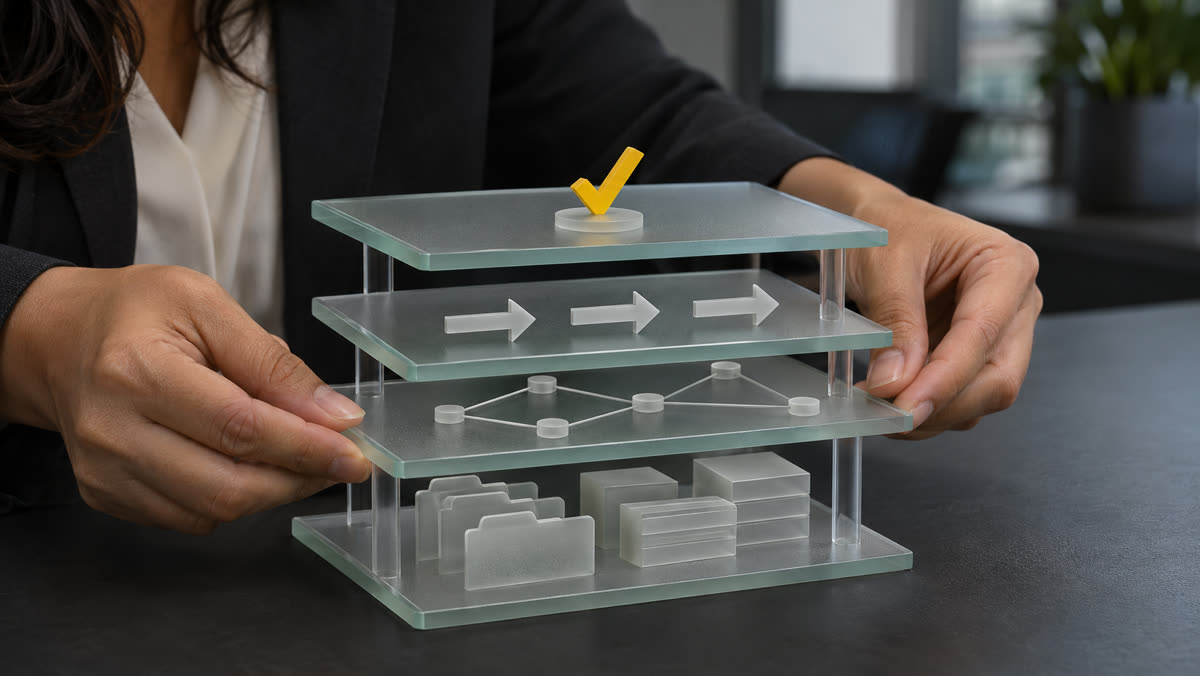
The organization with operational intelligence
In this guide, operational intelligence means using information and AI to understand a situation, support a decision, coordinate action, and check the result.
| Layer | Role | Practical question |
|---|---|---|
| Knowledge | Retrieve reliable records and relevant history | Where is the data, and when was it updated? |
| Intelligence | Connect data, form hypotheses, and compare alternatives | What evidence supports this recommendation? |
| Execution | Take the action using connected tools | What was authorized, and how can you prove it happened? |
| Representation | Explain according to the audience and decision | Who needs to understand this, and in what format? |
| Governance | Define access, approval, recordkeeping, and responsibility | Who is accountable for the decision and can stop the action? |
These layers may be distributed across different systems. A database, a financial ERP (an integrated business management system used in finance), and a communication tool are still useful. You can start with an exported file and a manual test before connecting any systems.
Memory needs to preserve decisions and reasons, distinguish between people and projects, and retrieve the correct version. Also keep the source for each conclusion. An extensive, contradictory history can make the answer worse.

What is each deliverable for, and who is it for?
Before requesting any materials, answer:
- Which person needs to make which decision or take which action?
- What does this person already know, and what do they still need to understand?
- What evidence is needed to trust the proposal?
- What needs to be documented, and what can be a brief conversation?
- How will we find out whether the deliverable was useful?
For executives, a page with alternatives may be enough. For the person doing the work, instructions with criteria and examples are usually more useful. For a client, a visual explanation may be clearer than a table. Ask the recipient whether they were able to take action.
A meeting is valuable when there’s negotiation, conflict, joint creation, or a choice that calls for dialogue. Send the context beforehand. Start the conversation with the pending decision. Close by recording owners, deadlines, and reasons. Relationships and trust also need human time.

The impact on software companies
This project’s thesis predicts pressure on products whose value depends on making people navigate screens and fill in fields. When AI can coordinate this work, customers may question subscriptions, user counts, and the price charged for intermediate tasks.
Scenario: Suppliers that fail to adapt may lose market share or shut down. That doesn’t let us say which companies will fail or when. Difficult integrations, contracts, reliability, and habits can keep applications relevant for a long time.
There are ways to adapt: expose operations to agents with permissions, charge for verifiable results, improve data quality, and solve specialized problems. Established vendors can also lead this change. The existence of solutions like Work IQ shows that the response is already part of the competition.
If you buy software, assess the total cost per process completed: subscription, integration, review, errors, maintenance, and switching vendors. Preserve the ability to export your data. Replace a system only after proving that the alternative covers the function, records, and exceptions.

People, roles, and the preparation army
Manual preparation supports many roles: consolidating information, checking versions, updating records, preparing materials, and following up. When these tasks change, the distribution of work and demand for professionals may also change.
Scenario: Some companies may reduce their teams; others may expand service with the capacity freed up. An automatable task does not mean an entire job can be eliminated. Customer service, judgment, negotiation, accountability, and business knowledge may remain decisive.
A ILO, in its 2025 occupational exposure study, highlights the exposure of administrative occupations and considers job transformation more likely than full replacement. Exposure measures tasks that could be affected; it is not a forecast of layoffs.
Leadership needs to redesign roles together with the people doing the work: uncover exceptions, create time to learn, and monitor quality and workload. Removing a role without preserving the knowledge it carried may simply shift the problem.

How to prepare to think differently
For the professional: Start describing the purpose of your tasks. Learn to provide context, ask for evidence, compare alternatives, and take ownership of the next action. Your knowledge of customers and exceptions helps you evaluate AI. Learning the tool is still useful, but connect that learning to the problem you solve.
For the manager: Choose a repetitive process where errors have little impact and an owner is available. Agree on what you’ll measure and keep the current process in place during the test. Have the team take part in the evaluation. Use evidence to decide whether to expand.
For the business owner: Look for where decisions are delayed, customers are left waiting for a response, or data gets lost. Time saved on preparation can free up capacity. The financial benefit only appears if that capacity reduces actual costs, improves delivery, or creates measurable value.
If you create software or services: Start with the customer’s need. Sell a verifiable deliverable with clear limits. Test how your service handles incomplete data, connection failures, and requests without authorization. The conversational interface is one component of that deliverable.

A 30-day transition plan
The timelines below are a suggested way to organize the work, not a promise of a complete transformation in one month.
| Period | Work | Evidence to move forward |
|---|---|---|
| Days 1–7 | Choose a process, observe how it works today, and record the time and errors | Desired outcome, owner, sources, and baseline described |
| Days 8–14 | Test with fictitious or approved data, without external actions | Each conclusion points to its source; gaps and errors are visible |
| Days 15–21 | Repeat comparable cases with human review and record the full time | At least acceptable quality, with review costs accounted for |
| Days 22–30 | Decide whether to expand, correct, or abandon; only then plan integrations | Decision recorded with results, limits, and an owner for the next step |
Start today: choose a task, write in one sentence the decision it prepares for, and show that sentence to the recipient. Find out whether they actually need the material you produce.

Optimized time: measure without fooling yourself
Measure the entire process, including data searches, preparation, interaction with AI, review, correction, and follow-up. Compare cases with similar levels of difficulty and volume. Keep the poor results, too.
Arithmetic example only: If the earlier process took 120 minutes and the test requires 35 minutes of preparation, 20 minutes of review, and 15 minutes of corrections, the total is 70 minutes and the difference is 50. This is not an observed result from this project. If review and corrections take longer than the earlier process, it hasn’t improved yet.
Time saved does not automatically turn into money. Also measure response time, errors, rework, action outcomes, and recipient satisfaction. Avoid simply speeding up the production of materials nobody uses.

Where the process can fail
| Status | Consequence | Practical response |
|---|---|---|
| Incomplete or duplicate record | Misleading customer list | Show problematic records and review them before making recommendations |
| Vague objective | Polished material that helps no one | Define the recipient, decision, and completion criteria |
| Conclusion without a source | Confidence based on wording | Require a record, time period, and verifiable reasoning |
| Action without an owner or connection | Request sits in chat | Assign an owner and verify actual execution |
| Excessive access | Information or change outside the scope | Start with reading, limit access, and record actions |
| Ignored exception | Automation repeats an error at scale | Test difficult cases and keep the ability to stop and review |
| Dependence on a vendor | Difficulty changing or recovering | Preserve exports, criteria, and decision records |

Are you part of this new world?
You’re in when you can point to the work’s outcome, organize the context, review the proposal, and track what happened. The change shows up in how you operate the business, even before any sophisticated integration.
What preparation takes up your day and could already start with the decision it is meant to support? Use the kit to test a hypothesis and bring the result to the conversation at INEMA.

How the kit helps you make the shift
The transformation begins when you redesign the work that needs to happen. Define the outcome, give the intelligence the context, and establish the decisions and actions it can take on. Data and execution systems remain in the background. The person can devote attention to relationships, creation, opportunities, and exceptions that require judgment.
From process to a new role
- Map the outcome. Use the migration template to explain why the process exists and who needs the outcome.
- Define rules and exceptions. Separate the delegable routine from cases that need a person, with limits and evidence of execution.
- Redesign your role. Identify the preparatory work that decreases and the relationship, opportunity, or responsibility you will develop.
These templates help plan and test the migration. They do not install agents or connect systems. The record-checking exercise remains a specific example of verification; the vision is broader than that exercise.
Example: inventory and relationships
When restocking inventory, the intelligence can monitor the data and carry out the routine within authorized limits. The person negotiates with suppliers and resolves exceptions. In customer relationships, the intelligence can coordinate history and permitted next steps; the person invests time in listening, trust, and new opportunities.
Rule-based automation already existed. The proposed change is to combine rules with an understanding of context and coordination of tools. The benefit needs to be verified for each process, including delivery quality and the human time freed up for other work.
The kit: for anyone who wants to test it in their own work
You don’t need this section to understand what’s above.
Choose a process and run a verifiable test
The kit contains request templates, a process map, time tracking, and a decision log. The example uses fictional data and a local fixed-rule checker. You have the conversation with AI in the tool you already use; this project does not provide a model, integration, or autonomous agent.
First use, no terminal required
- Download the ZIP, extract it, and open the folder kit/en. The .md files are text files: use a text editor.
- Open pedido-por-resultado.md, read the request and attach ../clientes-ficticios.csv in the AI conversation you already use.
- Make the example request, keeping the file names, IDs, and reference date. No CRM connection is needed.
- Compare the response with “How to check without code”. Expected: C001 and C004 are unique candidates; C003 has no date; C004 is a duplicate. This is an analysis of fictional records, with no messages sent.
- Fill in the map for a real process. Use business data only in a tool approved by your organization.
- Record the full time and quality on the form. Decide whether it is worth repeating before automating.
Optional verification with Python
Requires Python 3.9 or later. This command uses only the standard library, works offline, and does not call AI or an API. Open the terminal in the extracted folder, which contains the kit folder.
python3 kit/conferir_exemplo.py
On Windows, with Python installed, use:
py -3 kit/conferir_exemplo.py
To use another file in the same format and an explicit date:
python3 kit/conferir_exemplo.py --arquivo kit/clientes-ficticios.csv --referencia 2026-11-16
Expected output: 2 unique candidates (76 and 46 days), 2 data-entry issues, and 0 messages sent. Conflicting duplicates are excluded from the recommendation. The field modo says “regra fixa sem IA” (fixed rule without AI).
If the command is unavailable, install Python from your system's official distribution or perform the check manually as shown above.
Sources, authorship, and limitations
- Nei Maldaner’s original perspective, document dated 15/11/2026: From software to operational intelligence (in Portuguese).
- ILO — occupational exposure to generative AI (2025). Task exposure is not a forecast of layoffs.
- Microsoft — Work IQ. Description of an organizational context layer, without measuring this project’s productivity.
- Actual result from the local checker (in Portuguese), with entirely fictional records.
Editorial analysis prepared on 16/11/2026. Market forecasts are scenarios; the example is educational. This project did not measure gains at companies.