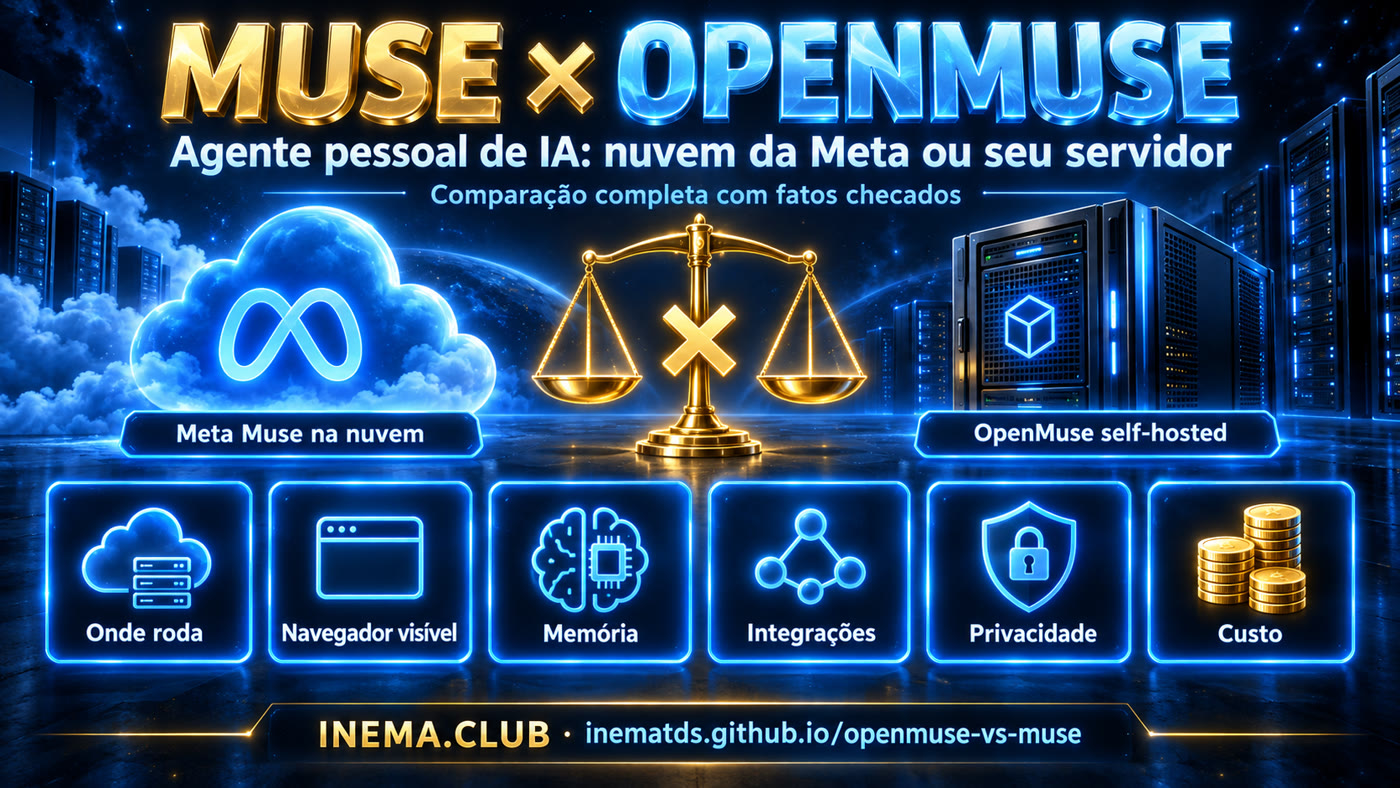
Meta Muse and OpenMuse (CopilotKit, MIT license) promise the same idea: an agent with its own computer and browser that you can watch work. We compare them point by point and check every claim against primary sources.

This page brings together claims circulating on social media about Muse and OpenMuse and checks each one against Meta’s official announcement, press coverage, and OpenMuse’s own code on GitHub.
Personal agent launched by Meta on Sep 8, 2026. Each user gets a dedicated secure VM in Meta's cloud, with a Chromium browser they can watch and take over. Free, $20, and $100/month plans.
Open-source response from CopilotKit, created on 15/Sep/2026, MIT license. Runs on your server: Expo app (iOS/Android/web), Hono API, browser via Playwright, and Linux computer in Docker, both optional. It’s in alpha.
Most of the claims circulating check out. There are significant errors: the US$ 18 deal billion sometimes appears as “millions,” the database cited as “Pika Light” is PGlite, and OpenMuse does depend on an external service.
The difference lies less in the features than in where the agent and its data live and how much work installation requires.
| Criterion | ☁️ Meta Muse | 🖥️ OpenMuse |
|---|---|---|
| Where it runs | Dedicated VM (“Muse Secure VM”) in Meta’s cloud, maintained by Meta | On your laptop or VPS; optional Linux computer in Docker, without root or mounting host folders |
| Browser | Virtualized, visible Chromium; take control whenever you want | Optional worker with Playwright/Chromium, persistent profiles, and “takeover” of the same session |
| Terminal / files | Inside the managed VM | Optional Docker container, 30-second command limit, persistent storage |
| Personalization and memory | Name, avatar, tone; learns from conversations; “forget this” | Editable profile (name, tone, avatar, memories) stored in your database |
| Where the data is stored | Meta’s cloud; Meta says it doesn’t use it for ads | PGlite embedded (or PostgreSQL) on your server. But conversations go through CopilotKit Intelligence (an external service) |
| Integrations | Email and calendar; Meta is targeting payments and shopping | Gmail and Google Calendar via OAuth (your own credentials). Health, banking, and social media are only on the roadmap |
| Voice and hardware | Real-time voice, voice created from a description, “Jolly” avatar, Meta glasses with a wake word (Connect, 23/Sep) | None of that yet; voice is on the roadmap |
| Shopping / money | Buys tickets and products; checkout agents are the stated direction | Read-only finance: imports transaction CSVs and summarizes spending. It doesn’t buy or move money |
| Privacy | Promise: data stays out of ads; “Muse Confidential VM” with a key only the user holds, announced for the end of the year | You control the host and accounts. Exception: conversation persistence in CopilotKit Intelligence |
| Cost | Free + US$ 20 and US$ 100/month | Free code (MIT); you pay for hosting, the language model you connect, and any charges from CopilotKit Intelligence |
| Code | Closed, proprietary | MIT, 2,765★, and 351 forks as of 09/28/2026 |
| Installation | Download the app or go to muse.ai and sign in | Node 24 + pnpm 11.19.0 + CopilotKit key; ~6 commands |
| Maturity | Product launched in the U.S. (iOS, Android, web) | Declared alpha, “for self-hosting and building on top of” |
CPK_INTELLIGENCE_API_KEY “in every mode,” to persist and replay conversations. CopilotKit Intelligence is a separate service and is outside the MIT license. The sample app doesn't need a model, Google account, or Docker, but it also isn't 100% independent of third parties.Each claim was checked against Meta's announcement, the press (TechCrunch, Axios, Washington Post), and the OpenMuse repository, read directly through the GitHub API on 09/28/2026.
| What’s circulating on social media | Status | What the sources say |
|---|---|---|
| Muse launched on 8/Sep/2026 | CONFIRMED | “The world's first personal AI agent built for everyone”. Meta Newsroom |
| Dedicated computer in the cloud | CONFIRMED | The official name is “Muse Secure VM” (also called “Secure Machine”), with visible Chromium and manual control. Meta AI |
| Sneakers, movie theater, trip permission form | CONFIRMED | The same examples appear in the official announcement. |
| Data outside the ads; confidential VM | CONFIRMED | “Muse Confidential VM,” with a key only the user controls, is promised for the end of the year: it's a promise, not an available feature. |
| Free + US$ 20 and US$ 100/month | CONFIRMED | US, iOS, Android, and muse.ai; glasses “coming soon.” Axios |
| Connect: voice, “Jolly,” glasses | CONFIRMED | Meta Connect on Sep 23, 2026, 15 days later. TechCrunch |
| $18 billion agreement | INCORRECT | That’s US$ 18 billion (29 states, Aug 26, 2026). Some cite “18 million.” TechCrunch |
| Muse requests access to health and payments | UNVERIFIED | Email and calendar are covered. We found no primary source listing health and payments as permissions. |
| OpenMuse is MIT-licensed and from CopilotKit | CONFIRMED | CopilotKit/openmuse, created on Sep 15, 2026. |
| 2,100★, 230 forks, 22 branches | OUTDATED | As of 09/28/2026: 2,765★, 351 forks, 22 branches, 54 commits. The numbers circulating are outdated: the repository has grown. |
| Successor to “Open Bot” | CONFIRMED | CopilotKit/OpenBot. The OpenBot adapter is in the code, but disabled by default. |
| Stack (Expo, Hono, Playwright, Docker) | CONFIRMED | Matches the README, including SQL leases, a rootless container, and a 30 s limit. |
| “Pika Light” database | WRONG NAME | É o PGlite (@electric-sql/pglite), with the option to use PostgreSQL. |
| Features (Ideas, goals, PDF, finance, Gmail) | CONFIRMED | The README's feature table matches item by item. |
| Alpha; health, banking, and voice on the roadmap | CONFIRMED | The roadmap also includes executable tools generated by the agent and automatic reservations/payments. |
| Node 24 + pnpm 11.19.0, “4 commands” | PARTIAL | pnpm checks out. The README asks for Node 24 LTS (the package.json agrees ≥22). The quickstart has 6 commands, including logging in to CopilotKit. |
| “No external service” in the basics | DIVERGENT | The model, Google, and Docker are optional, but a CopilotKit Intelligence key is required in every mode. |
Commands taken from the official README (09/28/2026). Since the project is in alpha, check the repository first because the steps may change.
Node 24 LTS, pnpm 11.19.0, and a CopilotKit account, required for the Intelligence key.
node -v # v24.x corepack enable && corepack prepare pnpm@11.19.0 --activate
Install with the lockfile frozen to reproduce the project’s exact versions.
git clone https://github.com/CopilotKit/OpenMuse.git openmuse cd openmuse pnpm install --frozen-lockfile cp .env.example .env
This is the step that is often left out. The key stays only on the server, in the .env.
npx copilotkit@latest login npx copilotkit@latest project select # paste the generated key into .env: CPK_INTELLIGENCE_API_KEY=...
You’ll need two terminals. The sample app runs without a model, a Google account, or Docker.
pnpm dev # terminal 1: API + task worker pnpm dev:web # terminal 2: web interface
Three demos use a test inbox and don’t touch anything real: fill out a trip permission form (generates the PDF and drafts the reply), create a goal that monitors a page, and import sample transactions to see the spending summary.
The real browser requires Chromium and a token that protects the connection. The Linux computer runs in Docker.
pnpm dev:browser # Playwright/Chromium worker COMPUTER_ENABLED=true pnpm dev # connects a Linux computer in Docker
In .env: WORKSPACE_MODE=live, OPENMUSE_ACCESS_KEY (24+ random characters) and TOKEN_ENCRYPTION_KEY (32 bytes in base64), plus Google OAuth credentials. Then restart the API.
openssl rand -base64 32 # value for TOKEN_ENCRYPTION_KEY
The conclusion circulating holds up: OpenMuse matches the central idea of Muse, but not yet its polish or reach.
.env, Docker, and the CopilotKit key.Dates verified against the sources. The last row is OpenMuse’s stated roadmap, meaning intent, not delivery.
The complete list, with the status of each claim, is in docs/VALIDACAO.md in the repository.