Open kit for consultants · restaurants, hotels, clinics, salons

Find where the business is losing money

Don't sell AI or another app. Show the owner, in dollars, what is leaking out, fix it and prove what came back. A lead hunter built on open data, an X-Ray with a PDF report, fix playbooks and measurement — all in the browser, nothing to install.

Margin X-Ray: find where the business is losing money and win it back
What it is

One tool for each stage of the sale

The question stops being "do you need AI?" and becomes "where is the money you already earned going?". The kit covers the whole path, from first lead to monthly retainer.

Lead hunter, X-Ray, playbooks and measurement

🎯 Lead hunter

Lists the businesses in a city or neighborhood from open data (OpenStreetMap anywhere, plus your country's business registry as a CSV), reads each one's own website and scores who already has demand and is leaking money. Writes the outreach message for you.

🩻 X-Ray

Filled in with the owner in 40 minutes: prices each leak in $/month (as lost margin, not revenue), ranks them from quickest to hardest fix and prints the report "you are leaving $X on the table every month".

🔧 Playbooks + measurement

For every leak, a fix guide with a ready-made (SaaS) path or an open-source one, a checklist and how to measure before × after — the evidence that backs a recurring fee.

Sectors and markets

Each sector is a data pack (questions, formulas, how much is recoverable, how to measure). Each language is a separate market, with its own platforms, payments and rules.

Sector🌐 Global (EN)🌎 Latin America (ES)🇧🇷 Brazil (PT)
RestaurantDoorDash, Uber Eats, Grubhub, Deliveroo, Just Eat · card processingRappi, DiDi Food, Uber Eats · CoDi/DiMonational delivery apps · instant payments
Hotel / guesthouseBooking, Expedia, Airbnb · no rate parity in the EEA (DMA)Booking 15/18/23% · no parity in ChileBooking, Airbnb
Clinic / practiceno-shows, claim denials, Zocdoc new-patient feesno-shows, insurersno-shows, health-plan denials
Salon / barbershoprebooking, membership · Fresha, Booksy Boostreturn within the cycle, clubreturn within the cycle, club
Appointment services (generic)default model for any appointment-based business — the profiles above inherit from it
How it works

From lead to recurring revenue

Start with the quickest leak (often card processing or no-shows): it pays for the setup and earns the trust you need for the rest.

Hunter→ Outreach→ X-Ray with the owner→ Proposal→ Playbooks→ Measurement→ Monthly fee

Restaurant leaks

Delivery apps charging 15–30% again for customers who are already yours, card processing above market, cash advances, customers who never come back, low average check, waste, buying without quotes, menu mix, repetitive staff work, ads and cash planning.

Hotel leaks

OTA commission on repeat guests, visibility programs that don't pay for themselves, empty rooms in low season, guests who never return, extras nobody offers, uncharged no-shows, card fees and cash gaps.

Service business leaks

No-shows, slots never booked, clients who don't rebook on time, booking marketplaces charging for clients you already have, add-ons, card fees — and in clinics, claim denials and treatment plans that never start.

Requirements

Almost nothing

The X-Ray and the Hunter run in the browser, even offline. Your client's numbers never leave your machine.

Use the app

Just a browser. Online through GitHub Pages, or download the repository and open the file.

# online
https://inematds.github.io/raio-x-margem/app/?lang=en
# or locally
git clone https://github.com/inematds/raio-x-margem
open raio-x-margem/app/index.html

Collect leads

Python 3 and Node, no extra libraries. The OpenStreetMap collector queries the public Overpass API, one request at a time — nothing big to download.

python3 --version   # 3.10+
node --version      # 18+

Optional

Website/Instagram search through Firecrawl (uses paid credits, only with --confirmar) and an AI review of the signals through your subscription CLI (claude or codex), no API key needed.

export FIRECRAWL_API_KEY=...   # optional
claude --version            # optional
Guide · step by step

From a neighborhood to a report in 8 steps

Example: restaurants in Austin, Texas. Swap the city and the sector (alimentacao = food, hospedagem = lodging, servicos = clinics and salons) for your own market.

1

List the businesses with open data

OpenStreetMap works worldwide. City and district boundaries use different admin_level values per country (US cities are usually 8; check the boundary on openstreetmap.org) — adjust with --nivel-cidade / --nivel-bairro. If your country publishes a business registry (UK Companies House, France SIRENE, Australia ABN, Canada's open business data), export your area as CSV and merge it with the map data (or import it straight into the Hunter). Dedicated registry collectors per country are on the roadmap. Or all at once: the Collect screen (python3 coletor/servidor.py) or bash coletor/rodar.sh — lists, merges, ranks by storefront name and enriches.

mkdir -p dados                                     # working folder, kept out of git
python3 coletor/osm.py --cidade Austin --setor alimentacao --saida dados/osm-austin.json
# optional: merge a registry CSV export without duplicates
node coletor/juntar.js dados/osm-austin.json dados/registry-austin.csv > dados/leads-austin.json
2

Enrich by reading each business's own website

Own online ordering? Text/WhatsApp link? Loyalty program? Links to delivery apps? The script reads each site respecting robots.txt; an optional AI review through your subscription double-checks the signals.

python3 coletor/sitios.py --entrada dados/leads-austin.json --saida dados/leads-austin-enr.json \
  --setor alimentacao --limite 30 --ia claude      # --buscar firecrawl --confirmar to find missing sites
3

Import into the Hunter and check by hand what platform terms forbid collecting

Google rating and reviews, an active Instagram and presence on delivery apps are checked with one click (the screen opens the search for you). The score only counts what was checked; the light bar shows the ceiling. A registry CSV is read directly: common English and Spanish headers (name, city, address, phone, website, rating, reviews…) are recognized.

app/cacador.html?lang=en  →  Import leads  →  dados/leads-austin-enr.json
4

Reach out with the generated message

It only mentions what was verified ("4.8 stars from 3,000 reviews…") and offers a free 40-minute diagnosis. Track each lead's status until the X-Ray. Follow the B2B outreach rules of your country (see the box below).

Copy message  →  Open X-Ray for this lead
5

Run the X-Ray with the owner

With the delivery-app and card-processor statements open. An empty field means "don't know": it stays out of the total and goes onto a list of data to collect. Packs default to USD with a US example. Save the diagnosis (.json) — that is your "before" baseline.

app/index.html?lang=en&setor=restaurante-global  →  Print report / PDF  +  Save diagnosis (.json)
6

Send the proposal

Three playbooks at most, starting with the quickest. The X-Ray’s Build proposal button turns the client’s numbers into a proposal and suggests prices within the rule: implementation spread over 6 months + retainer ≤ 1/3 of the recoverable amount. Contract and data-processing templates exist for Brazilian law only — have local counsel adapt them.

app/proposta.html?lang=en  →  Print / PDF   # sales kit texts in kit-comercial/, in Portuguese
7

Implement the playbook

Every playbook has a ready-made (SaaS) or open-source path, a checklist and what not to do — for example, never use a delivery app's order flow or packaging to pull its customers to your own channel when its terms forbid it.

docs/en/modulos/  cardapio-vivo · aquisicao · cobranca · marketing-local · canal-proprio · servicos-agenda · hotel-*
8

Measure and bill monthly

The report already includes "how we will measure" for every leak: baseline, metric after and time window. Charge a performance bonus only on what can be attributed (card processing fees, for example). The Recovery Dashboard opens the saved diagnosis, takes each month's numbers and shows, leak by leak, how much came back and how far you are from the target.

app/painel.html?lang=en  →  Open diagnosis (the .json from step 5)  →  Add month  # before × after, % of target, cumulative and bonus

⚖️ Within the rules

The kit does not scrape Google Maps, Instagram or delivery apps (their terms forbid it), never uses customer contacts passed on by a marketplace and only keeps business data. B2B prospecting rules vary: in the EU, GDPR legitimate interest plus national ePrivacy rules; in the UK, PECR lets you email corporate subscribers but treats sole traders as individuals; in the US, CAN-SPAM covers B2B email (clear opt-out); Canada's CASL is stricter. Messaging the business's own customers needs consent (TCPA in the US, PECR soft opt-in in the UK, GDPR in the EU). Health data is a special category (HIPAA, GDPR): a reminder should not reveal the procedure. Details in docs/TERMOS.md (in Portuguese) and docs/mercados/global-pesquisa-2026-10.md (research notes, in Portuguese).

Sources and limits

We could scrape it — and why the kit does not

Open-source tools exist to scrape Google Maps and Instagram. The kit does not use them: platform terms forbid it and the risk falls on you and your client. Each source has a route that gets the same information without breaking the rules.

Order of preference: 1) data from the owner (exported from their own dashboard) · 2) official open registries and OpenStreetMap · 3) indirect signals (the business’s website links its apps, Instagram, booking engine) · 4) official API with authorization · 5) assisted check (~1 min per lead, top prospects only).

SourceWould giveWhat forbids itInstead
Google Mapsrating, reviews, phone, hoursMaps Platform Terms 3.2.3 (no scraping)check in the Hunter · Places API (place_id only) · owner’s Business Profile
Instagramactivity, posts, followersInstagram and Meta terms (automated collection)@ from the website · manual check · Business Discovery API · owner’s Insights
Delivery appspresence, rating, priceseach app’s termslink on the restaurant’s site · web search · partner-portal reports
Booking sitespresence, rating, pricesBooking A15.2, Airbnb 11.1, Tripadvisortourism registries · hotel website · OTA extranet with the owner

Automatic collection, all from open sources: the Collect screen (run python3 coletor/servidor.py) or one command: bash coletor/rodar.sh --setor restaurante --uf PR --cidade Curitiba. Registry collectors currently cover Brazil; elsewhere use OpenStreetMap plus a CSV from your local registry.

Full report: Sources and limits

Examples

What the global packs calculate

Every pack ships with a worked US example in USD (the "Fill in example" button). The numbers below come straight from those examples; replace them with the owner's. The first field pilot ran in Brazil.

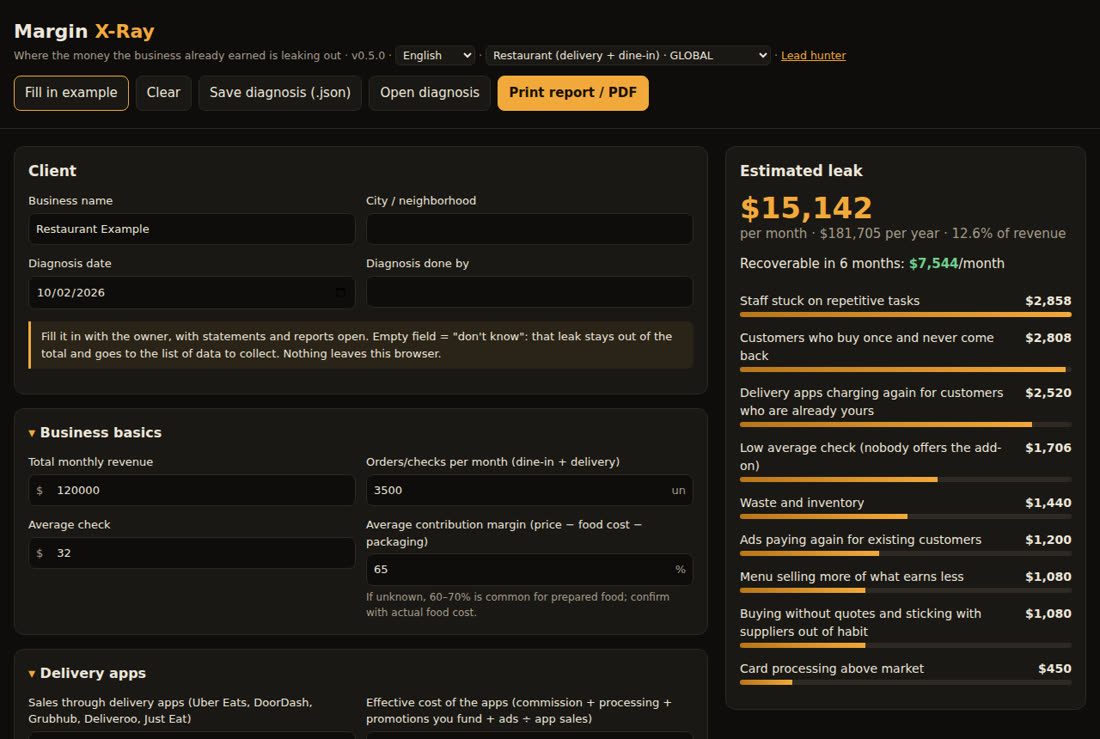
X-Ray filled in with the US restaurant example
X-Ray with the US restaurant example: $15,142/month leaking across 9 points, ranked by priority.
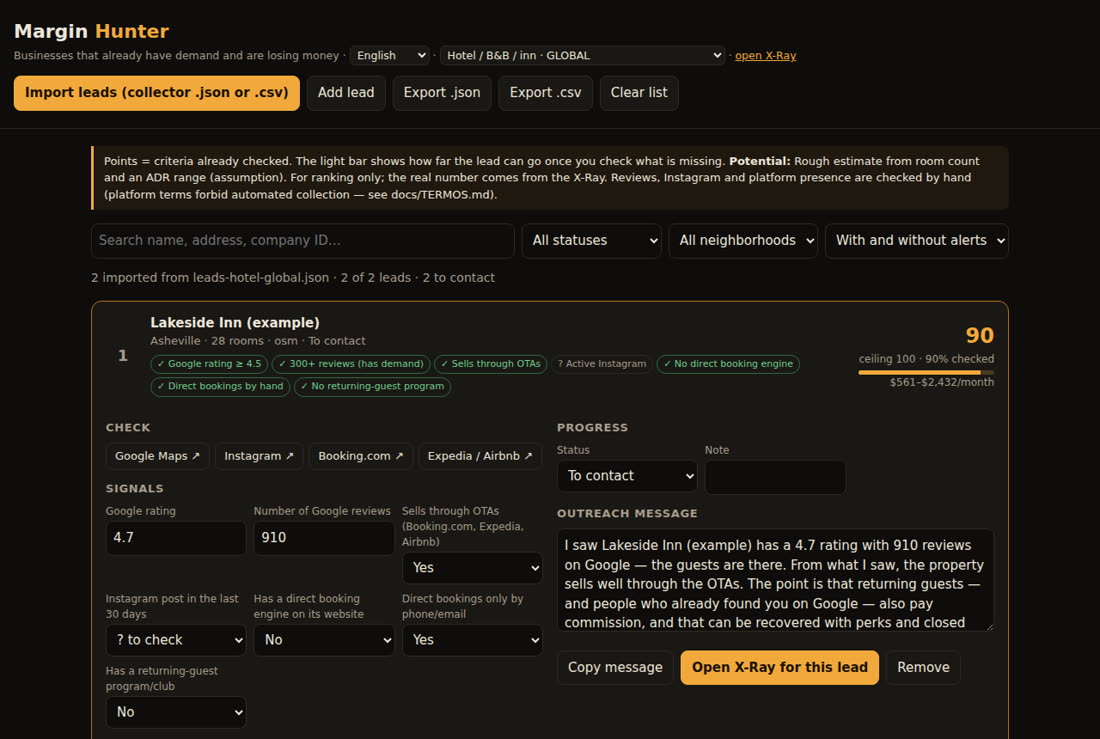
Margin Hunter with a hotel lead scored
Hunter in the hotel sector: score, verified signals, potential by number of rooms and a ready outreach message.

Restaurant · $120k/month

11 possible leaks; the example totals $15,142/month (12.6% of revenue), $7,544 of it recoverable. Biggest items: repetitive staff work ($2,858), customers who never come back ($2,808) and delivery apps charging again for regulars ($2,520).

Hotel · $150k/month

$18,038/month leaking (12.0% of revenue), $9,273 recoverable. Empty rooms in low season ($6,552) lead, then guests who never come back ($3,744) and a front desk quoting by hand ($1,732).

Clinic · $80k/month

$16,532/month leaking (20.7% of revenue), $7,848 recoverable — mostly slots never booked ($5,400), treatment plans that never start ($3,600) and no-shows ($3,402). Salon and generic-services packs follow the same model.

Roadmap

What exists and what's next

Current version: 0.8.1 — 15 packs (5 sectors × 3 markets), 60+ automated tests.

Done
X-Ray, Hunter and collectorsRestaurant, hotel and appointment services (clinic, salon) for the Global (EN), Latin America (ES) and Brazil (PT) markets; OpenStreetMap and website collectors that work anywhere.
Done
Proposal builderBuilds the proposal from the saved X-Ray in English, Spanish or Portuguese: scope by priority, prices within the 1/3 rule, payback, measurement plan and terms.
Done
Collect screen and rodar.shOne command or one form per neighborhood and sector: lists, merges, ranks and enriches, then opens in the Hunter. Shows the sources that could be scraped, why not, and the alternative route.
Done
Recovery dashboardOpens the saved diagnosis, takes each month's numbers and shows before × after per leak, % of target, cumulative recovery and a bonus only on what can be attributed.
Next
Registry collectors per countryCompanies House (UK), SIRENE (France), ABN (Australia) and DENUE (Mexico), filtered by industry code and area.
Later
More niches and a full sales kit in EnglishGyms, pet shops, auto repair, vacation-rental managers; proposal template, contract and data-processing terms.