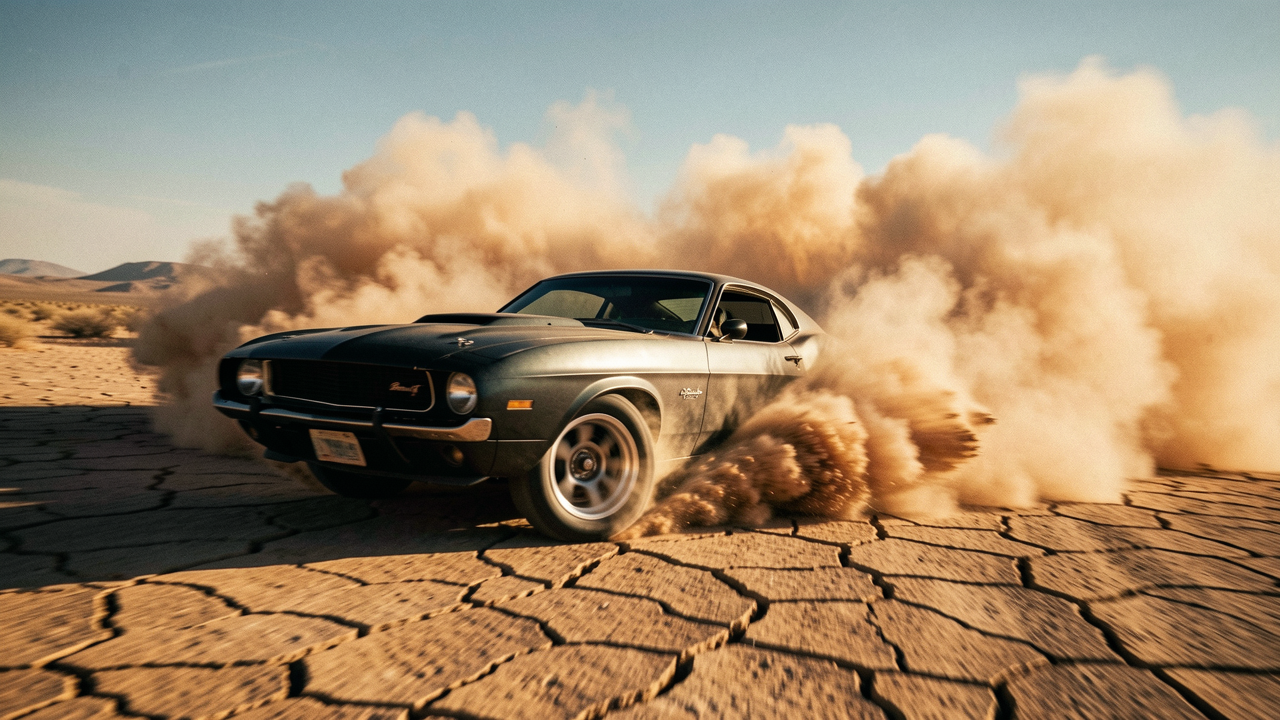
🎯 The Anatomy of Action
Remember: action isn’t just movement. A strong action scene creates Danger + Movement + Anticipation + Reward. The audience should always be wondering: "How will this end?".
💡 Golden rule
One strong visual idea = one great action scene. Don’t pile on effects — find the concept that catches the eye.
🚗 Mechanic 1 — Flying Transformation
Mechanics: transformation + scale. A car jumps off a collapsing bridge and suddenly transforms into a flying machine.
Why it works
The audience expects a collision, but gets a surprise and a revelation of power. The broken expectation is what delivers the spectacle.
Formula
Danger + Surprise + Change in Scale = Spectacle.
🚙 Mechanic 2 — Realistic Urban Chase
Mechanics: near miss. A muscle car nearly loses control and barely escapes amid tight traffic.
Why it works
A great action scene feels almost out of control. The imminence of disaster — not the disaster itself — sustains the tension.
Formula
Speed + Loss of Control + Near Miss = Tension.
💥 Mechanic 3 — SUV Rollover
Mechanics: controlled catastrophe. An SUV crashes, flips violently, and somehow survives.
Why it works
The audience loves the combination of pure chaos and survival. Maximum destruction with one survivor is cathartic.
Formula
Impact + Chaos + Survival = Adrenaline.
🎬 Slow motion in service of the action
Rollovers and impacts feel weightier when filmed in slow motion: overcranking stretches the critical instant and lets the audience feel every fraction of the catastrophe.
🏃 Mechanic 4 — Parkour Escape
Mechanics: height + movement. A runner leaps between rooftops, slides, and catches the edge at the last second.
Why it works
The real enemy here is gravity itself. The audience feels the void beneath the character with every jump.
Formula
Height + Momentum + Near-Fall = Suspense.
🌉 Mechanic 5 — Bridge Rescue
Mechanics: countdown + rescue. A bridge is actively collapsing as a motorcyclist saves someone seconds before disaster strikes.
Why it works
The human brain is wired to love countdowns, danger, and last-minute rescues.
Formula
Countdown + Danger + Rescue = Emotional Action.
🎯 The Final Formula and the Key Rule
All five mechanics boil down to a single equation: Risk + Movement + Near-Failure = Cinematic Action.
✓ The scene works when
- ✓The audience thinks, "He almost didn't make it"
- ✓There’s real risk and clear movement
- ✓The near failure comes before the reward
✗ The scene fails when
- ✗There’s movement, but no perceived risk
- ✗The outcome was never in doubt
- ✗Effects piled up without a central visual idea
🔑 Key rule
If the audience really thinks "He almost didn't make it" — your scene works.
📝 Task — Three Original Action Scenes
Create 3 original action scenes, each about 5 seconds long. For each scene, write:
- 👁️The Visual: what does the audience see?
- ⚙️The Mechanics: which lesson mechanic/formula is used?
- 🧠The Logic: why does this work as efficient action?
📌 Module Summary
Next:
Track 7 — Production and Career (visual storytelling, portfolio, and market).