🧭 Intention Before Aesthetics
The golden rule of this framework is simple: create prompts with intention and emotional change, instead of empty aesthetic words. Stacking "cinematic, 8k, beautiful lighting" isn't enough — what makes a sequence work is the arc: each scene changes something in the audience’s emotional state.
🎯 The 5-scene arc
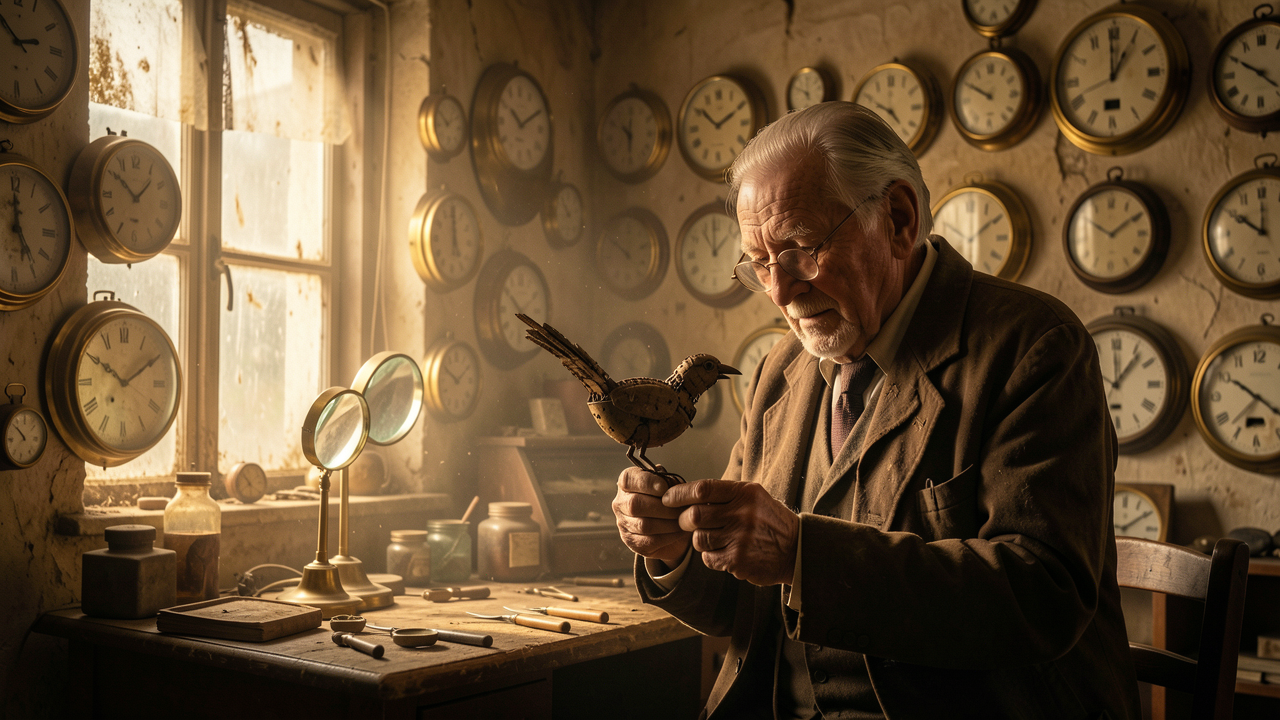
To follow the rule, we’ll follow the story of the watchmaker and the mechanical bird through five stages, each with its own objective, camera behavior, and emotion:
- 1️⃣Setup — establish the world · calm curiosity
- 2️⃣Conflict — introduce the change · uncertainty and concern
- 3️⃣Escalation — increase the pressure · urgency
- 4️⃣Emotion — build connection · relief and empathy
- 5️⃣Resolution — end with meaning · hope
💡 Practical tip
The build-up is the peak of tension; the emotion is the breath right afterward. Don’t end at the peak—the emotional turn and resolution are what give the whole sequence meaning.
1️⃣ Setup — Establish the World 🌍
A wide shot with a slow pan across an old, dusty, dimly lit watchmaker’s workshop. Hundreds of brass clocks keep time in unison on the walls. An elderly man wearing magnifying glasses carefully polishes a gear on his wooden workbench. The atmosphere is calm, orderly, and nostalgic. Soft, warm light comes through a dirty window.
2️⃣ Conflict — Introduce the Change ⚠️
Here you introduce new information and changes the sense of security to concern. The synchronized ticking breaks — and with it, the peace of the previous scene.
A medium tracking shot following the elderly watchmaker as he stops working. The synchronized ticking suddenly breaks. He looks down at a small, rusty mechanical bird on his table. The bird’s gears grind painfully, faint sparks come from its chest, and its artificial eyes flicker and dim. The man’s expression shifts from calm to deep concern.
3️⃣ Escalation — Raise the Pressure 🔥
The sequence’s tension peaks. Increase the danger, risk, and tension — unstable handheld camera work amplifies the desperation of trembling hands.
A tighter medium shot of the watchmaker’s trembling hands as he frantically tries to replace a broken mainspring inside the mechanical bird. Smoke begins to rise from the bird’s delicate gears. The clocks in the background begin to chime irregularly, adding to the chaos. The man is sweating, his movements quick and desperate as the bird’s movements slow almost to a stop.
4️⃣ Emotion — Create a Connection ❤️
After the peak, slow down and let the audience feel the turning point. The tight close-up and the slow tilt from the hands to the bird turn despair into relief.
An extreme close-up of the elderly man’s eyes, wide with emotional intensity, reflecting a faint glow. The camera slowly tilts down to the mechanical bird in his hands. A new golden gear clicks perfectly into place. The smoke dissipates, the bird’s eyes glow with a warm, steady light, and its chest begins to rise and fall gently like a heartbeat. The man exhales deeply, his face softening with profound relief.
5️⃣ Resolution — End with Meaning 🌅
Return to a wide shot — but show how the emotional landscape changed completely. The same room from the Setup, now bathed in golden light and hope.
A wide shot of the workshop, slowly pulling back through the window. The elderly watchmaker sits peacefully at his workbench, watching the mechanical bird open its brass wings and sing. The chaotic ticking of the other clocks fades into the background. The morning sun breaks through the window, bathing the room in hopeful golden light. He is no longer just a lonely craftsman; he is a life-saver.
🎞️ The complete sequence, at a glance
💡 Director’s Checklist for Kling AI
Two tweaks make Kling follow the story instead of inventing random visual flourishes.
Creative Relevance
Set up around 0.5 – 0.6 to ensure it follows the narrative action closely, instead of inventing random visual flourishes.
Camera Movement
Let the prompt text dictate the camera behavior, for example: "wide slow pan", "tight close-up", because Kling responds very well to structural camera phrases.
✓ Structural camera phrases
- ✓wide slow pan
- ✓medium tracking shot
- ✓handheld, urgent
- ✓extreme close-up, slow tilt down
- ✓wide payoff, slow pull-back
✗ Avoid
- ✗Stacks of aesthetic words without intent ("epic, 8k, masterpiece")
- ✗Very low relevance — the model improvises and strays from the story
- ✗Five different cameras in the same scene
- ✗End at the peak of tension, with no twist or resolution
💡 Reuse the framework
The Setup → Conflict → Escalation → Emotion → Resolution structure works for any subject. Swap the watchmaker and the bird for your own story—keep the emotional arc and the structural camera phrases.
📝 Task — Your 5-Scene Framework
Choose a story theme and write your own sequence of 5 prompts for Kling, following the framework.
- 1️⃣Setup: establish the world with a wide shot and calm emotion.
- 2️⃣Conflict: introduce the change and break the sense of security.
- 3️⃣Escalation: build tension with urgent handheld camera movement.
- 4️⃣Emotion: slow down in a close-up for the turning point.
- 5️⃣Resolution: return to the wide shot showing the transformed emotional landscape.
- 🎚️Adjust: run it in Kling with creative relevance at 0.5–0.6 and structural camera phrases in every scene.
📌 Module Summary
Next step:
You completed the available content in Track 7. Modules 7.2 to 7.6 (Portfolio, Pitch, Monetization, Client & Market, and Career) are in development.