DICA 1 · Diagnosis: the Client Map|INEMA.CLUB-PRO

Lesson 2 · 20 min

The interview with the owner: prepare in 20 minutes, the 15 questions, the silence

The diagnosis has already been agreed on; now comes the conversation that decides whether it will be a good one. You show up prepared, ask to record and say what it's for, ask 15 questions always in the same order, and let the owner talk. The real pain shows up in a case from last week, almost never in the first answer.

Start the lesson
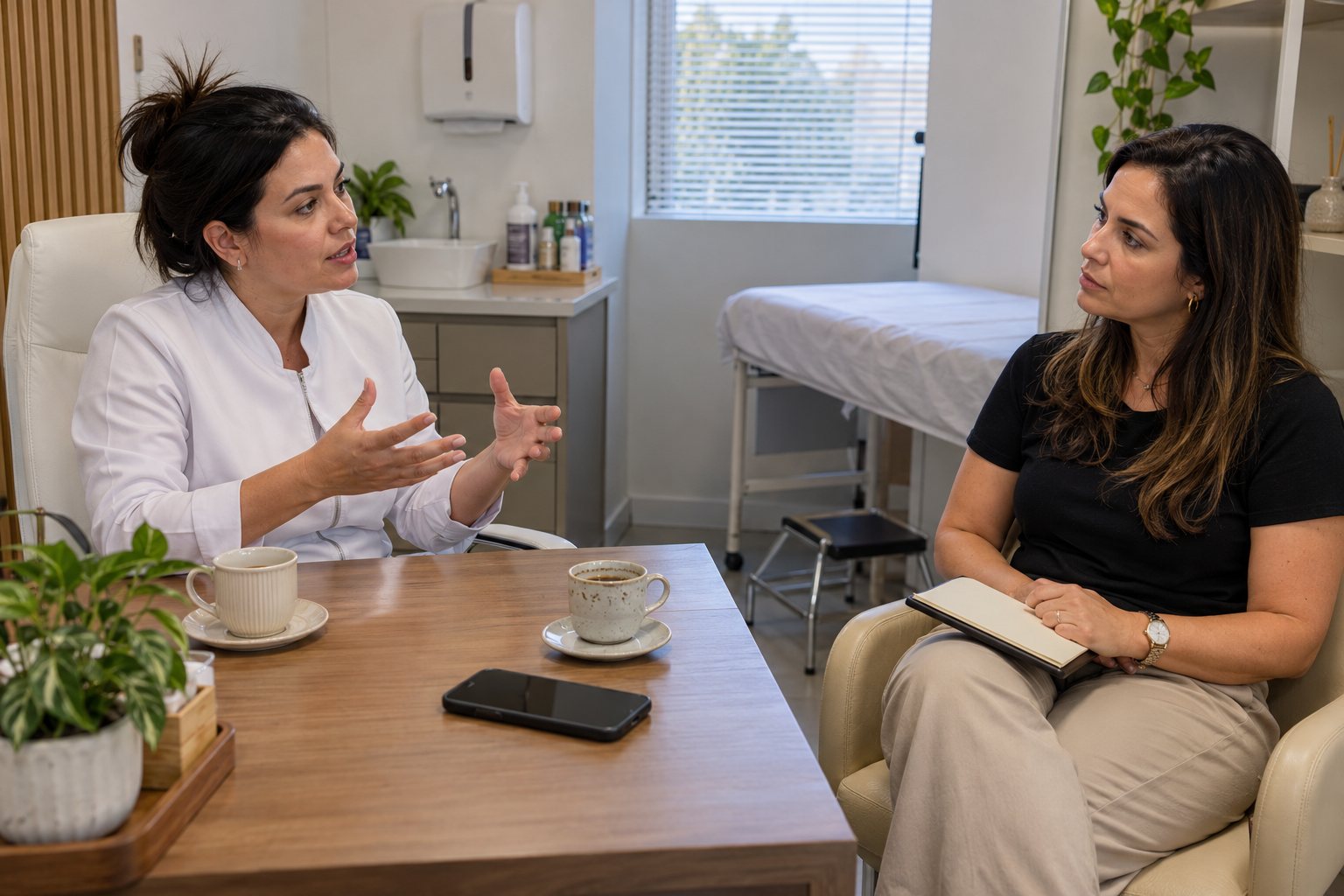
A clinic owner talks with her hands while the consultant listens with a notebook on her lap.

In this lesson you will

  1. 1Prepare for the conversation in 20 minutes
  2. 2Ask to record, stating the purpose, the tool, and the deadline
  3. 3Ask the 15 questions in 5 blocks and use silence
  4. 4Practice in a mock interview with the clinic owner

Goal: run the diagnosis interview with the 15 questions, ask for recording with clear consent, and tell real pain from false pain.

01The path of the interview

Five moments, always in this order. Click each one.

Click each block in the diagram to see what it does.

This is the delivery interview. The call that sells the diagnosis is a different one and is covered in Selling with AI 2.

02Question blocks and the pain test

Three questions per block, in 5 blocks. The order matters more than the wording.

1. Context and flow

Start with what the owner likes to talk about: what the business does, how it started, who is on the team.

Then the customer's path, from first contact to payment, and what stalls when the owner isn't there.

03Templates for the interview

Copy them, adapt them to the niche, and bring them printed. Swap whatever is between < > for your own details.

roteiro-15-perguntas.md
# Diagnostic interview — <business> — <date>
# Preparation (20 min): 3 pain hypotheses + 2 specific questions
Hypotheses: 1) <...> 2) <...> 3) <...>
Specific questions: a) <...> b) <...>

## Block 1 — Context
1. Tell me in one sentence what <company> does and who it's for.
2. How long have you been in business? How did it start?
3. How many people are on the team today? What's your role day to day?

## Block 2 — Flow
4. Walk me through the path of a <client/patient> from the moment they find you until they pay.
5. Which channels do they use to reach you? How many messages come in on a normal day?
6. When you're not there, what stops?

## Block 3 — Bottleneck
7. What's the most annoying thing about your week, the one you wish you didn't have to do?
8. Where do you lose <client/patient>: before, during, or after the service?
9. Is there any task you redo every week?

## Block 4 — Dream
10. 12 months from now, what needs to be different for you to be satisfied?
11. If you gained a few free hours a week, what would you use them for?
12. What kind of <client/patient> would you like to have more of?

## Block 5 — Fear
13. Have you ever tried a technology that didn't work out? What happened?
14. What worries you when you think about AI serving your <client/patient>?
15. Who else needs to agree for us to move forward?

## Exact phrases (write them down in quotes)
- "<...>"
## Numbers they mentioned / that we are going to count
- <...>
consentimento-gravacao.txt
Before we start: may I record our conversation?
It's just so I don't miss a single thing you say when I put the report together.
- Who listens: only me (and the transcription tool processes the audio).
- Tool: <tool name> will turn the audio into text; <does or doesn't keep the audio; does or doesn't use it for training>.
- Where it's kept: <folder/account>, not shared with anyone.
- When I delete it: the audio after <N> days; the text stays only until the report is delivered.
One request: please don't say any patient's or client's name; say "a patient," "a client."
If you'd rather I not record, no problem: I'll take notes by hand.
May I record?

[record] Consent given on <date, time>, by <name>, for <purpose>.
encerramento.txt
Summary: "Let me give back to you in 3 sentences what I understood: <1>, <2>, <3>."
Validation: "Is that right? Is anything important missing?"
Delivery: "In <N> business days I'll show you a page with what I found and a recommendation."
Schedule: "What's your next free time slot so I can present it to you live?"
Task: "Until then, the front desk will mark on a sheet of paper <what we're going to count>, all right?"
Simulation: illustrative example
  • The script has the 15 questions with the words of the niche (patient, buyer, client).
  • The consent states the purpose, the tool, where it's kept, and when it's deleted.
  • The closing has a date for the follow-up and a counting task, when a number is missing.

04Simulated interview: the owner of Vila Serena

This is a simulated, fictional conversation, for practice. Choose what you would say; the comment appears right after.

Owner of Clínica Vila Serena (fictional)physical therapy and aesthetics · 9 people

Choose your answer. The feedback appears right after, and the conversation continues based on your choice.

    05Practice: your script

    Use Vila Serena (fictional) or a real business that has authorized you.

    E1 · Script adapted to the niche

    20 min

    Copy the 15-question script and swap the words for the niche's vocabulary (patient, student, buyer). Fill in the 3 hypotheses and the 2 Vila Serena-specific questions.

    Done when: the script has the 15 questions in the 5 blocks, in order, with the niche's vocabulary and the hypotheses filled in.

    E2 · Consent script

    10 min

    Adapt the consent script with the tool you actually use and a deletion deadline you will actually keep.

    Done when: the script states the purpose, the tool, where it is stored, and when it is deleted, and it has the line for recording consent.

    E3 · Simulated conversation

    10 min

    Do this lesson's simulated interview until you reach the "Diagnosis with a foundation" ending.

    Done when: your best score in the simulated conversation is the maximum number of points.

    06Test what you learned

    Question 1 of 4

    Why does the fear block come last in the interview?

    07Summary

    Prepare and ask20 minutes of research, 3 hypotheses, 2 specific questions. In minute 1, consent with purpose, tool, and retention period.
    Order and silence15 questions in 5 blocks, dream before fear. Repeat their word and wait.
    Case, number, dateReal pain has a recent case and a size. A missing number becomes a count. The conversation ends with the debrief on the calendar.

    Going further

    Previous lessonNext lesson