Organize digital roles, responsibilities, and autonomy. Track decisions, evaluations, and improvements in a lab that runs in your browser.

The first version works with local data and fictional scenarios. It does not run models or access CRM, ERP, or email. Real integrations have a separate technical plan.
Define an objective, a human owner, steps, and a target. Give each agent a mission, inputs, deliverables, and limits.
Simulate normal situations and exceptions. Record human decisions and check the promotion criteria for each version.
Compare expected and produced results, track metrics, and document experiments in the LOOP-R cycle.
Start with a single process. The supervisor and integrations are part of the future architecture; the lab already lets you design and practice management.
To try the published version, all you need is a modern browser. To edit the code locally, use Git, Node.js 22.12+ or 24+, and npm.
Open the tool. Data stays in this browser and on this origin; export a JSON copy to save your work.
node --version npm --version git --version
The sales qualification example is fictional. Use it to learn the workflow, then add your own scope using anonymized data.
Use the “Open tool” button. To run a local copy, execute:
git clone https://github.com/inematds/gestoria.git cd gestoria npm install npm run dev
In Processes, create an operation with an objective, owner, steps, volume, current time, and target. Start with a narrow scope, such as preparing sales qualification.
In Workforce, record the mission, inputs, output, owner, and what the agent can and cannot do. Tools, model, and Skills are metadata planned for this version.
In Overview, choose a process and simulate a routine, conflicting data, or a request outside the policy. In Human Decisions, approve it or send it back with a reason.
Record the expected result, the result produced, and the human classification. Check the agent profile: educational promotion requires 100 cases from the current version, the target met, no critical errors, and all pending items resolved.
In Continuous Improvement, record the problem, hypothesis, and test. Add evidence to validate and promote an experiment. Changing the agent creates a new version and requires a new evaluation.
In Lab Data, export the JSON copy. Importing replaces the current records after confirmation. There is no account or syncing between devices.
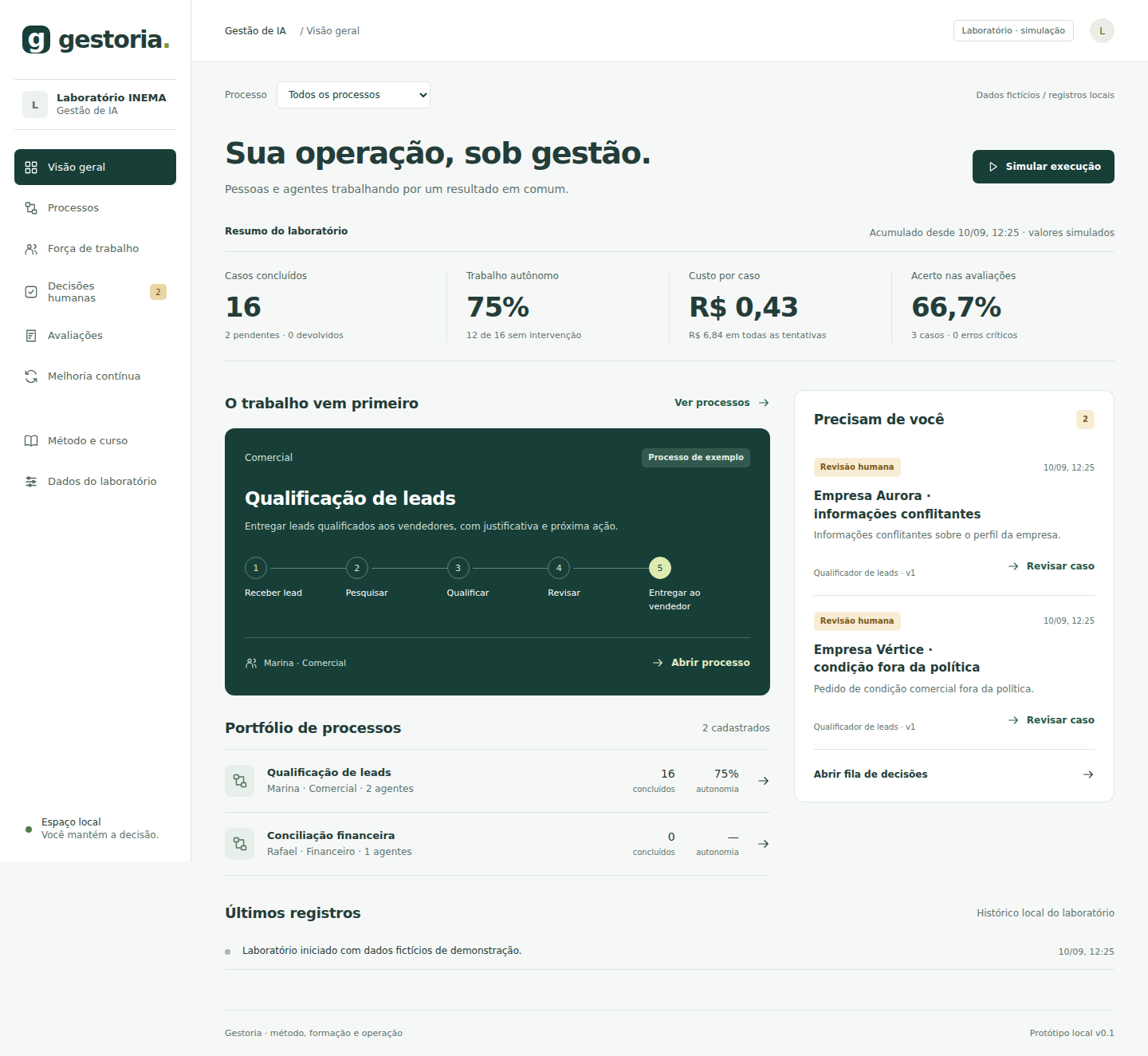
Real app capture with the initial fictional data. Metrics are calculated from the lab records.

A human approval increases the number of completed cases, but not the autonomous work. Pending and returned cases are shown separately.
Cost includes all attempts. Evaluations count only for the agent’s current version.
The proposal includes ten modules and an applied project. The plan is available now; lessons are in development.
View the course planProgress is guided by evidence. What’s available today is the lab; future phases require authorized systems and data.