Video with agents · INEMA fork
Clone the viral video, not just the script
You hand over a video and the agent rebuilds the whole flow as an editable project: speech, captions, b-roll and effects.

You hand over a video and the agent rebuilds the whole flow as an editable project: speech, captions, b-roll and effects.
Hypit is an open-source tool that teaches agents such as Claude Code and Codex to produce video. You show a reference video and the agent builds a project that works the same way: the script, the images, the voice, the captions and the animations, all tied to the spoken words. It suits people who make short videos and want quick variations (another presenter, another topic, another language). To run it you need Node, pnpm and FFmpeg; the AI-generated video and image parts use paid services, but animation made in code renders locally at no cost. This is a fork of hypit-ai/hypit, tested on the INEMA server.
Instead of editing on a timeline, the agent writes a text file (SVML) that describes the video. Change the speech and the rest follows.
The agent watches the reference, transcribes it with the timing of each word and notes why each cut, image and caption appears where it does.
In the script, @{trofeu} … @{/trofeu} marks when an image comes in and goes out. If the sentence changes or moves to another language, the timing adjusts on its own.
Swap the presenter, the hook, the product or the language and render again, reusing the material that did not change.
The agent uses the /hypit skill to read the reference and write the project; the hypit CLI checks and renders it.
An HTML-like file with the script, image/voice/video requests, clips, captions and visual components.
Layout and motion packages: ranking scoreboard, karaoke captions, comment sticker, split-screen podcast.
Defines where each step runs: HTML rendered in a headless Chrome plus local FFmpeg, or external generation services.
Nothing is paid for the local test in this guide. Tested on 15/10/2026 on a Linux ARM server (NVIDIA GB10).
We used Node 24 and pnpm 10.33.
node -v; pnpm -v
Builds the final video and reads the media.
ffmpeg -version | head -1Draws the frames. On x86 Hypit downloads its own; on ARM point it to the Playwright one (step 4).
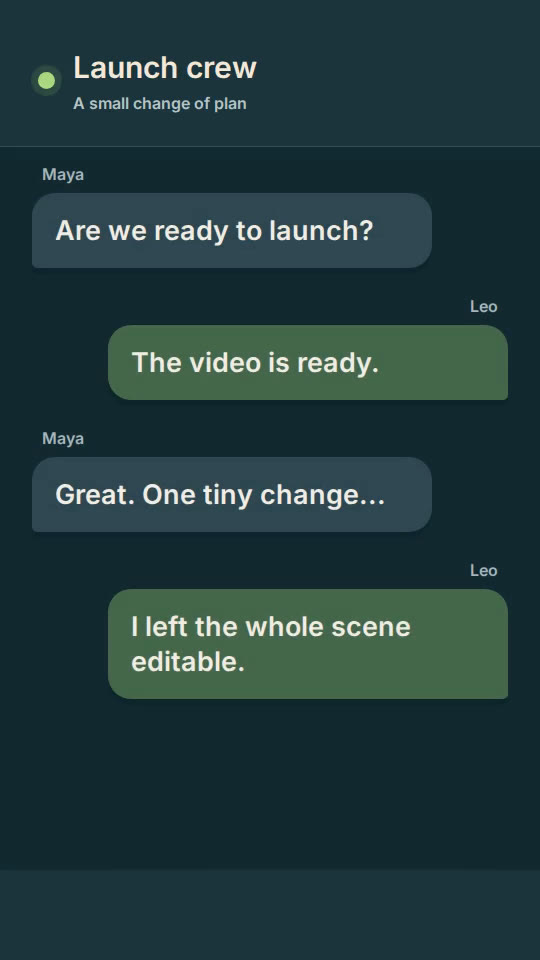
npx playwright install chromium-headless-shellThe chat.svml example is an 8 s chat animation drawn only in code. It uses no spoken script, no image AI and no source video.
The install only downloads JavaScript packages; it does not download a browser.
git clone https://github.com/inematds/hypit
cd hypit
pnpm install --frozen-lockfile
The @example/chat-scene component is what draws the messages.
pnpm build:public-types
pnpm --filter @example/chat-scene build
check validates the SVML and does not call any service.
node bin/hypit.mjs check examples/semantic-composition/chat.svml \
  --project examples/semantic-composition
# ✓ Source is valid · Outputs 11
Hypit tries to use an x86 Chrome that does not exist on ARM (error MANAGED_PROGRAM_DOWN). Create a runtime with chromePath pointing to Playwright's ARM headless build. On x86, skip this step and use hypit.runtime.json.
# examples/semantic-composition/hypit.runtime.arm.json
{
  "format": "hypit.runtime-local@1",
  "dataRoot": ".hypit/runtimes/local",
  "endpoints": {
    "media.local": { "use": "@hypit/media-local", "config": { "defaultConcurrency": 2 } },
    "html.local": { "use": "@hypit/provider-html-local", "config": { "workers": 2,
      "chromePath": "~/.cache/ms-playwright/chromium_headless_shell-1248/chrome-headless-shell-linux-arm64/chrome-headless-shell" } }
  }
}
# replace ~ with the absolute path of your home folder
Here it took about 10 s for 240 frames.
node bin/hypit.mjs build examples/semantic-composition/chat.svrun \
  --project examples/semantic-composition \
  --runtime examples/semantic-composition/hypit.runtime.arm.json --follow
# ✓ Build complete · Build bld_...
Use the build id that appeared in the previous step.
node bin/hypit.mjs get bld_... --output final.video \
  --project examples/semantic-composition --to chat.mp4
# 540×960, 8 s, h264 + aac
Install the skill in Claude Code or Codex and describe the video, with or without a reference.
npx skills add hypit-ai/hypit -g
# inside the agent:
/hypit Clone this video: /path/video.mp4 and swap the topic to AI tools
/hypit Make a ranking video that puts INEMA.CLUB in the S tier
Frames from the chat.mp4 rendered on the INEMA server, with no API calls.

The viral examples from the original project (football ranking, podcast, street interview) cost about US$1 each, with video and images generated by paid services. See the examples/ folder.
What we weighed while testing.
The viral clones use Seedance (video), GPT Image (image) and Fish Audio or ElevenLabs (voice), through your own account on each service. Without them, what remains is local: WhisperX transcription, code animation and FFmpeg.
Modified Apache 2.0: your own use, including commercial, is free. Offering it as a service to third parties or reselling it requires a commercial license, and you may not remove the CLI's name and logo. The videos you generate are yours.
It is a complete video engine. If you already use HyperFrames or another engine, you can take the ideas without switching tools.
Ideas noted for INEMA's video engines. None has been applied yet.