Why skills exist
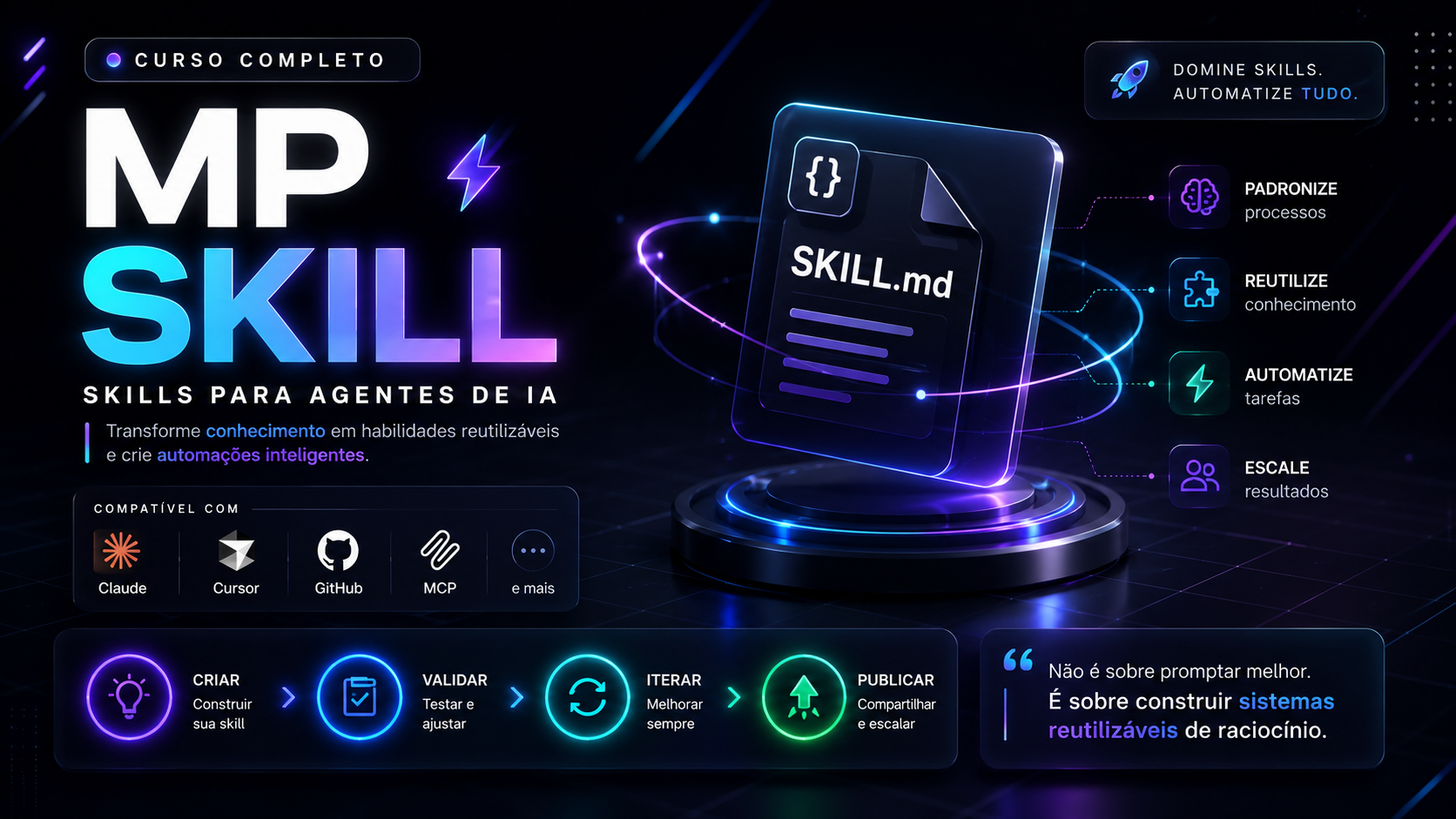
Skills are instruction packages loaded on demand that Claude Code (or Codex) activates only when the context calls for it. Instead of piling huge rules into the system prompt and hoping they're followed, you describe the skill once, in one place, and the agent loads it when needed.
Matt Pocock formalized this pattern to solve four very specific pain points that every engineer who uses LLMs seriously encounters. This course covers everything in 3 tracks: fundamentals, repository anatomy, and advanced usage.
The 4 problems that skills solve
Misalignment
The agent does almost what you want, but with the wrong conventions: variable names, test style, commit pattern. Skills lock down the "how" before the agent decides on its own.
Verbosity
You explain the same rules every session. A well-made skill breaks that loop—all it needs is the right trigger, and it loads everything at once.
Broken code
The agent generates code that seems right, but it doesn't run — validation is missing, there's no type check, and the test step is missing. Skills encode the quality checklist.
Ball of mud
CLAUDE.md turns into a 2,000-line file that nobody reads all the way through, and nothing gets followed. Skills break this monolith into pieces that are loaded only when relevant.
Who this course is for
👥 Target audience
- • Engineers using Claude Code or Codex day to day
- • Team leaders who want to standardize their workflow with LLMs
- • People who have tried CLAUDE.md and were frustrated with the result
📋 Prerequisites
- • Claude Code (or Codex CLI) account installed
- • Comfortable with the command line and Git
- • Have completed at least one real session with an agent
🎯 What you’ll learn
- • Anatomy of a skill: SKILL.md, triggers, scope
- • How to write descriptions that trigger at the right moment
- • Matt’s workflow: from sketch to published skill
- • Real examples: handoff, code review, debugging
The 3 course tracks
🌱 Fundamentals
The 4 problems that kill projects with agents
The essentials: grilling, ubiquitous language (CONTEXT.md), TDD with an agent, healthy architecture, and the end-to-end workflow.
📦 About the Repository
How mp-skill is organized and how to contribute
Project origin, philosophy (small, composable, adaptable), folder structure (engineering/, productivity/, misc/) and installation via skills.sh.
🧩 Advanced Usage
Compose, customize, and integrate with other agents
Patterns for composing skills, customizing templates, forks vs. overrides, and cross-runtime integration (Claude Code, Codex, MCP, CI/CD).
Enter Track 3 →
You’re not learning to use a tool.
You’re learning the engineering of the next decade.
AI agents are already part of engineers’ daily workflows. The question is no longer "if" — é how you’ll make use of it. And those who still treat the agent as glorified autocomplete will fall behind those who learned to build reusable reasoning systems.
This course gives you the 3 things no one teaches: how to align the agent before it makes a mistake, how to compose skills into workflows that deliver real value, e how to create a ubiquitous language that gets your whole team—human and machine—speaking the same language.
It's not about writing better prompts. It's about building a system that makes better prompts unnecessary.
Less rework
Stop redoing work because the agent "didn't understand"
Predictable result
Consistent workflow, not prompt roulette
Scales with the team
Skills are reusable; knowledge isn’t lost
Free, open-source course. Based on the skills from Matt Pocock.