Skill · parallel × sequential × hybrid
Decide on the architecture before creating agents
A skill that chooses between sequential, parallel, and hybrid workflows before execution — fewer tokens, less rework, more consistency.
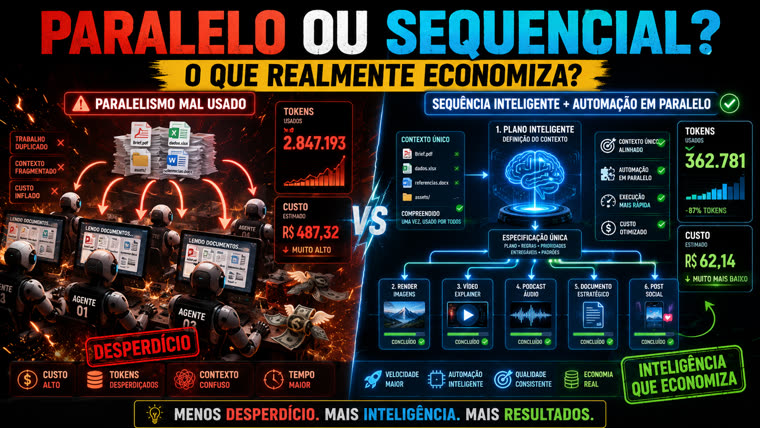
A skill that chooses between sequential, parallel, and hybrid workflows before execution — fewer tokens, less rework, more consistency.
Too many agents rereading the same context waste tokens; blind sequencing wastes time. The skill makes a deliberate decision — and only then executes.
First decision: does the task require splitting, multiple executors, or extensive context? If not, execute directly — no planning bureaucracy.
Scored signals for sequential and parallel work, with an objective threshold: a difference ≥ 2 points decides; a tie or smaller difference → hybrid.
Script for mechanical work, economical model for structured work, advanced model only for strategy and creation. Never an agent waiting for a render.
The workflow separates reasoning from execution: it centralizes decisions, records the context once, automates the mechanical work, and parallelizes only what is truly independent.
Dependent tasks or tasks with lots of shared context. What you learn at one step informs the next.
Independent tasks, frozen inputs, little context per task. Renders and conversions become parallel scripts.
Default for large projects: centralized planning, a single specification, independent parallel execution, central review.
The skill is a package of Markdown files — it works with any agent that supports skills. The test script uses the Claude Code CLI.
Claude Code, ChatGPT (ZIP upload), or Codex. The core is universal; the platform mappings are in references/.
# check the CLI (for Claude Code)
claude --version
To clone the repository with the skill, guide, and test script.
git clone https://github.com/inematds/agenteexecuta
Only to run the baseline × with skill behavioral test.
bash --versionFrom cloning to behavioral validation, with real commands.
The skill lives in the folder arquiteto-de-execucao/, with SKILL.md, references, and a test script.
git clone https://github.com/inematds/agenteexecuta
cd agenteexecuta
Copy the skill folder to the user's skills directory. It will then be triggered automatically before work involving subagents or batches.
cp -r arquiteto-de-execucao ~/.claude/skills/ # available in the next session
Use the ready-made zip — it includes the agents/openai.yaml with the interface configuration for the OpenAI ecosystem.
# upload this file when creating the skill/GPT:
arquiteto-de-execucao-v2.zip
Ask for a task with multiple deliverables. The skill produces a compact plan BEFORE creating any subagents — strategy, what is sequential/parallel, executors, limits, and the main risk.
# example request that activates the skill:
"Produza 15 vídeos curtos da série X usando agentes. O guia de estilo tem 40 páginas."
Scored signals and an objective threshold, with worked examples (15 videos, market research, migration, 500 files).
cat arquiteto-de-execucao/references/decision-matrix.md
The script runs the 3 test scenarios in headless mode and saves the responses for manual review against the criteria for references/test-scenarios.md.
./arquiteto-de-execucao/scripts/test-skill.sh              # smoke test: scenario 1, 1 run
./arquiteto-de-execucao/scripts/test-skill.sh all both 5   # full test suite
The savings don't come from "sequential is always better": they come from amortizing the cost of shared context.
# 3 agents rereading the same material:
3 × (50k contexto + 20k execução) = 210k tokens

# 1 executor reusing the context:
50k + 20k + 20k + 20k = 110k tokens
Estratégia: híbrida.
Sequencial: planejamento, spec e revisão final.
Paralelo: tarefas independentes e mecânicas.
Executores: avançado p/ decisões; econômico
  p/ checklist; scripts p/ render.
Contexto: PROJECT-SPEC.md + CHECKLIST.md.
Limites: 3 subagentes, 2 tentativas,
  retrabalho só dos reprovados.
From the monolithic version to a lean skill with behavioral validation.