🧠 Visual Thinking
A professional prompt doesn’t just describe a scene — it controls how the viewer experiences it over time. Five axes define this experience, and each serves a narrative function.
🎥 Format = Camera
Aspect ratios, lens, depth of field, motion blur, and movement. Defines how the scene is felt — not static, but controlled cinematic movement.
🌍 Setting = Story
The world already tells a story without words: ruins → lost civilization, dust and debris → constant movement. The viewer understands that something is wrong.
💡 Light = Emotion
Warm light → humanity and beauty; cool shadows → danger and emptiness. The contrast creates emotional tension.
🎭 Character = Contradiction
An elegant woman in a destroyed world. Red dress (focus), heels (dominance), glasses (mystery), weapon (power). The contradiction creates intrigue.
🎬 Scene structure = sequence
It’s not a single shot — it’s a progression in which the viewer discovers, doesn't just receive the information:
💡 Central idea
You’re not creating a scene. You’re creating a question in the viewer’s mind — controlling what it sees, where it looks, how things move, and when information is revealed.
📈 Diagonals & Leading Lines
Each composition serves a different purpose. The two most direct ways to guide the viewer’s eye are the diagonal (injects energy and movement) and leading lines (guide the eye to the right spot in the frame).
📈 Diagonal
- →Breaks horizontal stability and creates dynamism.
- →Suggests movement even in a still frame.
- →Ideal for tension, speed, and action.
🛤️ Leading Lines
- →Roads, hallways, cables, shadows: everything points.
- →Lead the eye directly to the focal point.
- →The viewer doesn’t search — they’re guided.
Principle: use the right composition at the right moment. Diagonals and leading lines don’t beautify the frame—they decide where the eye enters.
🔲 Rule of Thirds & Negative Space
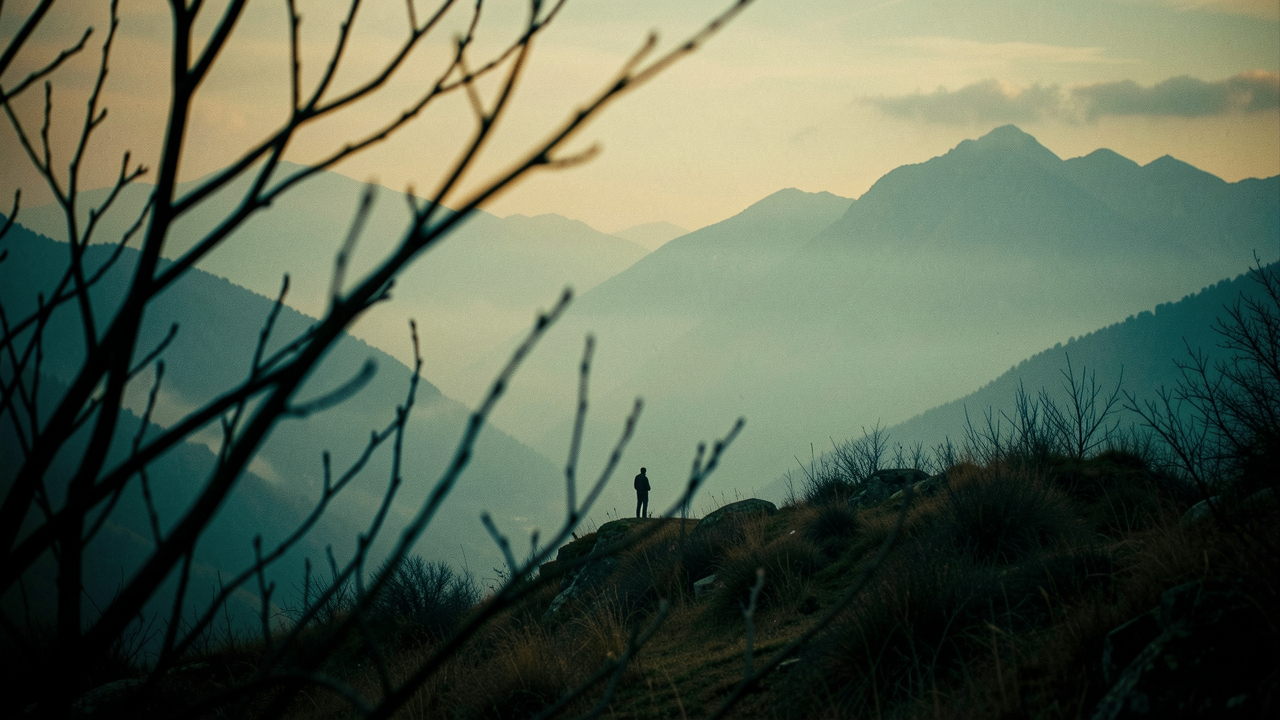
A rule of thirds provides balance and direction; the negative space isolates key moments. Empty space isn't a mistake — it's emotional structure.
✓ More negative space
- ✓Sense of freedom and space
- ✓Scale and grandeur
- ✓Isolation and loneliness of the character
↯ Less negative space
- →Tension and claustrophobia
- →Pressure and urgency
- →Forced closeness, discomfort
💡 Practical tip
Before generating, decide: should the viewer feel breathing room or tightness? The amount of empty space answers that before any other choice.
⚖️ Symmetry & Center
Compositions centered and symmetrical convey control, grandeur, and stability. Where a diagonal creates energy, symmetry asserts order and power.
Symmetry
Absolute balance: monumental and formal feel. Ideal for authority and control.
Center
The subject on the center axis holds attention and stabilizes the scene. Direct and undeniable.
vs. Diagonal
Center/symmetry = control. Diagonal = energy. The choice follows the shot’s emotion.
🔬 Macro, Scale & Contrast
Varying from detail to a wide shot is what makes the scene evolve, don't repeat. Macro delivers realism, a wide shot delivers atmosphere, and contrast creates focus.
🔬 Macro
Detail and realism: a drop, an eye, a texture. It brings the viewer closer to the scene’s material.
🌄 Scale
Wide shot: atmosphere, space, and context. Shows the world where everything happens.
⚡ Contrast
Light vs. dark, large vs. small: creates focus and intensity in just the right place.
🎬 Cinematic tensions
⏱️ Composition as a Sequence
You don’t write a prompt—you designs a sequence of compositions over time. Each shot uses the right composition at the right moment, and the scene evolves instead of repeating itself.
🎯 The difference
This is the boundary between a beautiful video e a cinematic sequence: the composition is used at the right moment, controlling not only the visuals, but also attention, rhythm, and timing.
📝 Task — Your Sequence of Compositions
Create your own version of a cinematic sequence:
- 🎬Take any simple subject and build from 5 to 7 shots.
- 🔲Use at least 3 compositions: center, rule of thirds, and negative space.
- 👁️Check where your eyes go in each shot.
- 🎯Objective: control not just the visuals — but attention, rhythm, and timing.
📌 Module Summary
Next Module:
4.2 — Lighting and Atmosphere