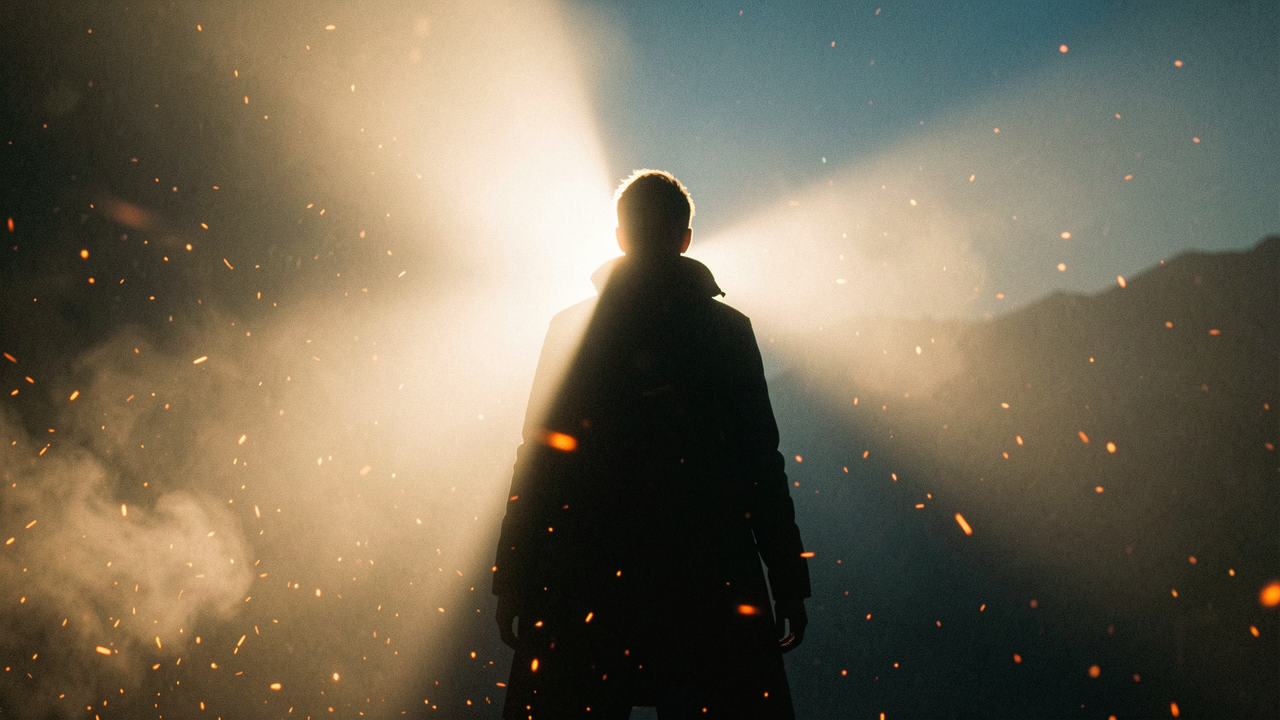
💡 LED Volume & Practical Light
Huge LED walls project photorealistic environments directly behind the actors during filming. The result: natural shadows, accurate reflections on costumes, and authentic rim lighting.
⚓ Impact
The real light "anchor" the actor in the digital world perfectly — the lighting isn't added in post; it actually happens on set.
🔥 Practical Fire & Practical Rain
Digital fire often looks too "clean." Real fire provides the unpredictability needed for immersion; physical water interacts with the environment in complex ways.
🔥 Practical Fire
- •Chaotic movement of flames and organic sparks
- •Natural flow of smoke and heat distortion
💧 Practical Rain
- •Soaked clothing, wet asphalt, puddles
- •Authentic splashes and reflections on wet surfaces
🗝️ Secret
Perfect movement looks fake. Chaos looks real. And water physics is one of the fastest ways to spot low-quality CGI.
🪢 Wire Suspension & Miniatures
Suspending actors on wires captures genuine physical responses; physical miniatures still rival digital renders with their tangible details.
🪢 Wire Suspension
Real inertia, natural fabric drag, bodily imbalance, and realistic delayed movement.
Fact: physical weight is one of the hardest things to simulate in post-production.
🏯 Physical Miniatures
Real dust, tactile textures, chipped surfaces, and natural atmospheric haze.
Illusion: with cinematic framing, the brain perceives the miniature as a full-scale structure.
🧩 Physical + Digital Hybrid
Combining real elements in the foreground with digital backgrounds. Creates convincing depth and realistic parallax.
⚓ Principle
Highly detailed foreground elements "anchors" the entire scene, lending credibility to the digital setting in the background.
⚙️ YAML for VFX & AI Limitations
In professional workflows, we use YAML to separate control into logical blocks. The essential rules: one purpose per field, physical focus, defined lighting, and controlled camera.
scene:
  technique: practical_fire
  lighting:
    source: "flames from frame right, flickering warm key"
    rule: "never leave light source to chance"
  motion:
    logic: "chaotic flame, organic sparks rising"
    secondary: "smoke drifts, heat distortion"
  camera:
    path: "slow push-in, grounded and logical"
⚠️ Keep an eye on
- •Motion deviation — objects “floating” or losing their trajectory
- •Timing breaks — artificial acceleration or visual glitches
- •Artificial textures — surfaces that are too smooth or plastic-looking
AI approximates reality—it doesn’t truly understand physics. Iteration is a normal part of the process.
🎥 The Final Blueprint
Cinematic realism follows a specific flow. Arrange any effects scene in this order:
🎯 Objective
Achieve uncompromising physical realism. Light → Texture → Movement → Atmosphere → Emotion it’s the sequence that supports any effects scene.
📝 Task — One Technique in YAML
Choose a technique (LED volume, practical fire, cables, rain, miniatures, or hybrid) and create a realistic 5-second scene using a structured YAML prompt. Apply the rules: one function, physical focus, defined lighting, and controlled camera.
📌 Module Summary
Next Module:
5.5 — Slow Motion & Particle Systems