Knowledge base · open resources
Understand AI.
Understand AI.
Put it into practice.
Move beyond collecting tools and turn a real task into a pilot you can evaluate.
Move beyond collecting tools and turn a real task into a pilot you can evaluate.
This artificial intelligence study and practice kit is for anyone who wants to understand the subject and make a first improvement at work. It brings together a video analysis, a glossary, and templates for assessing a process, writing a prompt and evaluating results. Start with a real task and check the outcome before automating it. To use the documents, simply read and copy them; the optional evaluation tool runs in Python without external services.
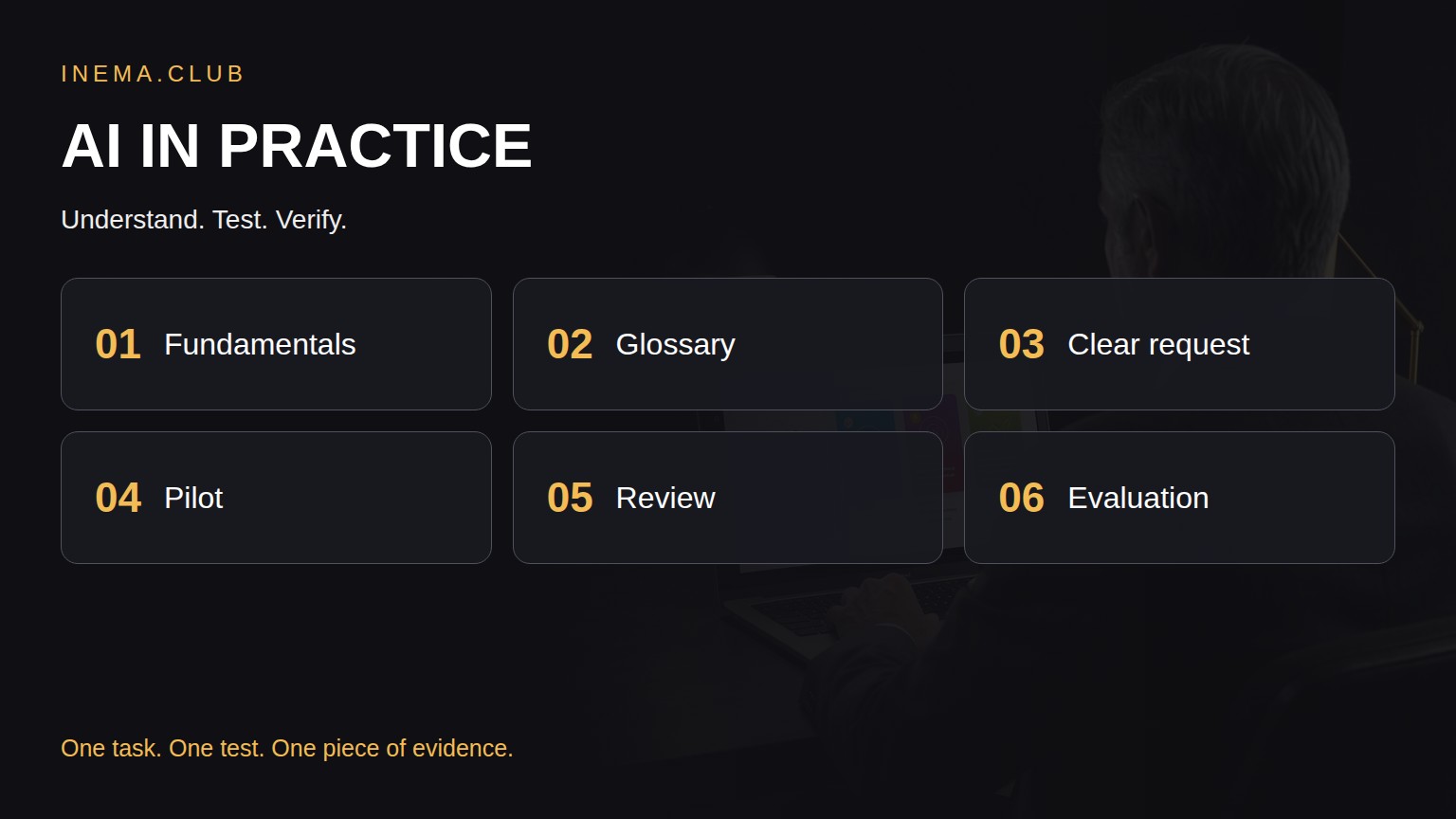
A critical reading and a set of original resources to turn information into practice.
Model, app, token, context and agent: a glossary to help you understand what each part does.
Define the task, the expected outcome and the review process. Use the templates to start with fictional data.
Record successes, failures and total time, including corrections. A polished answer is not enough.
This sequence helps you understand the problem before choosing a tool.
The reference video covers AI history, language models, infrastructure, labs, tools, prompts and opportunities. Our contribution is to turn that overview into exercises and evaluation criteria.
View sources and timestamped chapters (in Portuguese) →You can take the first steps with a text editor and the assistant you already use.
Example: organizing meeting notes. Record the input, output, time needed manually and who will review it.
Open the process assessment (in Portuguese)Provide context, source material, a format and criteria. Ask the assistant to flag missing information.
Copy the prompt template (in Portuguese)Include typical cases, incomplete data and ambiguous requests. Evaluate failures too.
Download the evaluation spreadsheet (in Portuguese) · Review checklist (in Portuguese)Add up time spent using the tool, reviewing and correcting. To calculate locally, clone the project and run the evaluation tool:
git clone https://github.com/inematds/roteiro-ia-pratica.git
cd roteiro-ia-pratica
python3 scripts/avaliar.py recursos/avaliacao.csv
The initial spreadsheet is empty: the program reports pending cases without making up a percentage improvement.
Adopt, adjust or abandon the pilot. Record your reasons before connecting systems.
Complete the pilot brief (in Portuguese) · Follow the seven-day plan (in Portuguese)Fictional data for testing without relying on an integration.
“At the meeting, we decided to revise the proposal. Ana took responsibility. We have not set a date yet.”
Decision: revise the proposal. Owner: Ana. Deadline: not provided.
If the assistant invents a date, the output fails the factual accuracy criterion. This simple test shows why context and review need to go together.
Use the glossary to understand the parts of the system.
Open the glossary (in Portuguese) →Distinguish explanations, opinions and predictions in the reference material.
Read the analysis (in Portuguese) →Use the templates and record what worked in your context.
View all resources (in Portuguese) →Open educational content. The seven-day plan is a suggested practice schedule, not a promise of mastery. Companion videos are in preparation.