VLA: robots that see, understand, and act|INEMA.CLUB-PRO

Lesson 1 · 14 min

From LLM to a robot that acts

A chatbot returns text. A robot has to return motion, dozens of times per second, while looking at a camera. This lesson separates the four model families you'll hear about in the course and shows what changed between 2023 and October 2026.

Start the lesson
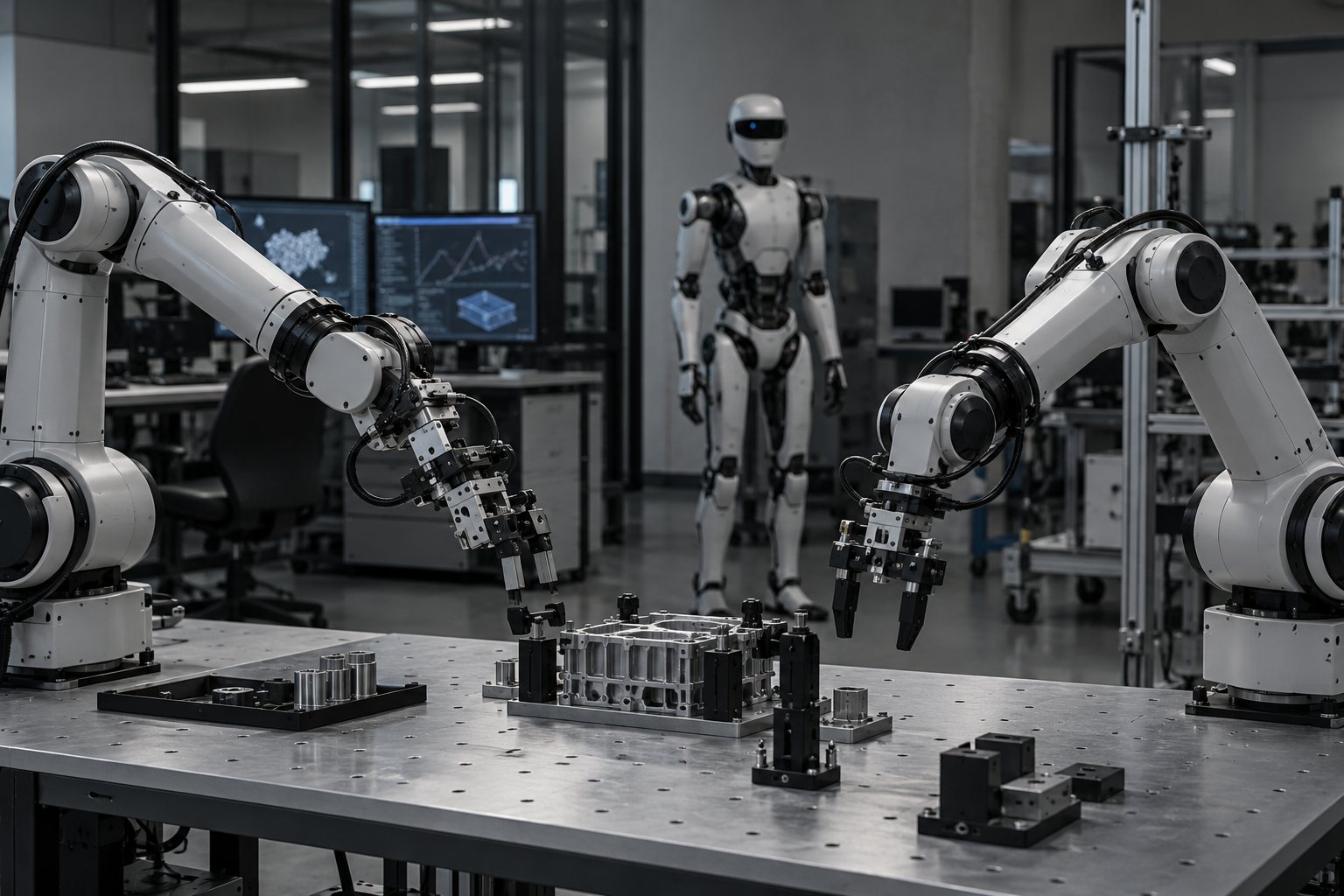
Robotics lab with a two-arm station and a humanoid in the background.

In this lesson you will

  1. 1What goes in and what comes out of each model family
  2. 2Why a VLA returns an action, not text
  3. 3What a World Action Model is, the new category of 2026
  4. 4Classify real systems with the source next to you

Goal: tell LLM, VLM, VLA, and World Action Model apart and say what changed from 2023 to Oct 2026.

01The ladder: from text to motion

Each step adds an input or an output. Tap each one.

The question that settles it: what comes out of the model? Text, action, or video + action.

LLMs and VLMs answer. VLAs and WAMs act: the output becomes a motor command.

02What changed from 2023 to October 2026

Four milestones. Tap each stage.

1. Data together

Open X-Embodiment (2023) merged dozens of datasets from different labs into a single format. It was the basis for training one model across many robots.

In Jun/2024, the 7B OpenVLA was pretrained on 970 thousand episodes from that collection, with open weights.

The ideaOne model, trained on data from many robots, instead of one model per robot.

03The classification sheet

Copy the table into your own file and fill it in as you practice.

classificacao.md
| System | Input | Output | Category | Source (URL) |
|---|---|---|---|---|
| OpenVLA | | | | |
| π0.5 (openpi) | | | | |
| Gemini Robotics-ER 1.6 | | | | |
| DreamZero | | | | |
| Cosmos 3 | | | | |
| SmolVLA | | | | |
Simulation: illustrative example
  • OpenVLA: camera + sentence → action. VLA. openvla.github.io
  • π0.5: camera + sentence + state → action. VLA. github.com/Physical-Intelligence/openpi
  • Gemini Robotics-ER 1.6: images + question → spatial reasoning, points, instrument reading. Embodied reasoning model (VLM family): it does not move the robot on its own. deepmind.google/blog/gemini-robotics-er-1-6/
  • DreamZero: camera + sentence → future video + action. WAM. arxiv.org/abs/2602.15922
  • Cosmos 3: world foundation model that combines world generation, reasoning, and action prediction; it serves as a base for WAM. huggingface.co/nvidia/Cosmos3-Super
  • SmolVLA: camera + sentence + state → action. Small VLA (450M). huggingface.co/blog/smolvla

04Practice: classify six real systems

Use primary sources only: official blog, paper, or model card.

E1 · Fill in the sheet

20 min

Copy the table, open each system's source (the links are at the end of the lesson), and fill in the input, the output, and the category.

Done when: all 6 rows have a category and a primary-source URL, and your answers match the answer key on at least 5.

E2 · The question that decides

5 min

For the system you got wrong or were unsure about, write one sentence: what comes out of it?

Done when: the sentence says text, action, or video + action, and that explains the category.

05Test what you learned

The explanation appears after your answer.

Question 1 of 4

What separates a VLA from a VLM?skill

06Summary

Look at the outputText is an LLM or VLM. Action is a VLA. Future video + action is a WAM.
2026 brought the whole bodyHelix 02 and Gemini Robotics 2 control entire humanoids, not just the arm.
Open and closed coexistπ0/π0.5 are open; π0.7, Helix, and Gemini Robotics 2 are closed or partner-only.

Sources for this lesson

Next lesson