VLA: robots that see, understand, and act|INEMA.CLUB-PRO

Lesson 8 · 18 min

From the lab to the real world

A policy that succeeds in the simulator is still far from a production line. In between are ROS 2, which connects the model to the motors, the safety layers, which no VLA can do without, and the real state of the market, which is less ready than the headlines make it look.

Start the lesson
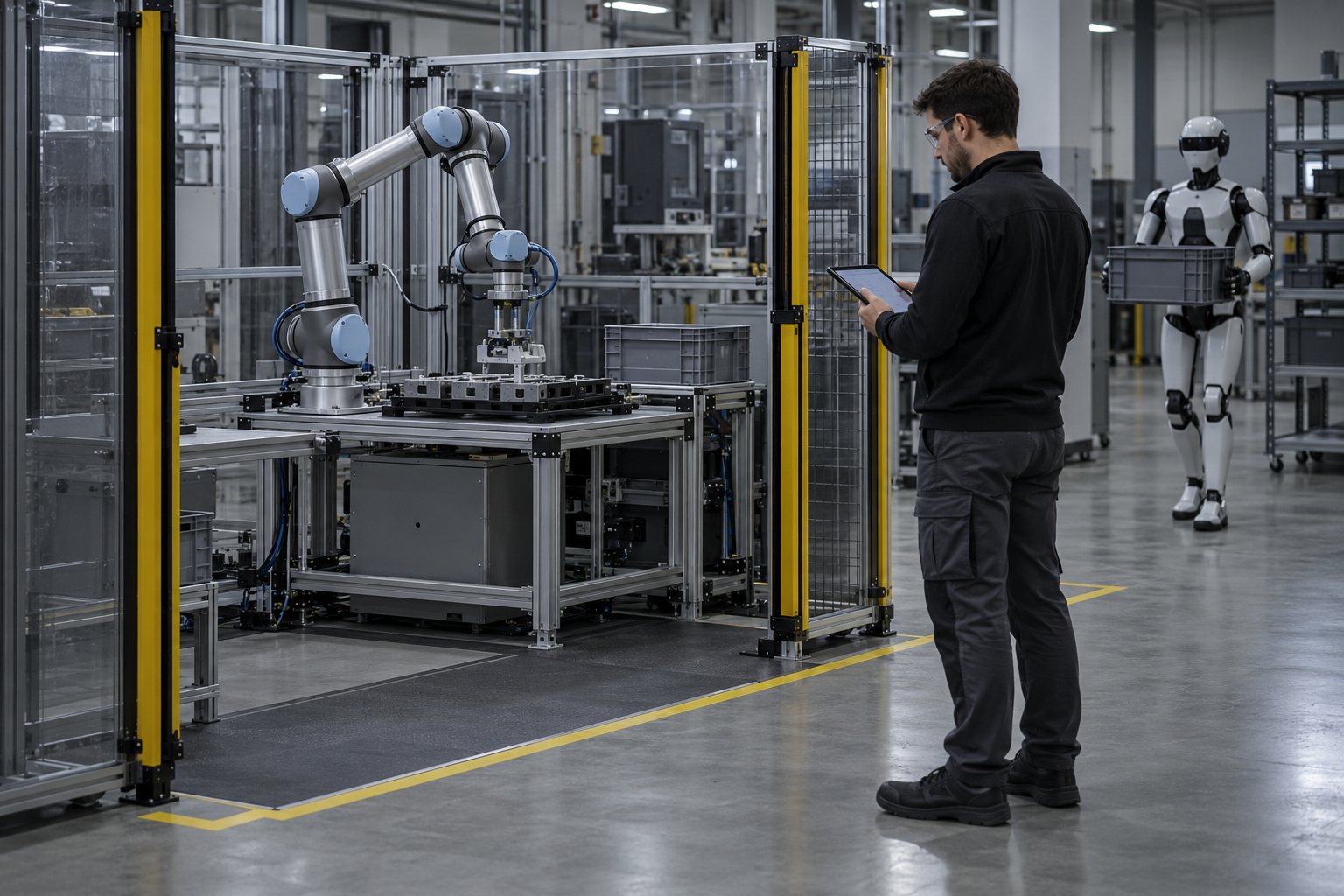
Factory floor with a collaborative robot cell behind a light curtain and safety markings on the floor.

In this lesson you will

  1. 1Where the VLA fits in a ROS 2 architecture
  2. 2The safety layers and what the standards say in 2026
  3. 3The 2026 market: facts, news, and projections
  4. 4Your study plan with dates

Goal: connect a VLA to ROS 2, build the safety checklist, and map out your next step.

01The VLA inside the robot

The policy is one piece. Safety stays outside it. Click each block.

Humble is still supported until May 2027 and Jazzy until May 2029. New project: Lyrical (Ubuntu 26.04).

The VLA decides; the controller executes; safety holds even when the VLA gets it wrong.

02Safety, market, and hardware in 2026

Standards and market come with their source: much of it appeared only in a secondary source.

1. Standards

According to the ISO page seen in a search result, ISO 10218-1 and 10218-2:2025 were published in Feb 2025 and remain in two parts: -1 for the robot and -2 for the application and the cell. According to secondary sources, -2 absorbed the content of ISO/TS 15066 on collaborative robots.

According to Drives & Controls magazine (Oct 18, 2026), ISO 25785-1, for humanoids and other robots with active balance, is still a draft (CD): no manufacturer can claim certification to it.

03The checklist for taking a VLA to the real world

Copy it and fill it in for a case of your own. Every line without an answer is a reason not to turn the robot on.

checklist-mundo-real.md
# Checklist: <task> at <place>

## Model
- [ ] Do the weights' license allow this use? (which: ______)
- [ ] Evaluated in simulation: success rate ____ % over ____ episodes
- [ ] Evaluated on the real robot: ____ % over ____ attempts
- [ ] Most common failure noted: ______

## Integration
- [ ] ROS 2 distribution and end-of-support date: ______
- [ ] Policy node publishes to the controller (not straight to the motor)
- [ ] Inference time measured: ____ ms; chunk covers ____ ms

## Safety (outside the model)
- [ ] Emergency stop tested
- [ ] Position, speed, and force limits in the controller
- [ ] Work zone / protection (light curtain, fence, marked area)
- [ ] Applicable standard checked with whoever certifies (ISO 10218-1/-2:2025 or local)
- [ ] What happens if the camera fails or the model hangs: ______

## People
- [ ] Who can take over control and how: ______
- [ ] Log of every intervention (it becomes correction data)
Simulation: illustrative example
  • Task: collaborative arm sorts parts on a lab bench.
  • License: Apache-2.0 (π0.5 from openpi).
  • Sim: 72% over 50 episodes. Real: 55% over 20 attempts; most common failure: shiny part.
  • ROS 2: Lyrical, supported until May/2031.
  • Inference: 180 ms; a 25 to 50 Hz chunk covers 500 ms.
  • Safety: stop tested, force limit in the controller, marked area; standard checked with the integrator.

Numbers made up to show how to fill it in. Yours come from lessons 2, 5, and 6.

04Practice: the checklist for a case of your own

Pick a real case, even a small one (a home bench, a lab, a customer's line).

E1 · Fill in the checklist

25 min

Copy the checklist and fill it in with the numbers from your practice sessions (lessons 2, 5, and 6) and the model you chose in lesson 3.

Done when: every line has an answer or is marked "missing", and the Safety section does not depend on the model.

E2 · Separate fact from news

10 min

Pick two market claims from this lesson and mark each one as a fact with a primary source, news, or a projection.

Done when: both are marked and you can say why the PI funding round is only news.

E3 · Your plan

10 min

Use the generator below to build the plan with dates and download the .md.

Done when: you have the plano.md with a start date and an end date, and the first step is marked on your calendar.

05Test what you learned

The explanation appears after your answer.

Question 1 of 4

Where should the emergency stop live?skill

06The course map

The four practical steps and what each one delivers. Click an exercise to see its "done when".

Week 1Choose

Concepts and license

3 exercises

A model chosen by license, size, and access.

See the lesson
Week 2Train

Data and LeRobot

3 exercises

An open dataset and a checkpoint of your own in outputs/.

See the lesson
Week 3Evaluate

Simulation

3 exercises

A success rate measured by you.

See the lesson
Week 4Take it to the real world

ROS 2 and safety

3 exercises

The checklist filled in for a case of your own.

See the lesson
By the end of the courseYou choose a model by license, train and evaluate a policy with LeRobot, and know what's missing to hook up a real robot.
8 lessons
Click an exercise to see what to do and the "done when".
  1. 1/5

    Choose

    Start with lessons 1 to 3: separating the model families, understanding the action chunk, and reading model cards. Without this, the rest turns into copying commands.

  2. 2/5

    Train

    Requires step 1. Lessons 4 and 5: open PushT, train ACT, and read the loss. Runs on CPU.

  3. 3/5

    Evaluate

    Requires the checkpoint from step 2. Lesson 6: lerobot-eval, videos, and comparing two training runs.

  4. 4/5

    Take it to the real world

    Requires the previous three. Lessons 7 and 8: the correction loop and the checklist, with safety kept outside the model.

  5. 5/5

    The whole course

    Choose, train, evaluate, and take it to the real world. Each step uses what the previous one delivered.

Suggested order: each step uses what the previous one set up.

07Generate your plan with dates

Pick the start date and how much time you have per week.

08The course in three sentences

Check the output and the licenseA VLA returns an action; pick the model by what you can download and use.
Measure it yourselfOpen dataset, short training run, lerobot-eval: the success rate is yours, not the leaderboard's.
Safety outside the modelStop, limits, and standards apply even when the VLA gets it wrong.

Sources for this lesson