🧱 The Three-Layer Rule
Depth is the illusion of three-dimensional space. It is created by organizing the frame into three layers — and every cinematic frame has all three.
Foreground
Where the viewer is.
Medium shot
Where the subject is.
Background
Where the context lives.
🔀 Layer Separation
Having three layers isn’t enough — they need to be visually distinct. Separation comes from focus, light, and color. Contrast and backlighting separate the space; haze and mist push elements into the distance.
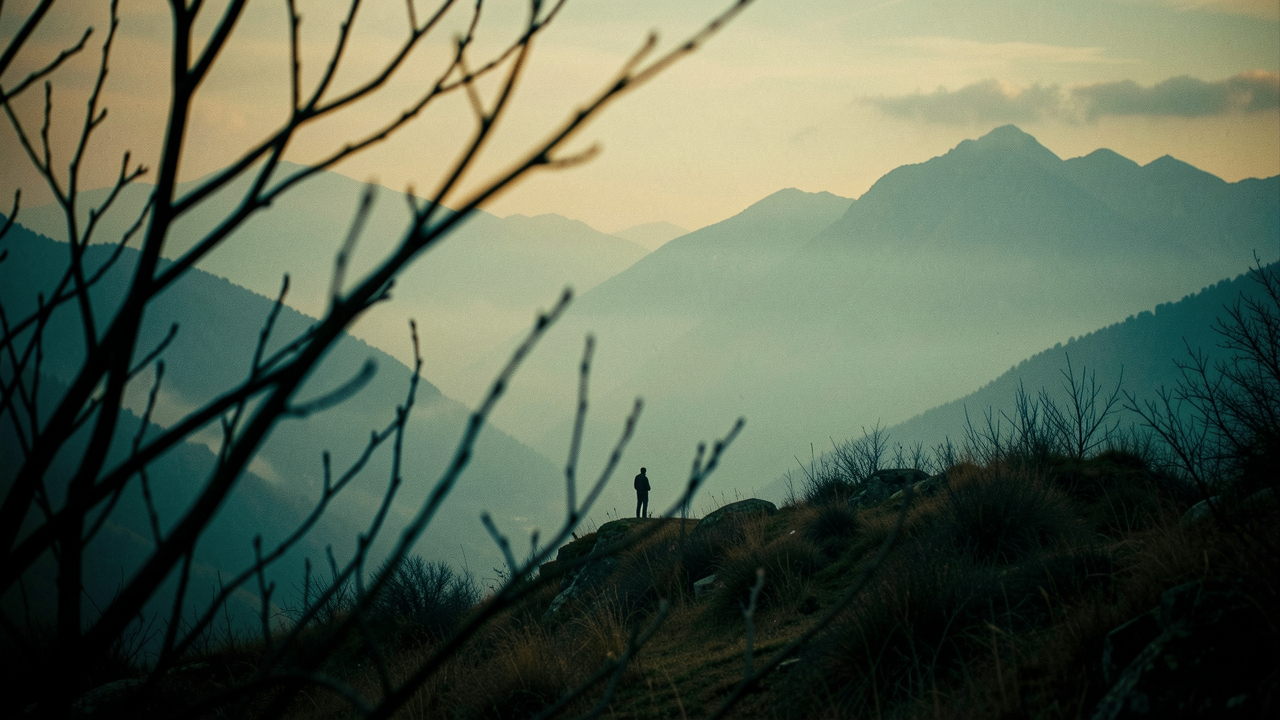
🎯 Depth of Field
Depth of field controls what’s in focus — and the sharp area is where the eye goes. It's a quiet, powerful way to guide attention.
🔵 Shallow Focus
- →Isolates the subject, melts the background (bokeh).
- →Intimacy and focused attention.
🔲 Deep Focus
- →Everything in focus, from foreground to background.
- →Provides context and the relationship between layers.
🔭 Lens: Wide-Angle vs. Telephoto
The lens choice shapes the sense of depth. Wide-angle expands the space; telephoto compresses the space. It’s an emotional decision, not just a technical one.
🌐 Wide-Angle → Expands
- →Layers spaced apart, creating a sense of breadth
- →Immersion and environmental scale
- →Distances seem greater
🔬 Telephoto → compresses
- →“Stacked” layers, shots glued together
- →Intimacy and isolation of the subject
- →Distances seem smaller
💡 Practical tip
In the prompt, state the lens explicitly: "wide-angle lens" to expand the setting, "telephoto lens" to compress it and bring it closer emotionally.
🌀 Movement & Parallax
Movement reveals depth as the layers move at different speeds — that’s parallax. Tracking and orbiting naturally enhance this effect.
🌀 Speeds by layer
Separated layers + moving camera = real depth. Without separation, parallax doesn't appear, and movement reveals a flat scene.
❤️ Depth = Emotion
Depth isn’t just visual — it’s emotional. Characters positioned at different depths show relationships without a word of dialogue.
🧠 Professional approach
A cinematic shot combines composition, camera and lens, lighting, movement, and character placement—all working as a single system.
You move beyond simply creating images and start to direct scenes: shaping space, controlling attention, and telling stories through depth.
📝 Task — Storytelling Through Depth
Create 3 cinematic scenes, each with one shot:
- 🧱Include foreground, midground, and background.
- 💡Use lighting and camera movement.
- 🎭Add 2 characters on different layers and show emotion only through their position and gaze.
- 🚫No dialogue · no action — focus on atmosphere and visual storytelling.
📌 Module Summary
Next Module:
4.4 — Shot Sizes & Camera Movement