Shot size, angle and distance: the grammar every generator understands
Shot size and angle aren't aesthetics: they decide what the audience sees and how they feel about the character. And it's a vocabulary that Google's official video prompt guide lists with names and examples. You leave with your scene's shot ladder written in the terms the prompt uses.
1Read the shot ladder, from the wide shot to the detail
2Use angle to convey power, fragility or unease
3Know what the lens does to space
4Write each choice with the term the generator understands
Goal: choose the shot size and angle based on the audience's emotion, and write the scene's shot ladder in the generator's terms.
01 · The shot ladder
From the widest to the tightest. Each step answers a question.
Click each block in the diagram to see what it does.
Decision rule: if the place or the action matters more, go wide; if the emotion matters more, go tight; if a detail changes the story, go to the detail.
02 · Size, angle and lens
Three decisions per shot, always based on what the audience should feel.
1. Size is emotion
A wide shot answers "where are we?". A close shot answers "how does this feel?". The detail shows what changes the story.
A path that works: open wide to show the world, move in to reveal the emotion, and end on a close-up or detail for impact.
In the batchWide shot of the dark street with the bakery lit up; medium shot of Dona Lia at the counter; close-up of her face lit by the oven.
2. Angle is a power relationship
Eye level is neutral. A high angle, looking down, makes the character small or vulnerable. A low angle, looking up, makes them powerful or imposing.
A top-down shot gives a map-like view; a worm's-eye view exaggerates height; a dutch angle (tilted camera) brings discomfort. Use the dutch angle rarely, or it loses its force.
3. The warning from the official guide
Google's video prompt guide (Veo and Gemini Omni Flash, page updated on 10/15/2026) lists these angles and warns: some advanced angles and lenses are not officially supported, and results vary.
In practice, a simple, well-justified angle comes out more stable than a rare one. If the rare one doesn't work, swap it for a simple one with the same intent.
4. The lens changes the space
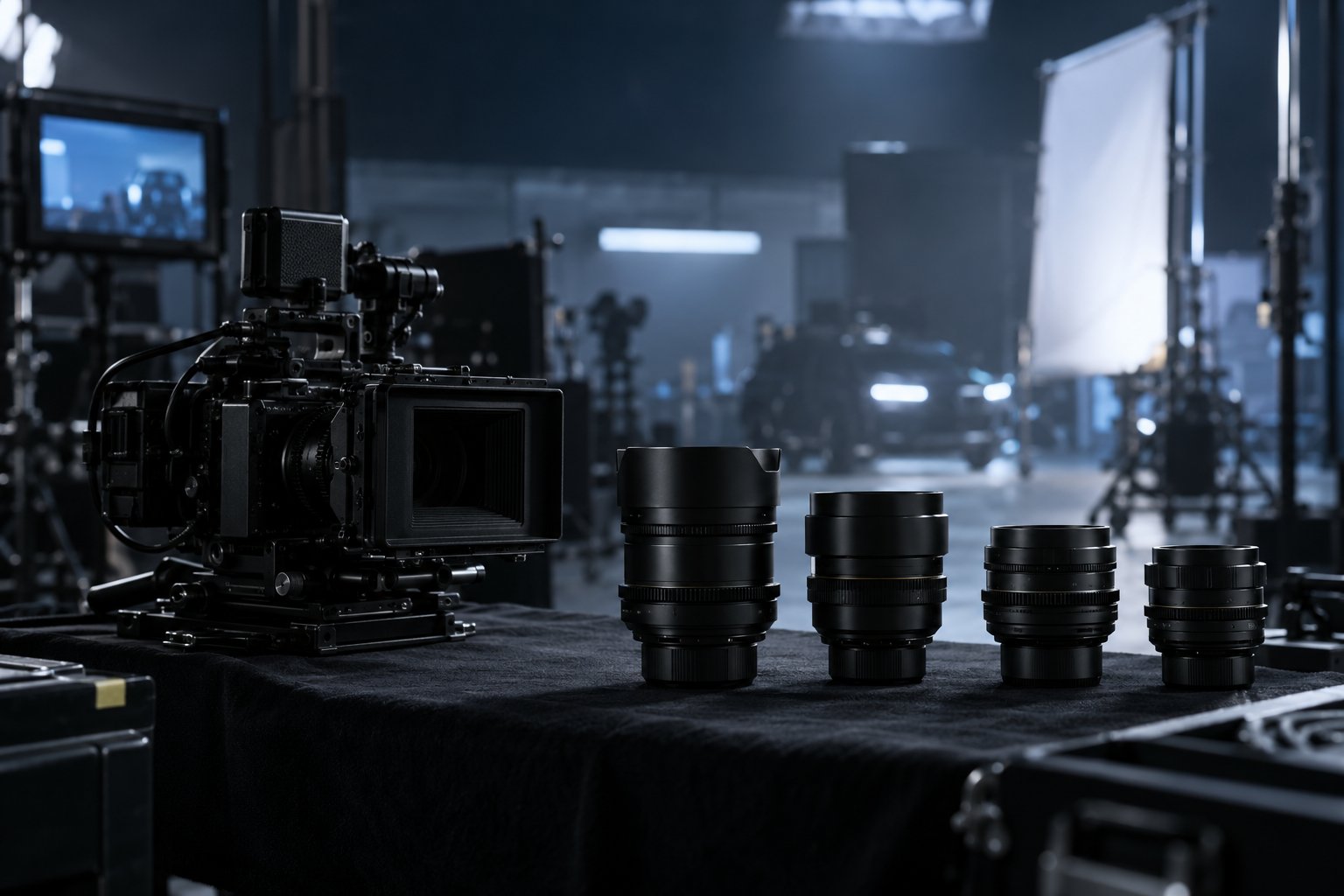
A wide-angle lens opens the field and exaggerates perspective: the place looks bigger. A telephoto lens narrows the field and compresses space: the background looks glued on and the subject is isolated.
Shallow depth of field keeps only the subject sharp and blurs the rest. It is a quiet way to say where to look (lesson 5).
03 · Templates to copy
The vocabulary in Portuguese with the term used in prompts, and the ladder template. Angles, movements and lenses checked against Google's official guide on 10/19/2026.
Vocabulary: Portuguese → prompt term
# tamanho do plano
plano geral / de estabelecimento → establishing shot, extreme wide shot
plano aberto → wide shot
plano americano → medium wide shot (cowboy shot)
plano médio → medium shot
meio primeiro plano → medium close-up
close (primeiro plano) → close-up
plano detalhe → extreme close-up, macro shot
# ângulo
altura do olho → eye-level shot
câmera alta (plongée) → high-angle shot
câmera baixa (contra-plongée) → low-angle shot
zenital → bird's-eye view, top-down shot
rente ao chão → worm's-eye view
holandês → dutch angle, canted angle
# lente
grande-angular → wide-angle lens
teleobjetiva → telephoto lens
profundidade de campo rasa → shallow depth of field
escada.txt (template)
Scene: <scene name>
1 | <size> | <angle> | <what the shot shows and what the audience feels>
2 | <size> | <angle> | <what the shot shows and what the audience feels>
3 | <size> | <angle> | <what the shot shows and what the audience feels>
04 · Check your ladder
The page checks that each shot has a size and an angle and that the ladder varies: at least 4 different sizes and 3 different angles.
escada.txt
05 · Practice
Use the scene from the card in lesson 1.
Ladder · your scene in 5 to 8 shots
15 min
Write the ladder for your scene: on each line, the size, the angle, and what the audience sees and feels. Vary it: at least 4 sizes and 3 angles. Check it in the section above and download the escada.txt into the project folder.
Done when: the page answers OK: [n] shots with varied size and angle for your text, and the escada.txt is in the project folder.
Swap · the most important shot with another angle
5 min
Pick the shot that carries the emotion of the scene and imagine it from another angle. At the end of the escada.txt, write a line starting with Swap: with the new angle and what changes in the audience's feeling.
Done when: the escada.txt has, after the shots, a line that starts with Troca: with an angle different from the original and the effect in one sentence.
06 · Quick quiz
Four questions. The explanation shows up after each answer.
Question 1 of 4
The scene needs to show that Dona Lia is alone in a neighborhood that is still asleep. Which shot size?
Correct
Loneliness in space is shown through the relationship between the person and the place: a wide or establishing shot. The close-up shows emotion, but it hides the empty neighborhood that gives the scene its meaning.
Not this one
Loneliness in space is shown through the relationship between the person and the place: a wide or establishing shot. The close-up shows emotion, but it hides the empty neighborhood that gives the scene its meaning.Review: The shot ladder
Question 2 of 4
According to Google's official guide, what does the low-angle shot do to the character?
Correct
A camera below the subject, looking up, gives power. Small and vulnerable is the high camera; neutral is eye level; map view is the overhead.
Not this one
A camera below the subject, looking up, gives power. Small and vulnerable is the high camera; neutral is eye level; map view is the overhead.Review: Size, angle and lens
Question 3 of 4
What does the official guide warn about advanced angles and lenses?
Correct
The guide says that some advanced angles and lenses are not officially supported and that the result varies. That is why a simple, justified angle is the most stable bet.
Not this one
The guide says that some advanced angles and lenses are not officially supported and that the result varies. That is why a simple, justified angle is the most stable bet.Review: Size, angle and lens
Question 4 of 4
When is the detail shot (extreme close-up) the right choice?
Correct
The detail reveals the clue: the hand on the doorknob, the bread crust crackling. To show the place, go wide; for conversation, the medium shot or the over-the-shoulder shot work better.
Not this one
The detail reveals the clue: the hand on the doorknob, the bread crust crackling. To show the place, go wide; for conversation, the medium shot or the over-the-shoulder shot work better.Review: The shot ladder
Quiz complete
You got {a} of {n} right. Get them all right and the lesson is marked as complete.
Pick an answer. The explanation appears after you try.
07 · To keep
SizeWide shows where; tight shows how it feels; detail shows the clue.
AngleHigh makes small, low makes grand, eye level is neutral. Dutch, rarely.
Prompt termWrite the choice with the term the generator understands: wide shot, close-up, low-angle shot.