Direction: think like a director|INEMA.CLUB-PRO

Lesson 5 · 15 min

Composition and depth in the frame

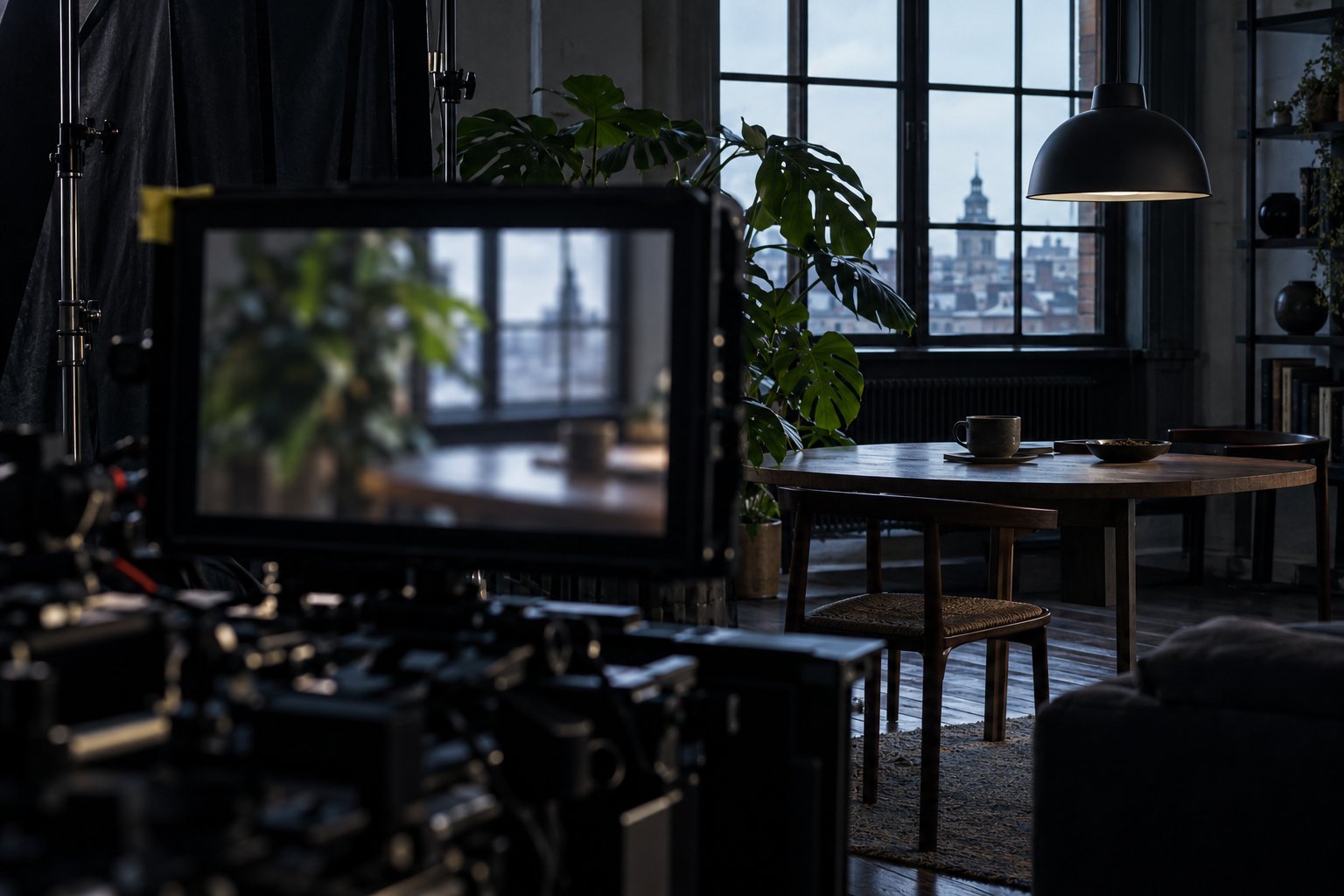
A beautiful frame where the eye doesn't know where to go communicates nothing. Composition is deciding what you see first, where empty space works in your favor, and how foreground, midground and background separate. It's what makes a generated image feel like real space instead of a flat backdrop.

Start the lesson
View from behind a camera monitor showing a frame with a plant in the foreground, a table in the midground and a window in the background.

In this lesson you will

  1. 1Apply the one-second test to any frame
  2. 2Choose between thirds, center and diagonal by emotion
  3. 3Use empty space to isolate or squeeze
  4. 4Set up foreground, midground and background and separate the layers

Goal: compose each frame with a subject you understand in one second and three layers of depth separated by focus, light or color.

01From subject to layers

Five decisions for every frame. Click each one.

Click each block in the diagram to see what it does.

The composition changes across the sequence: the scene evolves from shot to shot instead of repeating itself.

02Composition in practice

The examples come from the bakery.

1. The one-second test

Look at the frame for one second and say out loud what the subject is. If you hesitate, the audience will hesitate too.

One dominant subject per frame. Product, person and a background detail fighting for attention make a beautiful image that says nothing.

03Template to copy

One line per frame: the composition, the three layers and where the eye goes.

quadros.txt (template)
Scene: <scene name>
1 | <composition> | foreground: <what is close to the camera> | midground: <the subject> | background: <the context> | the eye goes to: <the subject>
2 | <composition> | foreground: <...> | midground: <...> | background: <...> | the eye goes to: <...>
# compositions: rule of thirds, center (symmetry), diagonal, leading lines, negative space, frame within a frame

04Check your frames

The page asks for 3 to 6 frames, each with the composition and the three layers, and at least 3 different compositions.

quadros.txt

05Practice

Pick the most important shots of your scene.

Frames · composition and layers

15 min

Write 3 to 6 frames of your scene with the composition, the foreground, the midground, the background and where the eye goes. Use at least 3 different compositions. Check them and download quadros.txt to the project folder.

Done when: the page replies OK: [n] frames with composition and three layers to your text and quadros.txt is in the project folder.

One second · the out-loud test

5 min

For each frame, read only the "the eye goes to" line and check that there is just one subject. If the line names two things, take light or focus away from one of them and rewrite it.

Done when: in every line of quadros.txt, after o olho vai para:, there is a single subject.

06Quick quiz

Four questions. The explanation shows up after each answer.

Question 1 of 4

What is the one-second test?

07To keep

One subjectThe audience understands the frame in one second, without searching.
Composition by emotionThirds for flow, center for control, diagonal for energy, empty space to isolate.
Three layersForeground, midground, and background, separated by focus, light, color, or fog.

Going further

Previous lessonNext lesson