DICA Program · course 1 of 2 · 8 lessons
Diagnosis: the Client Map
Before you put AI into a small business, you need to understand the business. In eight lessons you interview the owner, score the 5 areas, pull out of their head the rules nobody wrote down, and deliver a one-page map with one recommendation and a 30-day plan.

- 8short lessons
- 8documents to fill in
- 1simulated interview
- 1fictional company from start to finish
The lessons
In the order of a diagnosis: understand the business, interview, score, extract the rules, prioritize, check the risk, and deliver one page.
 Lesson 1 · 14 minA small business is not a small company: the DICA methodA nine-person clinic is not a miniature big company. The owner decides alone, there's no IT, WhatsApp is the front door to everything, and a lot of the rules live in her head. That's why the diagnosis comes before any tool, and it's where the DICA method starts.
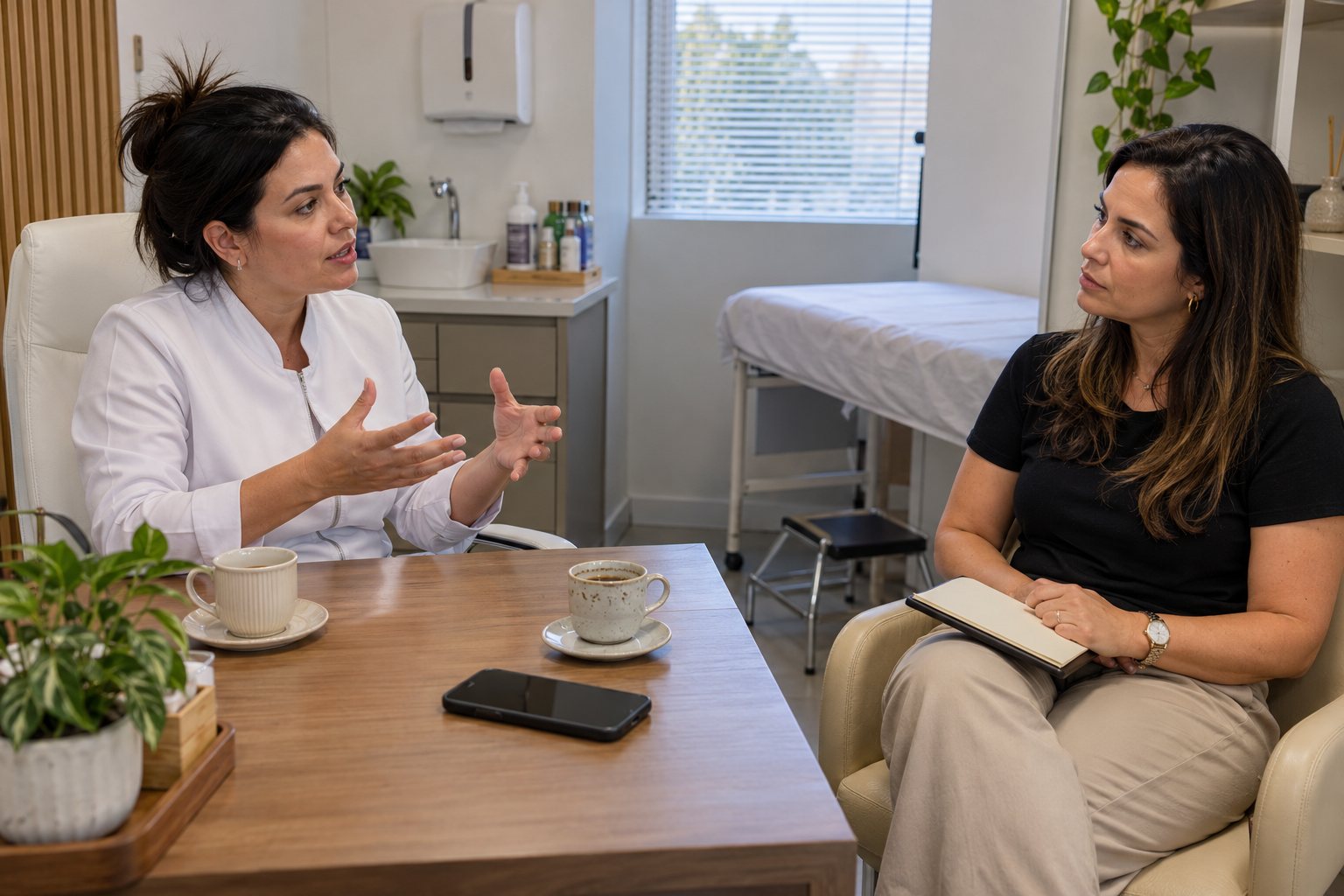 Lesson 2 · 20 minThe interview with the owner: prepare in 20 minutes, the 15 questions, the silenceThe diagnosis has already been agreed on; now comes the conversation that decides whether it will be a good one. You show up prepared, ask to record and say what it's for, ask 15 questions always in the same order, and let the owner talk. The real pain shows up in a case from last week, almost never in the first answer.
 Lesson 3 · 18 minThe 5 areas: customer service, sales, marketing, management, financeWithout scoring, your suggestion sounds like an opinion. With a score, it becomes a diagnosis the owner can discuss. You go through the 5 areas with 3 questions each, score pain, urgency, and readiness from 0 to 3, and write next to each score why you gave it.
 Lesson 4 · 16 minWhat the owner knows and doesn't write down: "tell me about a recent case"Ask "how do you qualify a new patient?" and the owner answers "it depends." Ask "tell me about the last new patient who came in" and they narrate, step by step, the decisions they make without noticing. Three cases of the same type show the pattern that will become a rule in the next lesson.
 Lesson 5 · 18 minFrom case to rule: validate with 3 new cases and save it in the context packThe pattern from the cases is still in your own words. Now it becomes an IF/THEN rule in the owner's words. It goes through three cases the owner didn't use to teach you, then it goes into a file with an owner, a date, and a version. This is the file any assistant will read later, and it's the one the company keeps.
 Lesson 6 · 18 minThe opportunity map: 6 axes, 4 quadrants, and what not to recommendMany ideas come out of the interview, and the new consultant picks the most interesting one. The diagnosis picks the one that gives a fast result safely, so the trust pays for the next ones. You score each candidate on 6 axes, place it on the 4-quadrant chart, and also write down what you won't recommend, and why.
 Lesson 7 · 18 minRisk, data and human dependency before you recommendThe candidate you picked is not ready to go into the report yet. First, four questions: how much can it do on its own, what personal data passes through it, who answers if it makes a mistake, and whether the channel is the official WhatsApp. In a small business, WhatsApp sits in the middle of almost everything, and its rules changed in 2025 and 2026.
 Lesson 8 · 20 minThe one-page report in the owner's language + 30-day planNobody reads a long report. The owner wants to know what you found, what you recommend, what's left out, and what happens each week. All on one page, in their own words, no acronyms. This lesson pulls together what you did in the course and builds your plan with dates.
Who it's for
- 1Small business owners (clinic, real estate agency, bakery, repair shop, store) who want to bring AI into their own business with a method.
- 2Beginner consultants who serve small businesses and need to deliver a diagnosis the owner can understand.
- 3People who have already sold the diagnosis and now need to do it well.
What you'll be able to do
- 1Run the diagnostic interview with 15 questions and clear consent to record.
- 2Score the business's 5 areas with a written criterion for each grade.
- 3Turn cases the owner tells you into tested IF/THEN rules.
- 4Deliver a one-page report with 1 recommendation, what stays out, and a 30-day plan.
Where it fits in Professional 2030
- 1Professional 2030 has four roles: Consultant, Auditor, Mentor, and Trainer. All four sell trust, not building.
- 2The DICA Program is the Consultant role, scaled to the small business: an owner who decides alone, no IT department, with WhatsApp at the center.
- 3DICA = Diagnose, Implement, Coach, Accompany. This course is the D; course 2 is the I, the C, and the A.
What was covered in Selling with AI
- 1The 4 roles and "what you are not": Selling with AI 1 and prof2030-base.
- 2Discovery call to sell: Selling with AI 2.
- 3Objections and closing: Selling with AI 3.
- 4Pricing, proposal, and first client: Selling with AI 4.